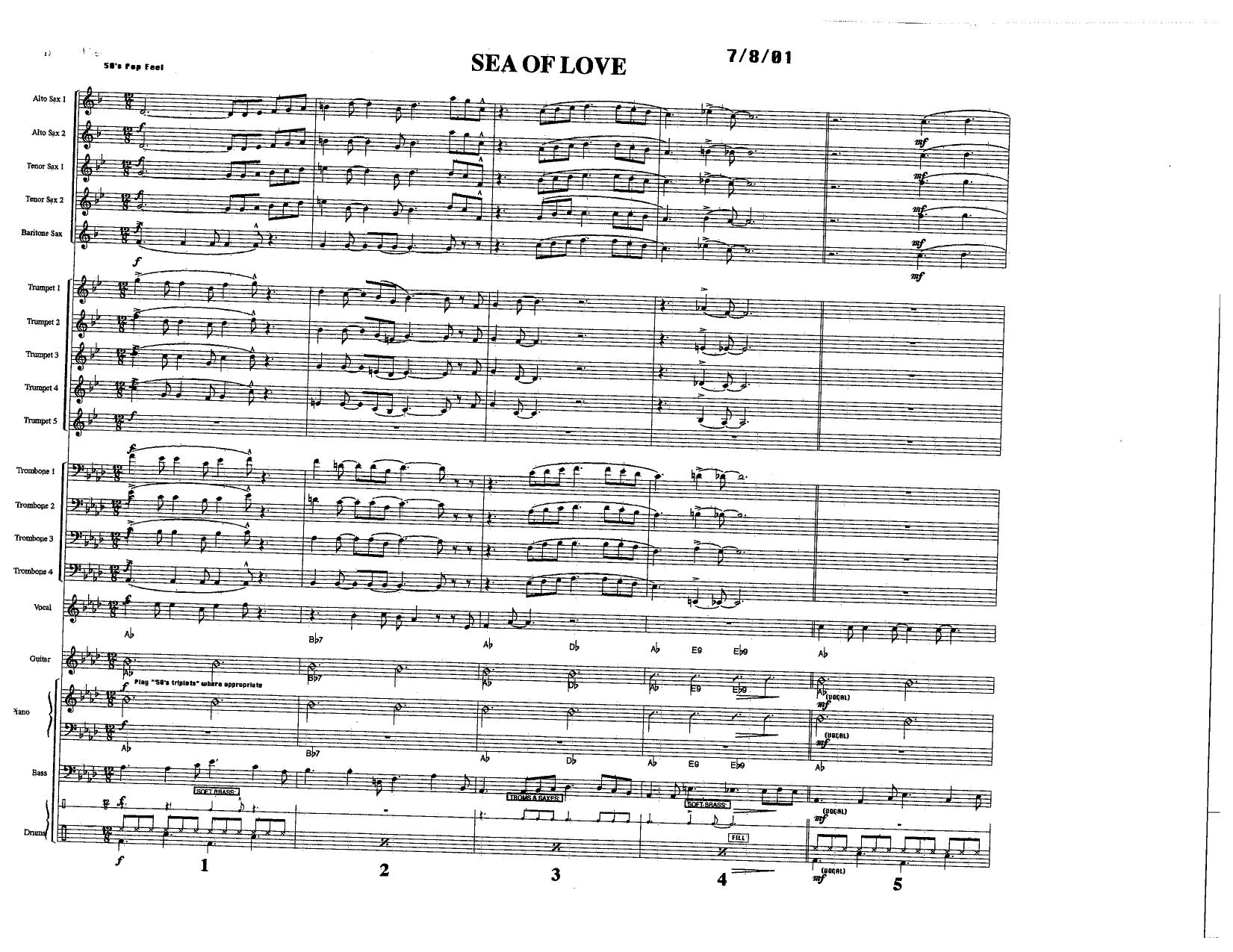
Sea Of Love (G.Urwin)
Composed by Phil Phillips
Arranged by Gary Urwin
- Ensemble: Big Band
- Pages: 49
- Instruments (19): Alto Sax 1, Alto Sax 2, Tenor Sax 1, Tenor Sax 2, Baritone Sax, Trumpet 1, Trumpet 2, Trumpet 3, Trumpet 4, Trumpet 5, Trombone 1, Trombone 2, Trombone 3, Bass Trombone, Vocal, Guitar, Piano, Bass, Drums
- Difficulty: medium
- Content: Individual Parts
- Format: PDF Download (Instant)
- Price: $24.99
Phil Phillips’ enduring 1959 rhythm and blues classic "Sea of Love" undergoes a sophisticated big band transformation in this masterful treatment by renowned West Coast arranger Gary Urwin. Originally recorded as a swamp pop crossover ballad that captured the innocence and romantic yearning of the late-fifties pop landscape, the tune possesses an inherent melodic sweetness and a swaying 12/8 or slow triplet feel that translates remarkably well to the jazz orchestra idiom. Urwin takes this nostalgic vocal-style blueprint and reframes it through a lens of lush, West Coast modern jazz harmony, balancing accessible emotional resonance with rich, sophisticated counterpoint that elevates the source material far beyond a simple nostalgic novelty. Musically, this arrangement unfolds as a relaxed, evocative medium-slow swing ballad with an underlying warmth and shimmering harmonic texture. The mood shifts seamlessly from tender, introspective phrasing to sweeping, cinematic dynamic swells. Urwin utilizes extended chord extensions—major ninths, thirteenths, and altered dominants—to color the foundational progression, giving the saxophones and brass lush voicings reminiscent of the classic Billy May or Nelson Riddle writing styles, yet anchored firmly in a contemporary jazz aesthetic. The arrangement opens with an atmospheric, rubato-tinged introduction before settling into a steady, pulsing groove that highlights the rhythmic interplay between the rhythm section and the horn tiers. The dramatic arc of the chart relies heavily on textural contrast and fluid section writing. The melody is initially introduced by a featured horn—often shared between lead alto and trumpet—before opening up into rich, interwoven woodwind solis that showcase Urwin’s gift for horizontal voice-leading. A dynamic, soaring shout chorus builds organically from a whisper to a rich, brass-heavy climax, utilizing subtle plunger effects and muted brass colors to maintain transparency and emotional depth without overwhelming the ensemble. Solo opportunities are strategically integrated, allowing a featured soloist (such as tenor saxophone or flugelhorn) to stretch out over lush, sophisticated changes that encourage expressive, lyrical playing rather than technical gymnastics. Advanced high school, collegiate, and professional community big bands will find this chart to be a rewarding addition to their repertoire. While it does not demand blazing execution speeds or extreme high-register endurance from the brass, it places a heavy premium on intonation, blend, stylistic cohesion, and dynamic control. Sections must listen across the ensemble to balance Urwin’s dense, colorful chord clusters. Because the arrangement relies so heavily on breath support, rubato pacing, and nuanced articulation, it serves as an exceptional pedagogical tool for developing a band's maturity, listening skills, and ballad-playing sensitivity while offering audiences a refreshingly sophisticated take on a timeless mid-century classic. Executing Gary Urwin's arrangement of "Sea of Love" successfully requires a disciplined approach to balance, intonation, and stylistic nuance. Conductor and ensemble focus should center on maintaining a relaxed, buoyant triplet feel within the slow-swing framework, avoiding any tendency to rush the tempo or drag the backbeats. The primary technical challenge lies in the execution of Urwin's dense, close-position voicings; section leaders must ensure that internal chord tones are meticulously tuned, particularly during the softer dynamic plateaus where every voice is exposed. Saxophones should focus on a warm, blended tone quality during the soli passages, using minimal vibrato except where specified for expressive effect. Brass players will need to handle mutes (cup and straight) with precision, ensuring quick, silent changes and smooth transitions between open and muted playing. Rehearsal time should be heavily invested in the rubato introduction and transitional interludes, ensuring the ensemble breathes together as a unified chamber unit. Pay close attention to dynamic markings: the emotional impact of the chart relies on the contrast between the intimate, whisper-soft statements and the expansive, gorgeously voiced shout chorus. Q: What instruments and parts are included in this publication? A: This 49-page publication includes a complete 19-instrument big band score and individual parts for Alto Saxophone 1, Alto Saxophone 2, Tenor Saxophone 1, Tenor Saxophone 2, Baritone Saxophone, 4 Trumpets, 4 Trombones, and a full rhythm section (piano, guitar, bass, drums), plus the conductor score. Q: What is the difficulty level of this arrangement? A: This arrangement is rated as medium-advanced, making it ideal for collegiate ensembles, advanced high school bands, and professional community jazz orchestras that excel in ballad playing and subtle dynamic control. Q: What is the historical style and background of this piece? A: It is a jazz big band adaptation of Phil Phillips' iconic 1959 swamp pop/R&B hit "Sea of Love," re-imagined through Gary Urwin's signature West Coast modern jazz arranging style. Q: What makes this particular arrangement unique? A: Gary Urwin elevates a simple pop-ballad melody into a sophisticated jazz chart by utilizing lush, extended harmonies, transparent counterpoint, and clever use of brass mutes that add cinematic depth without losing the tune's inherent emotional sweetness. Q: What is the recommended tempo and performance duration? A: The piece is set in a relaxed, medium-slow swing feel (approximately quarter note = 72-80 BPM), with a typical performance duration of roughly 4 to 5 minutes depending on the length of improvised solo sections.
Questions and answers
- What is included in the Sea Of Love (G.Urwin) PDF?
- The verified current file contains a conductor score and individual parts across 49 pages.
- How many instruments or parts are listed for Sea Of Love (G.Urwin)?
- The verified instrumentation list contains 19 entries for this Big Band arrangement.
- Who is credited for Sea Of Love (G.Urwin)?
- Composer: Phil Phillips. Arranger: Gary Urwin.
- What difficulty is listed for Sea Of Love (G.Urwin)?
- The verified difficulty level is medium.
- Can I preview Sea Of Love (G.Urwin) before buying?
- Yes. The product page provides a preview generated from the current PDF file.
- How is Sea Of Love (G.Urwin) delivered?
- After successful payment, the digital PDF is made available for download. The displayed price is $24.99.
Musicians Also Search For
Sea Of Love Gary Urwin PDF • Sea Of Love Gary Urwin sheet music • Sea Of Love arranged by Gary Urwin • Gary Urwin big band charts • Gary Urwin jazz arrangements PDF • Sea Of Love Phil Phillips sheet music • Sea Of Love Phil Phillips big band arrangements • Phil Phillips big band charts • Sea Of Love big band arrangements • Sea Of Love big band PDF download • Sea Of Love jazz sheet music • big band sheet music download • Sea Of Love conductor score PDF • Sea Of Love individual parts download • Sea Of Love sheet music PDF • buy Sea Of Love sheet music • download Sea Of Love PDF • Sea Of Love jazz charts • best Gary Urwin big band arrangements • Phil Phillips arranged by Gary Urwin • Sea Of Love printable sheet music • big band repertoire PDF