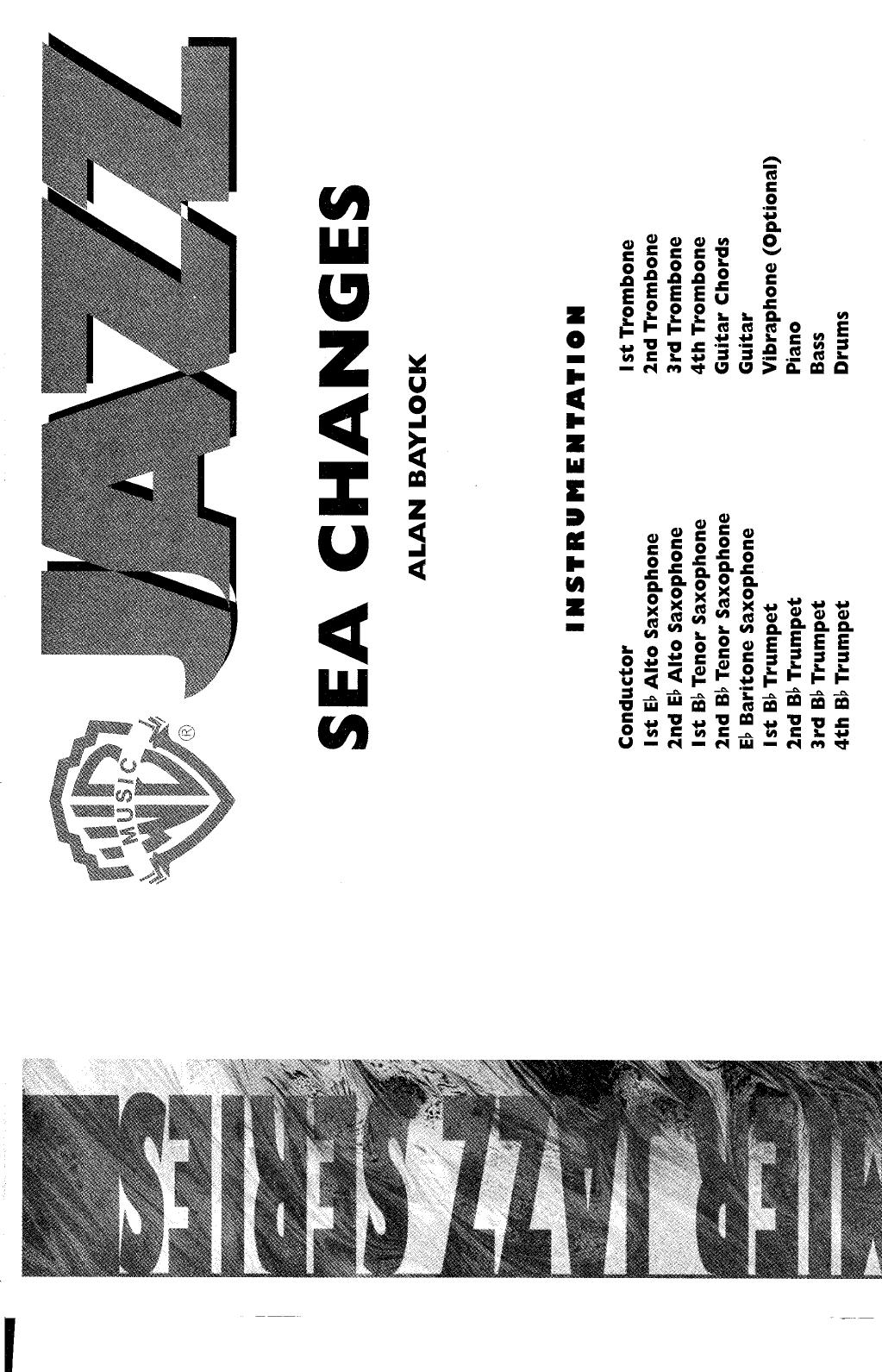
Sea Changes (A.Baylock)
Composed by Alan Baylock
Arranged by Alan Baylock
- Ensemble: Big Band
- Style: Jazz Standard
- Pages: 103
- Instruments (18): 1st Eb Alto Saxophone, 2nd Eb Alto Saxophone, 1st Bb Tenor Saxophone, 2nd Bb Tenor Saxophone, Eb Baritone Saxophone, 1st Bb Trumpet, 2nd Bb Trumpet, 3rd Bb Trumpet, 4th Bb Trumpet, 1st Trombone, 2nd Trombone, 3rd Trombone, 4th Trombone, Guitar, Vibraphone, Piano, Bass, Drums
- Difficulty: advanced
- Content: Individual Parts
- Format: PDF Download (Instant)
- Price: $24.99
"Sea Changes," composed and arranged by the prolific Alan Baylock, stands as a quintessential modern jazz standard, offering a sophisticated yet accessible journey through contemporary big band writing. While not a historical standard from the mid-20th century, Baylock's original composition has quickly established itself as a staple in collegiate and professional jazz ensemble repertoires, embodying the evolution of the big band sound in the late 20th and early 21st centuries. It reflects a period where composers began to blend traditional swing elements with more intricate harmonic palettes and rhythmic textures, moving beyond the well-worn paths of classic big band charts. Baylock, known for his masterful command of orchestration and his ability to craft pieces that are both challenging and deeply musical, brings his signature touch to this original work, making it a compelling addition to any band's library. Musically, "Sea Changes" is typically presented as a medium-tempo swing piece, often hovering around 140-160 BPM, though its inherent flexibility allows for nuanced interpretation. The mood is generally uplifting and dynamic, characterized by a vibrant energy that builds throughout the piece. Baylock frequently employs a rich, often open-voiced harmonic language, creating lush textures that shimmer and evolve. The piece is typically set in a comfortable key, allowing for full exploration of the ensemble's range and timbre. Its character is one of continuous development, with thematic material undergoing subtle transformations—much like the "sea changes" implied by the title—maintaining listener engagement through its inventive melodic and harmonic pathways. Baylock's arrangement of his own composition showcases his distinctive approach to big band writing. Expect meticulously crafted soli sections that highlight instrument families, particularly the saxophones and brass, often featuring intricate counterpoint and challenging unison lines that demand precision. His shout choruses are powerful and meticulously voiced, building to exhilarating climaxes without sacrificing clarity or musicality. Baylock is adept at weaving in extended harmonies and unexpected modulations that keep the listener guessing, yet always resolve with a sense of inevitability and satisfaction. The piece often features prominent solo opportunities, typically for tenor saxophone and trumpet, allowing individual musicians to shine within the ensemble framework. These solos are usually supported by sophisticated background figures that are integral to the arrangement's overall texture. Performing "Sea Changes" is a rewarding experience for a big band. The melody is often passed between sections, requiring excellent blend and articulation from all players. Technical challenges include navigating complex rhythmic figures, maintaining precise ensemble timing in fast-moving soli passages, and achieving the dynamic contrasts essential to Baylock's writing. The piece is particularly suitable for advanced high school, collegiate, community, and professional big bands. Its demands on individual musicianship, ensemble cohesion, and interpretive depth make it an excellent vehicle for developing a band's overall proficiency and musical sophistication. The intricate interplay between sections and the powerful, driving swing feel make "Sea Changes" a standout performance piece that consistently captivates audiences. Conductors should establish a consistent medium-swing feel, aiming for a tempo around quarter note = 144-152 BPM, allowing the intricate rhythmic figures to breathe without dragging. Key technical challenges include the precise execution of saxophone soli passages, which require meticulous attention to articulation, blend, and rhythmic accuracy. Brass sections must focus on clean attacks and releases, particularly in the powerful shout choruses, ensuring proper balance to avoid overwhelming the woodwinds. Encourage soloists to embrace the modern harmonic language, utilizing the provided chord changes as a springboard for creative improvisation. Rehearsal time should be dedicated to isolating and polishing the ensemble figures supporting the solos, as these are often complex and crucial to the arrangement's character. Dynamic contrasts are paramount; emphasize the dramatic shifts from subtle underlying figures to full-ensemble explosions to fully realize Baylock's vision. Q: What instruments and parts are included in this arrangement of "Sea Changes"? A: This arrangement is scored for a standard 17-piece big band, including Alto Saxophone 1, Alto Saxophone 2, Tenor Saxophone 1, Tenor Saxophone 2, Baritone Saxophone, Trumpet 1, Trumpet 2, Trumpet 3, Trumpet 4, Trombone 1, Trombone 2, Trombone 3, Bass Trombone, Piano, Bass, Drums, and Guitar. Q: What is the difficulty level of Alan Baylock's "Sea Changes" for a big band? A: This arrangement is considered advanced, suitable for advanced high school, collegiate, community, and professional big bands. It demands strong individual musicianship, excellent ensemble precision, and a solid understanding of modern jazz harmony and rhythm. Q: What is the musical style and historical context of "Sea Changes"? A: "Sea Changes" is an original contemporary jazz standard composed by Alan Baylock, reflecting the evolution of big band writing in the late 20th and early 21st centuries. It is characterized by a sophisticated medium-swing feel, modern harmonic language, and dynamic orchestration. Q: What makes Alan Baylock's arrangement of "Sea Changes" unique compared to other big band charts? A: Baylock's arrangement is distinguished by its inventive use of intricate soli sections, powerful and meticulously voiced shout choruses, and a rich harmonic palette that blends traditional swing with contemporary jazz elements. It showcases his signature ability to create pieces that are both challenging and deeply musical. Q: What is the typical performance duration and tempo for "Sea Changes"? A: The performance duration for "Sea Changes" typically ranges from 5 to 7 minutes, depending on the length of improvised solos. It is generally performed at a medium swing tempo, usually between 144 and 152 beats per minute.
Musicians Also Search For
Sea Changes Alan Baylock PDF • Sea Changes Alan Baylock sheet music • Sea Changes arranged by Alan Baylock • Alan Baylock big band charts • Alan Baylock jazz arrangements PDF • Sea Changes Alan Baylock big band arrangement • Sea Changes big band arrangement • Sea Changes big band PDF download • Sea Changes jazz ensemble sheet music • big band sheet music instant download • Sea Changes conductor score PDF • Sea Changes individual parts download • Sea Changes sheet music with parts • Sea Changes Jazz Standard chart • Jazz Standard big band arrangements • buy Sea Changes sheet music online • download Sea Changes PDF • Sea Changes jazz chart • best Alan Baylock big band arrangements • Sea Changes printable sheet music • big band repertoire PDF