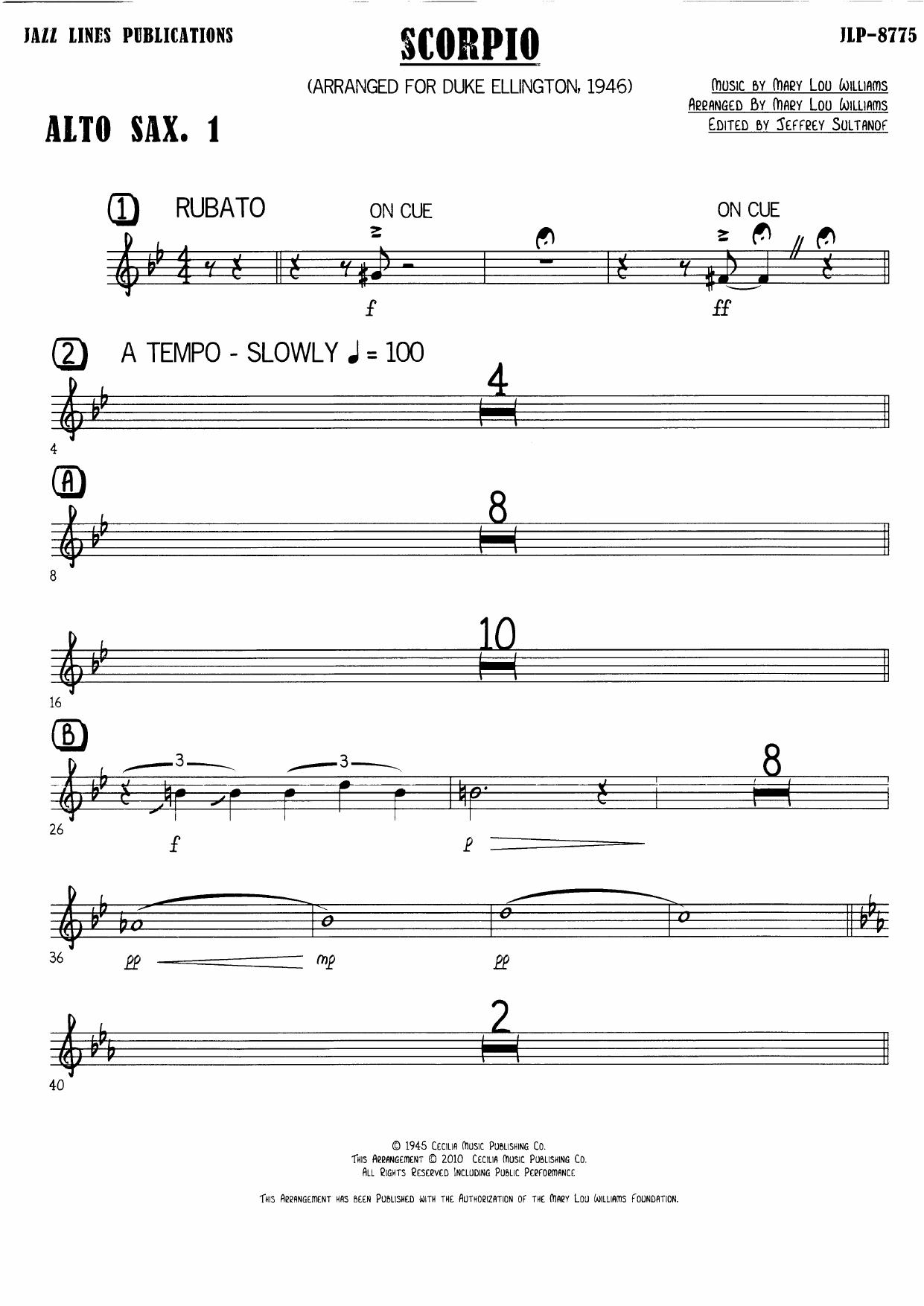
Scorpio (D.Ellington) 1946 (M. L.Williams) sheet music preview

Scorpio (D.Ellington) 1946 (M. L.Williams)

Composed by Duke Ellington

Arranged by M.L.Williams

  • Ensemble: Big Band
  • Pages: 56
  • Instruments (18): Alto Saxophone 1, Alto Saxophone 2, Tenor Saxophone 1 / Clarinet 1, Tenor Saxophone 2, Baritone Saxophone / Clarinet 2, Trumpet 1, Trumpet 2, Trumpet 3, Trumpet 4, Trumpet 5, Trombone 1, Trombone 2, Trombone 3, Trombone 4, Guitar, Piano, Bass, Drums
  • Difficulty: advanced
  • Content: Individual Parts
  • Format: PDF Download (Instant)
  • Price: $24.99

Originally recorded in 1946 as part of Duke Ellington’s ambitious and groundbreaking suite *The Deep South Suite*, "Scorpio" stands as one of the most fascinating intersections of Ellington's compositional genius and the brilliant mind of pianist, composer, and arranger Mary Lou Williams. While Ellington’s original portrait captured the fierce, stinging independence and complex rhythmic vitality associated with the astrological sign, Williams’s unique treatment of this material recontextualizes the piece with her signature harmonic sophistication and driving modernist edge. Emerging from the late swing era into the dawning bebop landscape, this 1946 work bridges the gap between classic big band orchestration and the adventurous, forward-thinking modernism that Williams championed throughout her legendary career. Driven by a relentless, taut rhythmic pulse, the musical character of this arrangement balances calculated tension with explosive bursts of kinetic energy. Written in a medium-up tempo swing feel with underlying chromatic urgency, the piece evokes a mood of mysterious intensity, shifting effortlessly between shadowy, Ellingtonian voicings and the razor-sharp angularity characteristic of Williams's writing. The arrangement opens with an arresting, dissonant motif that immediately establishes a suspenseful atmosphere before breaking into a compelling, forward-driving groove. Throughout the chart, unconventional chord extensions and unexpected dynamic drops keep both the performers and the audience on edge, perfectly capturing the unpredictable nature of its astrological namesake. Mary Lou Williams approaches the material with her trademark mastery of counterpoint and dense, modern block-chording, refusing to rely on standard big band formulas. Rather than treating the wind section as a monolithic block, Williams weaves independent linear voices through the texture, giving the chart a chamber-like transparency even during heavy ensemble passages. The arrangement features intricate sax solis that demand absolute rhythmic precision and a seamless blend, while the brass section utilizes tight, muted colors to heighten the dramatic contrast. The melodic weight shifts fluidly across the 8-instrument ensemble, allowing both the woodwinds and the brass to share primary thematic responsibilities before building toward a relentless, high-octane shout chorus that showcases Williams’s penchant for structural climax. Designed specifically for advanced collegiate, professional, and elite community jazz ensembles, this 56-page publication demands a high degree of technical proficiency, stylistic versatility, and deep listening across all chairs. The primary technical challenges lie in executing the dense harmonic language, navigating tricky chromatic lines at a brisk tempo, and maintaining a unified stylistic approach that marries 1940s big band swing with early bebop sensibilities. Soloists will find ample room to stretch out over sophisticated changes, making this piece an exceptionally rewarding centerpiece for concerts focusing on the evolutionary history of jazz composition and the monumental contributions of women in jazz. Conductors approaching this 1946 Mary Lou Williams arrangement of "Scorpio" must prioritize rhythmic crispness and internal metric stability over sheer volume. The tempo should be locked into a driving, confident medium-up swing (approximately quarter note = 184–192), ensuring that the underlying pulse never drags during the rhythmically complex transitional passages. A primary technical hurdle is the execution of dense, modern chromatic lines; sections should practice these passages slowly at first, isolating the inner-voice movements to achieve immaculate intonation and balance. Special attention must be given to articulation: short notes must be clipped and uniform, while accented notes require weight rather than harshness. Brass players should utilize subtle cup or straight mutes where indicated to achieve the authentic late-1940s coloration without sacrificing core tone projection. In rehearsal, isolate the sax soli and brass interludes independently before integrating them, ensuring the counterpoint remains transparent and dynamic interplay is clearly articulated across the 8-instrument texture. Q: What instruments and parts are included in this 56-page publication? A: This arrangement is scored for an 8-instrument ensemble, specifically featuring Alto Saxophone, Tenor Saxophone, Baritone Saxophone, Trumpet, Trombone, and standard rhythm section support. Q: What is the difficulty level of this arrangement? A: This piece is best suited for advanced high school, collegiate, and professional jazz ensembles due to its complex harmonic language, intricate counterpoint, and brisk tempo demands. Q: What is the historical background of this specific version of "Scorpio"? A: Originally composed by Duke Ellington for his 1946 suite *The Deep South Suite*, this unique arrangement was crafted by pianist and composer Mary Lou Williams, blending Ellingtonian mood-painting with her own pioneering modern jazz sensibilities. Q: What makes Mary Lou Williams's arrangement unique compared to the original recording? A: Williams infuses the chart with her signature dense block-chording, advanced chromatic counterpoint, and chamber-like transparent textures that foreshadow the arrival of bebop while retaining classic big band grit. Q: What is the recommended performance tempo and duration for this piece? A: The arrangement is designed to be performed at a medium-up swing tempo of approximately quarter note = 184–192, resulting in a performance duration of roughly 3 to 4 minutes depending on solo extensions.

Questions and answers

What is included in the Scorpio (D.Ellington) 1946 (M. L.Williams) PDF?
The verified current file contains a conductor score and individual parts across 56 pages.
How many instruments or parts are listed for Scorpio (D.Ellington) 1946 (M. L.Williams)?
The verified instrumentation list contains 18 entries for this Big Band arrangement.
Who is credited for Scorpio (D.Ellington) 1946 (M. L.Williams)?
Composer: Duke Ellington. Arranger: M.L.Williams.
What difficulty is listed for Scorpio (D.Ellington) 1946 (M. L.Williams)?
The verified difficulty level is advanced.
Can I preview Scorpio (D.Ellington) 1946 (M. L.Williams) before buying?
Yes. The product page provides a preview generated from the current PDF file.
How is Scorpio (D.Ellington) 1946 (M. L.Williams) delivered?
After successful payment, the digital PDF is made available for download. The displayed price is $24.99.

Musicians Also Search For

Scorpio M.L.Williams PDFScorpio M.L.Williams sheet musicScorpio arranged by M.L.WilliamsM.L.Williams big band chartsM.L.Williams jazz arrangements PDFScorpio Duke Ellington sheet musicScorpio Duke Ellington big band arrangementsDuke Ellington big band chartsScorpio big band arrangementsScorpio big band PDF downloadScorpio jazz sheet musicbig band sheet music downloadScorpio conductor score PDFScorpio individual parts downloadScorpio sheet music PDFbuy Scorpio sheet musicdownload Scorpio PDFScorpio jazz chartsbest M.L.Williams big band arrangementsDuke Ellington arranged by M.L.WilliamsScorpio printable sheet musicbig band repertoire PDF

All arrangements by M.L.Williams All Duke Ellington sheet music