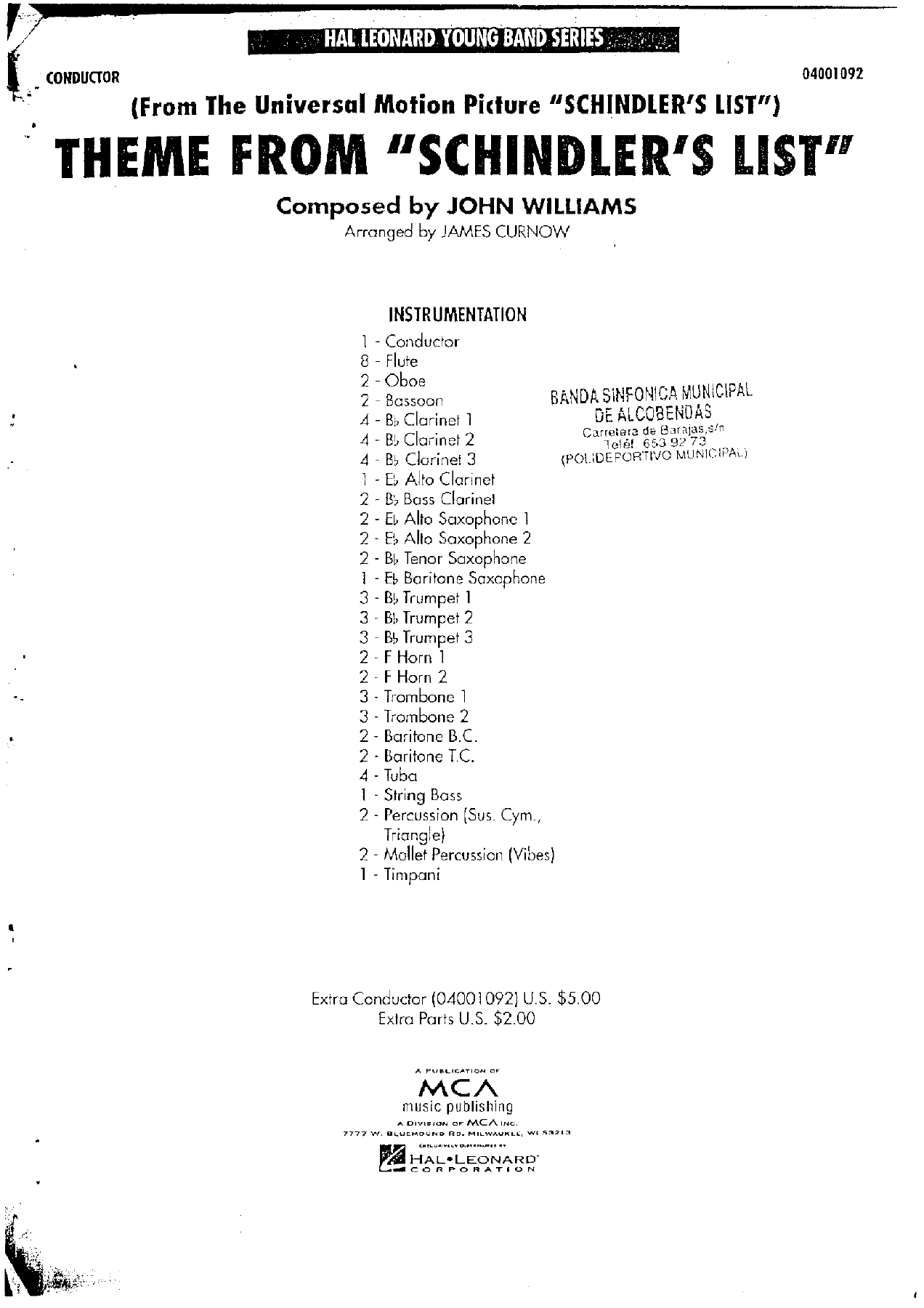
Schindler'S List (J.Williams) sheet music preview

Schindler'S List (J.Williams)

Composed by John Williams

Arranged by J.Williams

  • Ensemble: Concert Band
  • Style: Film Music
  • Pages: 39
  • Difficulty: medium
  • Content: Sheet Music
  • Format: PDF Download (Instant)
  • Price: $22.99

John Williams' iconic theme from *Schindler's List*, originally composed for Steven Spielberg's 1993 cinematic masterpiece, stands as one of the most poignant and instantly recognizable melodies in modern film history. While not a jazz standard in the traditional sense, its profound emotional depth and lyrical beauty have transcended its orchestral origins, inspiring countless interpretations across various genres. The original score, featuring the haunting violin solo by Itzhak Perlman, captured the somber dignity and tragic humanity of the Holocaust narrative, earning Williams an Academy Award for Best Original Score. This piece represents a pivotal moment in film music, demonstrating how a simple, elegiac melody can convey immense sorrow, resilience, and hope, resonating deeply with audiences worldwide and cementing its place in the cultural lexicon. This particular arrangement by J. Williams masterfully reimagines the orchestral grandeur for the concert band medium, maintaining the original's profound emotional impact. The musical character is primarily that of a slow, expressive ballad, often marked by a reflective and melancholic mood. While not adhering to a specific jazz tempo like swing or Latin, the arrangement allows for significant rubato and expressive phrasing, inviting musicians to imbue their performance with deep feeling. The primary key signature is D minor, which lends itself naturally to the piece's somber and introspective nature, though subtle modulations occur to build emotional intensity before returning to the home key. The arrangement's energy is derived not from rhythmic drive, but from its dynamic contour and the sustained, soaring melodic lines that evoke a sense of solemn beauty. J. Williams' approach to transcribing this orchestral work for concert band is characterized by a meticulous attention to instrumental color and dynamic layering. Rather than attempting to force a jazz idiom onto the piece, the arranger focuses on preserving the original's integrity, translating its lush harmonies and soaring melodies into the concert band's unique palette. Expect rich, sustained voicings across the brass and woodwind sections, often building from delicate, exposed lines to powerful, full-ensemble statements. The arrangement features the iconic melody predominantly in the upper woodwinds (flute, oboe, clarinet) and occasionally in the trumpet or alto saxophone, providing opportunities for featured soloistic playing that demands exceptional lyrical control and emotional sensitivity. There are no traditional shout choruses or extended jazz solos, but rather moments of heightened emotional expression through careful orchestration and dynamic shaping. Performing this arrangement is an incredibly rewarding experience, offering musicians a chance to connect with a piece of profound historical and emotional significance. The technical challenges lie less in rapid passages or complex rhythms, and more in achieving perfect intonation within sustained chords, maintaining breath control for long phrases, and executing nuanced dynamics. Specific musical moments that stand out include the initial delicate presentation of the theme, the gradual build to a powerful full-band statement, and the poignant, often sparse, concluding passages. This arrangement is ideally suited for college, community, and advanced high school concert bands. Its demands for mature musicality, expressive phrasing, and sensitive ensemble playing make it an excellent choice for groups looking to perform a truly moving and impactful work that transcends typical band repertoire. Approaching "Schindler's List" requires a focus on lyrical expression and dynamic control rather than technical virtuosity. The primary challenge lies in maintaining consistent intonation within sustained, often dense, harmonies, particularly in the slower sections. Encourage musicians to listen across sections for blend and balance. The tempo should be treated with flexibility, allowing for natural rubato to enhance emotional depth, but always returning to a steady, reflective pulse. Markings such as "espressivo" and "cantabile" are paramount. Pay close attention to breath support for long melodic lines, especially in the featured woodwind and brass parts. There are no special techniques like plunger mutes or falls required; the emphasis is purely on tone quality, phrasing, and emotional resonance. Rehearsal time should be dedicated to shaping phrases, balancing dynamics from *pianissimo* to *fortissimo*, and ensuring a unified, heartfelt interpretation of this powerful theme. Q: What instruments/parts are included in this arrangement? A: This arrangement for concert band typically includes a full complement of woodwinds (flute, oboe, bassoon, clarinet, bass clarinet, saxophone family), brass (trumpet, horn, trombone, euphonium, tuba), and percussion parts. Specific instrumentation details are provided on the score. Q: What is the difficulty level of this arrangement? A: This arrangement is rated as medium-advanced, suitable for college, community, and advanced high school concert bands. Its demands lie in musicality, intonation, and expressive phrasing rather than extreme technical speed. Q: What is the musical style and historical context of this piece? A: The piece is a film music theme, originally composed by John Williams for the 1993 film *Schindler's List*. It is characterized by its melancholic, reflective, and deeply emotional ballad-like style, conveying the somber dignity of the historical narrative. Q: What makes J. Williams' arrangement unique? A: This arrangement by J. Williams is unique in its faithful transcription of the original orchestral score's emotional depth and harmonic richness for the concert band, prioritizing lyrical expression and instrumental color over jazz-specific idioms, while still allowing for the band's unique voice to shine. Q: What is the approximate performance duration and tempo of this arrangement? A: The approximate performance duration for this arrangement is typically between 4 to 6 minutes, depending on the conductor's interpretation of the rubato. The tempo is generally slow and expressive, marked by a reflective and melancholic feel.

Musicians Also Search For

Schindler'S List J.Williams PDFSchindler'S List J.Williams sheet musicSchindler'S List arranged by J.WilliamsJ.Williams concert band chartsJ.Williams jazz arrangements PDFSchindler'S List John Williams sheet musicSchindler'S List John Williams concert band arrangementJohn Williams concert band chartsSchindler'S List concert band arrangementSchindler'S List concert band PDF downloadSchindler'S List jazz ensemble sheet musicconcert band sheet music instant downloadSchindler'S List sheet music with partsSchindler'S List Film Music chartFilm Music concert band arrangementsbuy Schindler'S List sheet music onlinedownload Schindler'S List PDFSchindler'S List jazz chartbest J.Williams concert band arrangementsJohn Williams songs arranged by J.WilliamsSchindler'S List printable sheet musicconcert band repertoire PDF

All arrangements by J.Williams All John Williams sheet music