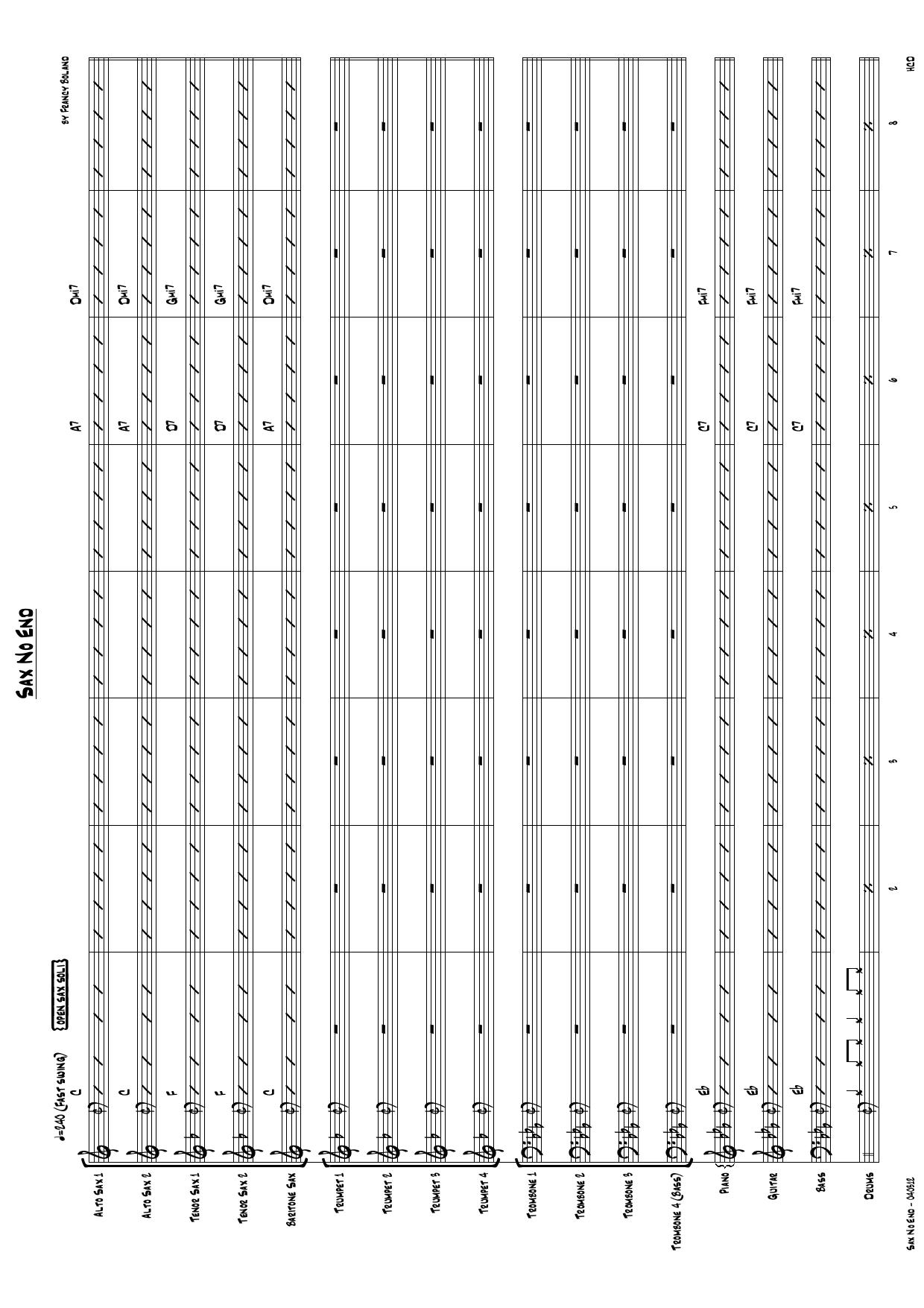
Sax No End (F.Boland) sheet music preview

Sax No End (F.Boland)

Composed by Francy Boland

Arranged by Francy Boland

  • Ensemble: Big Band
  • Pages: 92
  • Instruments (17): Alto Saxophone 1, Alto Saxophone 2, Tenor Saxophone 1, Tenor Saxophone 2, Baritone Saxophone, Trumpet 1, Trumpet 2, Trumpet 3, Trumpet 4, Trombone 1, Trombone 2, Trombone 3, Trombone 4 (Bass), Piano, Guitar, Bass, Drums
  • Difficulty: advanced
  • Content: Individual Parts
  • Format: PDF Download (Instant)
  • Price: $24.99

Originating from the powerhouse European jazz orchestra co-led by drummer Kenny Clarke and pianist-arranger Francy Boland, *"Sax No End"* stands as a monumental achievement of late-1960s big band writing. Released on the SABA label in 1967 and famously grounded in the chord changes of the traditional tune *"Chinatown, My Chinatown"*, this chart captures the peak creative output of an ensemble celebrated for pairing American expatriate virtuosos with Europe’s finest jazz instrumentalists. The Kenny Clarke-Francy Boland Big Band operated with a distinct international pedigree, merging the ferocious, driving wallop of the Count Basie Orchestra with sophisticated, modern European harmonic palettes akin to Gil Evans. Driven by an unrelenting, high-velocity medium-up swing tempo, the musical character of the chart is explosive, sophisticated, and relentlessly energetic. The piece opens with an unmistakable sense of urgency, maintaining an electric mood that alternates between tightly coiled tension and uninhibited release. Emotionally, it evokes the sophisticated swagger of underground European jazz clubs combined with the muscular intensity of peak-era American bebop. The harmonic language is rich with chromatic submediants, altered dominants, and dense cluster voicings that push traditional big band boundaries while keeping the foot-tapping groove securely intact. Boland’s compositional and arranging fingerprint is immediately recognizable through his masterful handling of sectional interplay, particularly within the woodwinds and brass. His writing for saxophone sections is legendary for its labyrinthine lines and Olympian velocity. In this arrangement, the woodwind and horn textures function with absolute transparency, deploying block-chords and counterpoint that demand immaculate articulation. Sweeping sax soli sections serve as the core centerpiece, requiring the woodwind department to lock together with terrifying precision and uniform intonation. The shout choruses build vertically and horizontally, layering brass counterlines over churning rhythm section grooves that reward an aggressive, forward-leaning approach. The melodic load is distributed heavily across the multi-reed section, showcasing interlocking lines that trade punches with brass stabs. Extended solo spaces provide ample opportunity for featured performers on alto, tenor, and baritone saxophones to stretch out over complex changes. Technical challenges abound, notably in the blistering unison and harmonized lines characterized by rapid-fire bebop phrasing, wide dynamic shifts, and rapid articulations across registers. Performers find deep fulfillment in the sheer kinetic drive of the charts, where every section acts as an equal partner in executing Boland's intricate architectural design. Advanced collegiate ensembles, professional repertory bands, and elite community big bands will find this arrangement an exhilarating test of ensemble literacy and endurance. Because of its demanding saxophone requirements, aggressive tempo, and dense harmonic structure, it is best suited for groups boasting advanced technical proficiency and a deep understanding of post-bop big band idioms. Conductors should approach this chart with a focus on razor-sharp articulation and deep rhythmic propulsion. Set the tempo at a brisk, driving swing feel (approx. quarter note = 210–220 BPM), ensuring that the underlying pulse remains feather-light yet unyielding. The primary technical hurdle lies in the execution of the dense saxophone soli passages; players must prioritize unified phrasing, seamless air support, and matching tonal weight over sheer volume. Brass players should keep staccato punches crisp and dry, avoiding excessive edge while maintaining a commanding presence behind the soloists. Rehearsals should begin by isolating the rhythm section to lock in the foundational swing groove before layering the horns section by section. Pay close attention to dynamic contrasts—subito piano markings immediately following screaming shout choruses must be executed with absolute discipline to preserve the dramatic tension inherent in Boland's writing. Q: What instrumentation and parts are included in this arrangement? A: This arrangement is scored for an 8-instrument core structure expanding across a modern big band framework, featuring parts for Alto Saxophone, Tenor Saxophones, Baritone Saxophone, Trumpets, and Trombones, alongside a full rhythm section (92 total pages). Q: What is the difficulty level of this arrangement? A: It is graded as advanced, specifically tailored for college, professional, and elite community big bands with highly skilled saxophone sections and confident improvisers. Q: What is the historical background of this piece? A: Composed and arranged by Francy Boland, it was popularized by the legendary Kenny Clarke-Francy Boland Big Band during their acclaimed late-1960s European recording era. Q: What makes this specific arrangement unique? A: It showcases Boland’s signature writing style, which masterfully bridges the raw, swinging power of the Count Basie orchestra with the complex, modern harmonic sensibilities of post-bop. Q: What is the performance duration and tempo feel? A: The piece runs approximately 5 minutes at a fast, driving medium-up swing tempo that demands high endurance and absolute rhythmic precision.

Questions and answers

What is included in the Sax No End (F.Boland) PDF?
The verified current file contains a conductor score and individual parts across 92 pages.
How many instruments or parts are listed for Sax No End (F.Boland)?
The verified instrumentation list contains 17 entries for this Big Band arrangement.
Who is credited for Sax No End (F.Boland)?
Composer: Francy Boland. Arranger: Francy Boland.
What difficulty is listed for Sax No End (F.Boland)?
The verified difficulty level is advanced.
Can I preview Sax No End (F.Boland) before buying?
Yes. The product page provides a preview generated from the current PDF file.
How is Sax No End (F.Boland) delivered?
After successful payment, the digital PDF is made available for download. The displayed price is $24.99.

Musicians Also Search For

Sax No End Francy Boland PDFSax No End Francy Boland sheet musicSax No End arranged by Francy BolandFrancy Boland big band chartsFrancy Boland jazz arrangements PDFSax No End Francy Boland big band arrangementsSax No End big band arrangementsSax No End big band PDF downloadSax No End jazz sheet musicbig band sheet music downloadSax No End conductor score PDFSax No End individual parts downloadSax No End sheet music PDFbuy Sax No End sheet musicdownload Sax No End PDFSax No End jazz chartsbest Francy Boland big band arrangementsSax No End printable sheet musicbig band repertoire PDF

All arrangements by Francy Boland All Francy Boland sheet music