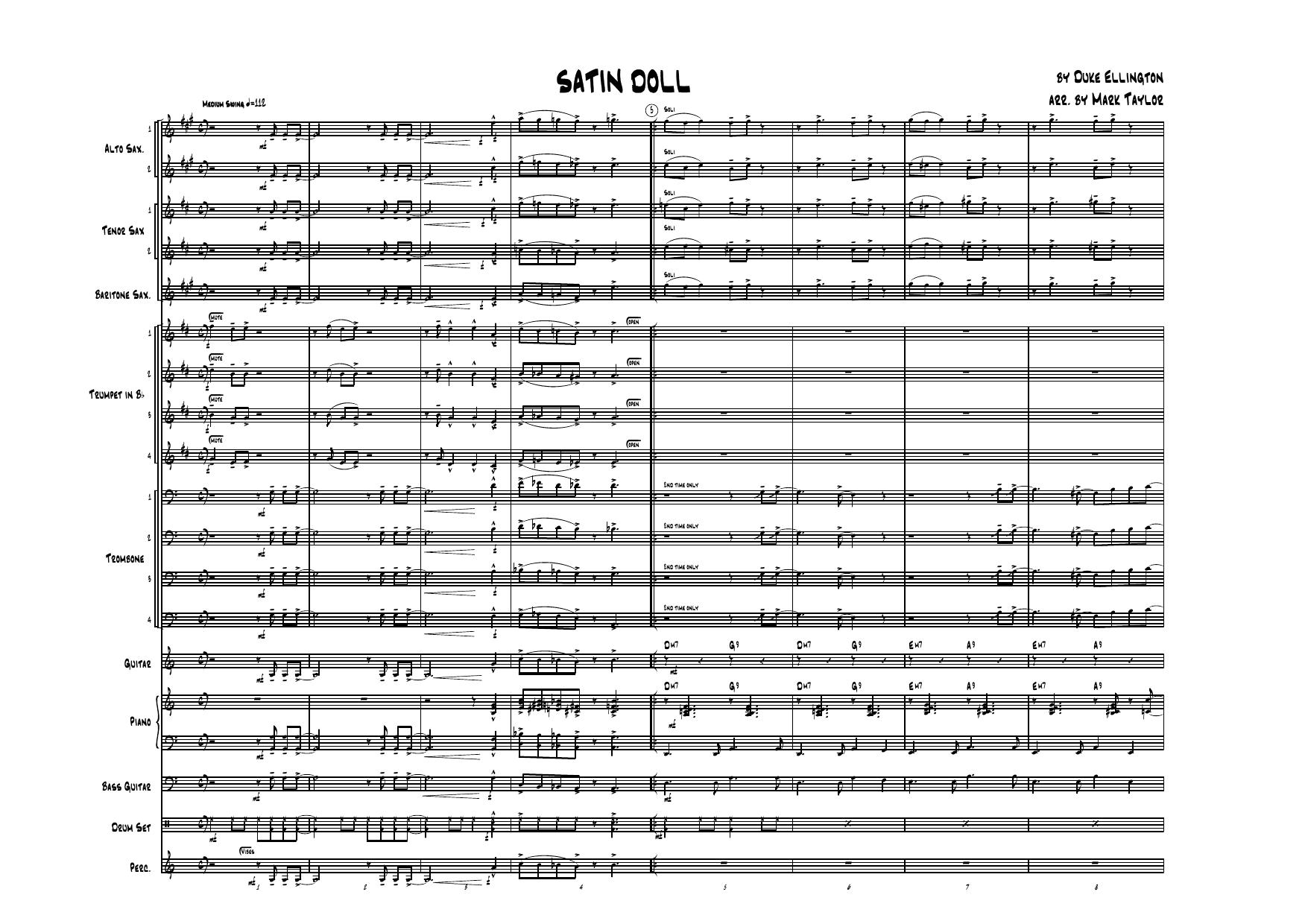
Satin Doll (M.Taylor)
Composed by Duke Ellington
Arranged by Mark Taylor
- Ensemble: Big Band
- Pages: 29
- Instruments (18): Alto Sax 1, Alto Sax 2, Tenor Sax 1, Tenor Sax 2, Baritone Sax, Trumpet 1, Trumpet 2, Trumpet 3, Trumpet 4, Trombone 1, Trombone 2, Trombone 3, Trombone 4, Guitar, Piano, Bass Guitar, Drum Set, Percussion
- Difficulty: medium
- Content: Individual Parts
- Format: PDF Download (Instant)
- Price: $24.99
Duke Ellington and Billy Strayhorn’s timeless composition "Satin Doll," co-written with Johnny Mercer, stands as one of the definitive pillars of the American Songbook and the quintessential mid-century big band repertoire. First recorded by Ellington in 1953 and later popularized by Ella Fitzgerald, Count Basie, and countless others, the tune captures the sophisticated urban elegance of the post-war jazz era. Its clever harmonic progression—featuring signature cyclic chord changes and a deceptive cadence sequence—has made it a mandatory rite of passage for improvisers and jazz ensembles across generations, bridging the gap between classic swing and modern modal accessibility. Mark Taylor’s masterwork big band treatment infuses this classic standard with a fresh, driving contemporary swing vitality while staying deeply respectful of Ellingtonian tradition. Set at a comfortable, infectious medium-swing groove (around 120–124 BPM), the arrangement opens with a sly, understated rhythm section vamp before introducing the theme through crisp, well-crafted saxophone solis. Taylor brilliantly balances rich, expanded chord voicings in the brass with playful, conversational counterlines in the reeds. The arrangement steadily builds in dynamic intensity, culminating in a soaring, high-energy shout chorus that trades traditional block-chord harmonies for punchy, modern syncopations that demand absolute precision and articulation uniformity from the ensemble. Throughout the chart, melody and accompaniment shift fluidly between sections, ensuring that every player feels engaged and vital to the texture. Trumpet and tenor saxophone are spotlighted with dedicated solo spaces over standard blues-infused changes, backed by tightly controlled comping figures that leave plenty of air for the improviser. Technically, the chart relies heavily on stylistic cohesion rather than blistering velocity; the primary challenges lie in maintaining a relaxed, driving pocket, executing accurate ghost notes, and nailing the dynamic drop-offs leading into the shout chorus. The harmonic language incorporates extended upper structures—ninths, elevenths, and altered dominants—giving the ensemble a rich, sophisticated sound without introducing unmanageable technical hurdles. Advanced high school ensembles, collegiate jazz orchestras, and professional community big bands will find this 16-instrument chart to be an exceptionally rewarding addition to their libraries. It offers enough harmonic depth and stylistic nuance to challenge developing players, yet it remains instantly recognizable and universally engaging for audiences. Whether programmed as a sophisticated concert opener or a classy second-set feature, Taylor’s arrangement of "Satin Doll" delivers an authentic big band experience that highlights the timeless brilliance of Ellington’s pen through a brilliantly modern lens. Achieving an authentic performance of Mark Taylor’s "Satin Doll" requires meticulous attention to the subtle art of medium-swing phrasing. The rhythm section serves as the anchor; the drummer should maintain a feather-light ride cymbal pattern with a crisp hi-hat closure on beats two and four, avoiding any heavy-handedness that could drag the tempo. Bassists must lock in with a steady, walking quarter-note line that emphasizes a warm, acoustic-style woody tone. For the horn sections, articulation is paramount. Ensure that all eighth-note lines are swung naturally in accordance with standard jazz interpretation—shorter on the upbeats and slightly detached, avoiding over-articulation. Dynamics are sharply contrasted; pay close attention to the sudden sub-ito piano drops following brass accents, which create the signature tension-and-release feel inherent to Taylor's writing. Brass players should utilize standard cup or straight mutes where indicated to achieve color variation during the head statements, while saxophones must blend as a unified choir during the soli passages, prioritizing smooth voice-leading over individual volume. Q: What instruments and parts are included in this big band arrangement? A: The 16-instrument configuration includes standard big band instrumentation: Alto Saxophone 1 & 2, Tenor Saxophone 1 & 2, Baritone Saxophone, 4 Trumpets, 4 Trombones, and a full rhythm section comprising piano, guitar, bass, and drums. Q: What is the difficulty level of this Mark Taylor chart? A: This arrangement is graded at a medium-advanced level (approx. Grade 4), making it ideal for advanced high school ensembles, collegiate bands, and professional community jazz orchestras looking for solid stylistic challenges. Q: What is the historical and stylistic context of this piece? A: Based on Duke Ellington's iconic 1953 jazz standard, this arrangement reimagines the classic tune through a contemporary big band lens, preserving the sophisticated swing-era aesthetic while incorporating modern harmonic voicings and punchy counterlines. Q: What makes this specific arrangement by Mark Taylor unique? A: Taylor distinguishes his chart through clever re-harmonizations, dynamic sectional interplay, and a modern, high-energy shout chorus that elevates a familiar melody into a fresh, contemporary concert piece. Q: What is the recommended tempo and performance duration for this arrangement? A: The chart is designed to be played at a comfortable, infectious medium-swing tempo of approximately 120 to 124 BPM, resulting in a total performance duration of roughly 3.5 to 4 minutes depending on solo choruses.
Questions and answers
- What is included in the Satin Doll (M.Taylor) PDF?
- The verified current file contains a conductor score and individual parts across 29 pages.
- How many instruments or parts are listed for Satin Doll (M.Taylor)?
- The verified instrumentation list contains 18 entries for this Big Band arrangement.
- Who is credited for Satin Doll (M.Taylor)?
- Composer: Duke Ellington. Arranger: Mark Taylor.
- What difficulty is listed for Satin Doll (M.Taylor)?
- The verified difficulty level is medium.
- Can I preview Satin Doll (M.Taylor) before buying?
- Yes. The product page provides a preview generated from the current PDF file.
- How is Satin Doll (M.Taylor) delivered?
- After successful payment, the digital PDF is made available for download. The displayed price is $24.99.
Musicians Also Search For
Satin Doll Mark Taylor PDF • Satin Doll Mark Taylor sheet music • Satin Doll arranged by Mark Taylor • Mark Taylor big band charts • Mark Taylor jazz arrangements PDF • Satin Doll Duke Ellington sheet music • Satin Doll Duke Ellington big band arrangements • Duke Ellington big band charts • Satin Doll big band arrangements • Satin Doll big band PDF download • Satin Doll jazz sheet music • big band sheet music download • Satin Doll conductor score PDF • Satin Doll individual parts download • Satin Doll sheet music PDF • buy Satin Doll sheet music • download Satin Doll PDF • Satin Doll jazz charts • best Mark Taylor big band arrangements • Duke Ellington arranged by Mark Taylor • Satin Doll printable sheet music • big band repertoire PDF