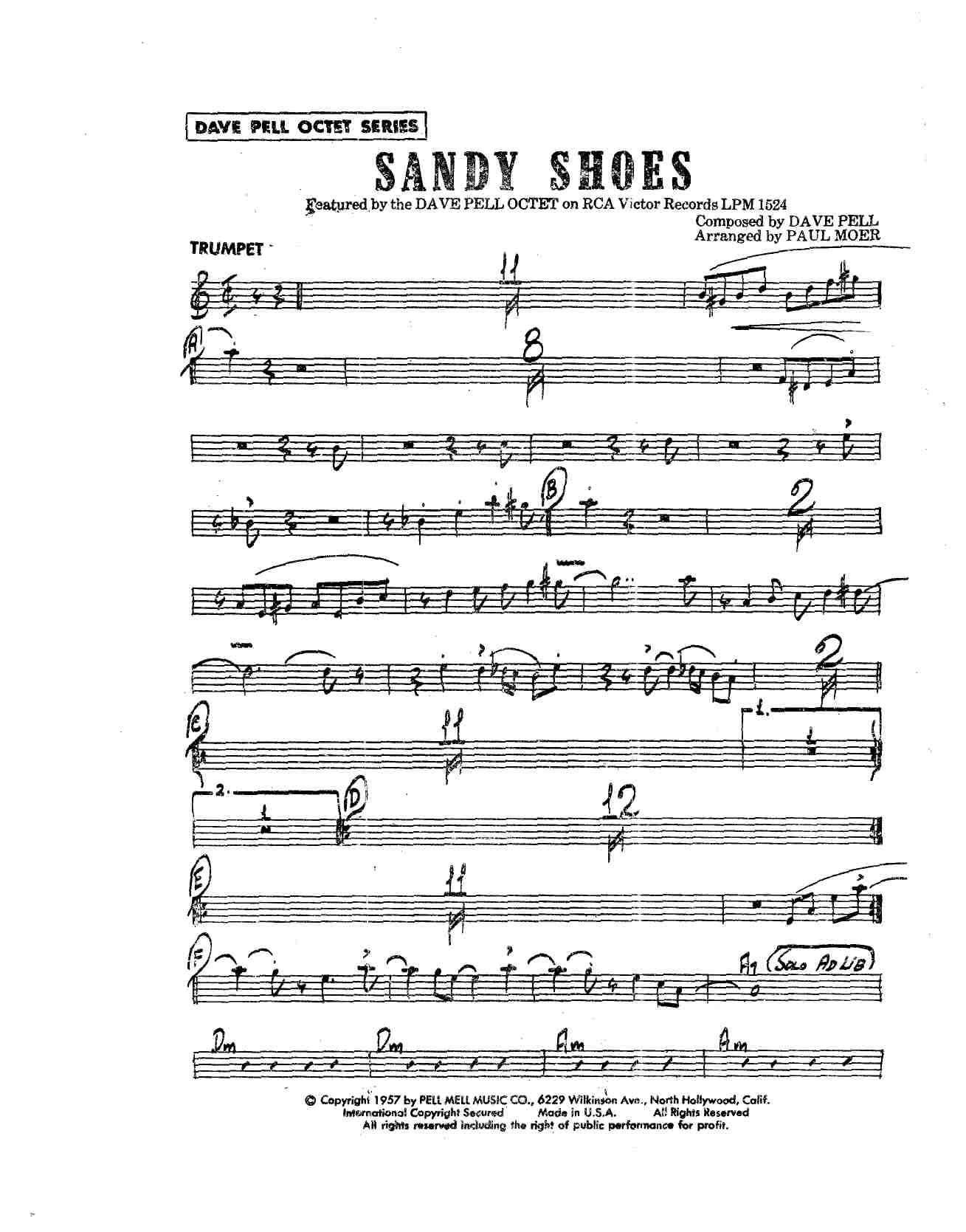
Sandy Shoes - Paul Moer - Dave Pell Octet - Ts,Bs,Trp,Trb+Rhythm (P.Moer)
Composed by Paul Moer
Arranged by Paul Moer
- Ensemble: Small Ensemble
- Pages: 16
- Instruments (8): Trumpet, Tenor Saxophone, Baritone, Trombone, Piano, Guitar, Bass, Drums
- Difficulty: easy
- Content: Individual Parts
- Format: PDF Download (Instant)
- Price: $12.99
"Sandy Shoes," penned by the esteemed composer and pianist Paul Moer, stands as a quintessential example of West Coast Cool Jazz, originally brought to prominence by the Dave Pell Octet. Composed and recorded during the vibrant mid-1950s, an era defined by sophisticated counterpoint, relaxed tempos, and meticulous arrangements, this piece embodies the intellectual yet effortlessly swinging aesthetic that characterized the West Coast sound. Moer, a significant figure in this movement, crafted a composition that, while not a "standard" in the traditional sense, is a highly regarded gem within the octet repertoire, showcasing his distinctive compositional voice and the era's harmonic and melodic sensibilities. This arrangement captures the original's medium-swing feel, typically executed in 4/4 time at a comfortable tempo that allows for clarity and precision. The musical character is one of understated elegance and melodic charm, evoking a sunny, laid-back atmosphere – much like the "sandy shoes" imagery suggests. The key is likely C or F major, typical for the era, providing a bright, accessible tonal center. Moer's signature as an arranger is evident in the intricate yet transparent voicings for the four-horn front line (Tenor Sax, Baritone Sax, Trumpet, Trombone). Expect carefully crafted counter-melodies, close-knit harmonies that often feature stacked fourths or sophisticated extensions, and a seamless interplay between the melodic lines. The arrangement avoids bombast, favoring a nuanced, conversational approach where each instrument contributes to the overall texture. The melody for "Sandy Shoes" is typically introduced by the tenor saxophone, often doubled or harmonized by the trumpet or trombone, creating a warm, blended timbre. Following the initial statement, the arrangement likely features a series of improvised solos over the form, providing opportunities for each horn player to shine. Moer’s arrangements often include a beautifully constructed soli section for the horns, showcasing his harmonic ingenuity and the ensemble's blend. The technical challenges lie less in extreme ranges or rapid-fire passages, and more in achieving precise articulation, impeccable intonation within the close voicings, and a unified, relaxed swing feel. The rewarding aspect of performing this piece comes from mastering its subtle complexities and experiencing the cohesive, polished sound of a well-rehearsed small ensemble. This arrangement is ideally suited for advanced high school, college, community, or professional jazz ensembles seeking to delve into the rich tradition of West Coast Cool Jazz and appreciate the artistry of Paul Moer. To capture the authentic West Coast Cool Jazz vibe of "Sandy Shoes," aim for a relaxed, medium-swing tempo, typically around 120-130 BPM. The feel should be light and buoyant, emphasizing a smooth legato approach in the melodic lines rather than aggressive articulation. Intonation is paramount, particularly in the close voicings of the horn section, so meticulous listening and blending are crucial. Pay close attention to dynamics; Moer's arrangements thrive on subtle shifts and carefully balanced ensemble textures, often featuring soft, sustained pads under melodic figures. Rehearsal should focus on precise rhythmic execution, especially in any unison or soli passages, ensuring that all entrances and releases are clean and unified. Encourage soloists to embrace the melodic and harmonic language of the era, favoring lyrical improvisation over purely technical displays. No special mutes or extended techniques are typically required, allowing the natural timbres of the instruments to shine. Q: What instruments are included in this arrangement of "Sandy Shoes"? A: This arrangement is scored for a 7-instrument small ensemble, specifically featuring Tenor Saxophone, Baritone Saxophone, Trumpet, Trombone, Piano, Bass, and Drums. All individual parts are included. Q: What is the difficulty level of this arrangement? A: This arrangement is considered advanced, suitable for college, community, or professional jazz ensembles. It requires strong technical proficiency, excellent intonation, and a nuanced understanding of jazz phrasing and ensemble blend. Q: What musical style and historical context does "Sandy Shoes" represent? A: "Sandy Shoes" is a prime example of West Coast Cool Jazz from the mid-1950s. It embodies the sophisticated, relaxed, and melodically driven characteristics of that era, originally popularized by the Dave Pell Octet. Q: What makes Paul Moer's arrangement of "Sandy Shoes" unique? A: Paul Moer's arrangement is distinguished by its intricate yet transparent voicings for the four-horn front line, sophisticated harmonic language, and a focus on ensemble blend and lyrical melodic development, characteristic of his West Coast style. Q: What is the typical performance duration and tempo for "Sandy Shoes"? A: While exact duration can vary with solos, "Sandy Shoes" typically runs between 4-6 minutes. It is performed at a medium-swing tempo, generally in the range of 120-130 beats per minute.
Questions and answers
- What is included in the Sandy Shoes - Paul Moer - Dave Pell Octet - Ts,Bs,Trp,Trb+Rhythm (P.Moer) PDF?
- The verified current file contains individual parts across 16 pages.
- How many instruments or parts are listed for Sandy Shoes - Paul Moer - Dave Pell Octet - Ts,Bs,Trp,Trb+Rhythm (P.Moer)?
- The verified instrumentation list contains 8 entries for this Small Ensemble arrangement.
- Who is credited for Sandy Shoes - Paul Moer - Dave Pell Octet - Ts,Bs,Trp,Trb+Rhythm (P.Moer)?
- Composer: Paul Moer. Arranger: Paul Moer.
- What difficulty is listed for Sandy Shoes - Paul Moer - Dave Pell Octet - Ts,Bs,Trp,Trb+Rhythm (P.Moer)?
- The verified difficulty level is easy.
- Can I preview Sandy Shoes - Paul Moer - Dave Pell Octet - Ts,Bs,Trp,Trb+Rhythm (P.Moer) before buying?
- Yes. The product page provides a preview generated from the current PDF file.
- How is Sandy Shoes - Paul Moer - Dave Pell Octet - Ts,Bs,Trp,Trb+Rhythm (P.Moer) delivered?
- After successful payment, the digital PDF is made available for download. The displayed price is $12.99.
Musicians Also Search For
Sandy Shoes - Paul Moer - Dave Pell Octet - Ts,Bs,Trp,Trb+Rhythm Paul Moer PDF • Sandy Shoes - Paul Moer - Dave Pell Octet - Ts,Bs,Trp,Trb+Rhythm Paul Moer sheet music • Sandy Shoes - Paul Moer - Dave Pell Octet - Ts,Bs,Trp,Trb+Rhythm arranged by Paul Moer • Paul Moer small ensemble charts • Paul Moer jazz arrangements PDF • Sandy Shoes - Paul Moer - Dave Pell Octet - Ts,Bs,Trp,Trb+Rhythm Paul Moer small ensemble arrangements • Sandy Shoes - Paul Moer - Dave Pell Octet - Ts,Bs,Trp,Trb+Rhythm small ensemble arrangements • Sandy Shoes - Paul Moer - Dave Pell Octet - Ts,Bs,Trp,Trb+Rhythm small ensemble PDF download • Sandy Shoes - Paul Moer - Dave Pell Octet - Ts,Bs,Trp,Trb+Rhythm jazz sheet music • small ensemble sheet music download • Sandy Shoes - Paul Moer - Dave Pell Octet - Ts,Bs,Trp,Trb+Rhythm individual parts download • Sandy Shoes - Paul Moer - Dave Pell Octet - Ts,Bs,Trp,Trb+Rhythm sheet music PDF • buy Sandy Shoes - Paul Moer - Dave Pell Octet - Ts,Bs,Trp,Trb+Rhythm sheet music • download Sandy Shoes - Paul Moer - Dave Pell Octet - Ts,Bs,Trp,Trb+Rhythm PDF • Sandy Shoes - Paul Moer - Dave Pell Octet - Ts,Bs,Trp,Trb+Rhythm jazz charts • best Paul Moer small ensemble arrangements • Sandy Shoes - Paul Moer - Dave Pell Octet - Ts,Bs,Trp,Trb+Rhythm printable sheet music • small ensemble repertoire PDF