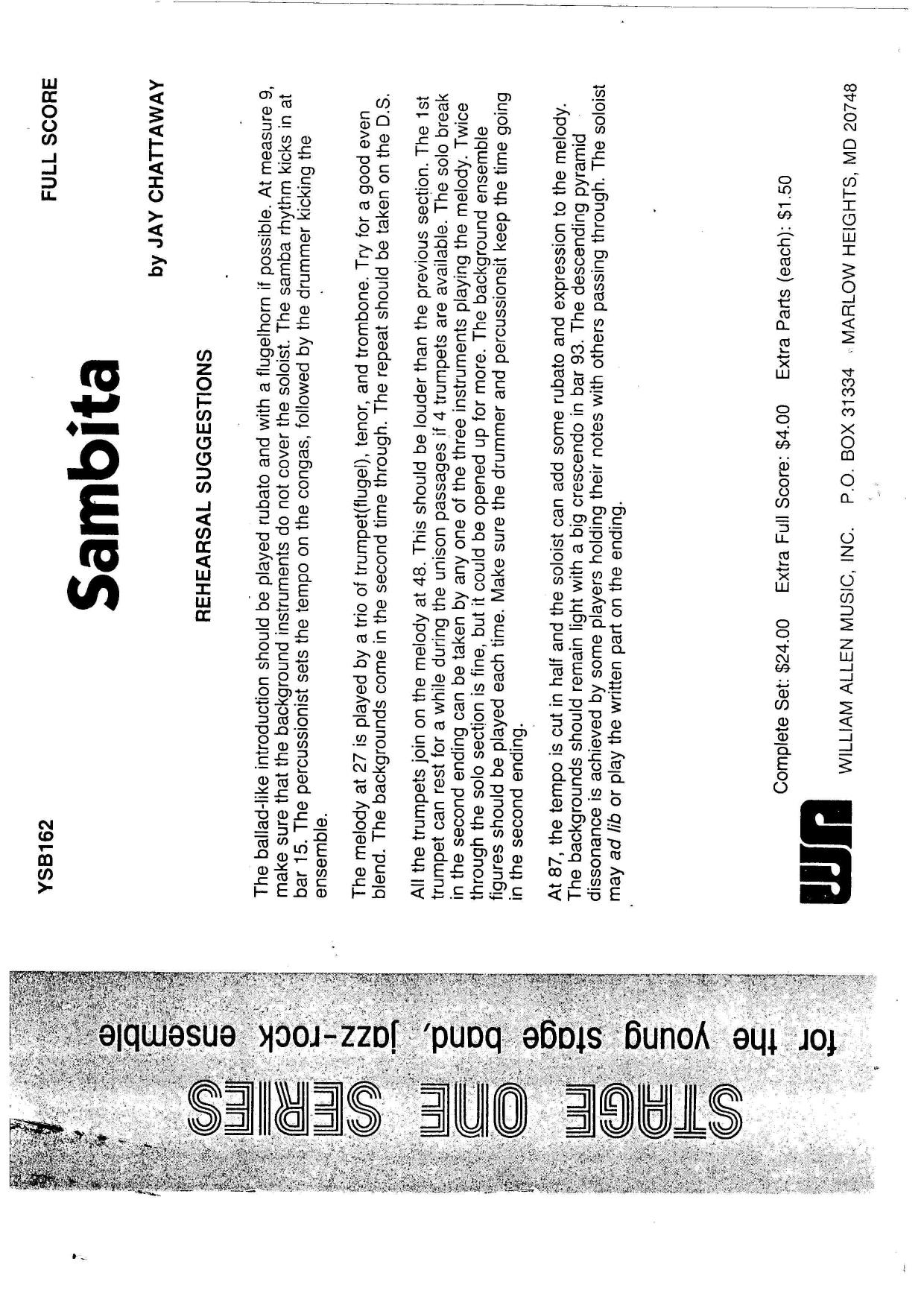
Sambita (J.Chattaway) sheet music preview

Sambita (J.Chattaway)

Composed by Jay Chattaway

Arranged by Jay Chattaway

  • Ensemble: Big Band
  • Pages: 36
  • Instruments (17): Alto Sax 1, Alto Sax 2, Tenor Sax 1, Tenor Sax 2, Baritone Sax, Trumpet 1, Trumpet 2, Trumpet 3, Trumpet 4, Trombone 1, Trombone 2, Trombone 3, Trombone 4, Guitar (Electric), Piano (Electric), Bass (Electric), Drums
  • Difficulty: medium
  • Content: Individual Parts
  • Format: PDF Download (Instant)
  • Price: $24.99

Jay Chattaway’s dynamic composition "Sambita" stands as a premier example of contemporary educational and professional big band writing, capturing the infectious energy of Latin-jazz fusion that gained immense popularity in the late 20th century. Chattaway, renowned for his prolific contributions to the jazz ensemble repertoire and his extensive work in television and film scoring, crafted "Sambita" to bridge straight-ahead swing sensibilities with vibrant Afro-Cuban and Brazilian rhythmic frameworks. While not an archaic Tin Pan Alley standard, this chart has earned a revered spot in the modern big band canon, celebrated for its ability to teach foundational syncopation while delivering high-octane excitement to concert audiences and festival adjudicators alike. Pulsing with an energetic, driving Latin groove, "Sambita" opens in a bright, infectious meter that immediately establishes a celebratory and danceable mood. The harmonic language is rich with extended major and minor sonorities, utilizing modal shifts and sparkling brass voicings to evoke the warmth and brilliance of a sun-drenched street carnival. The underlying percussion framework—anchored by a steady ride cymbal pattern, auxiliary Latin percussion, and a walking bassline that occasionally shifts to montuno-style repetition—propels the ensemble forward with relentless momentum, evoking an atmosphere of joyful exuberance and virtuosic display. Chattaway’s arrangement showcases his signature mastery of dynamic contrast and transparent scoring. Rather than relying on constant thick block-chord textures, the chart employs intricate counterpoint, crisp sax solis, and punchy brass interjections that leave ample room for the rhythm section to breathe. The woodwind section features tight, interwoven lines that demand absolute rhythmic precision, particularly during the unison and harmonized soli sections. The brass writing builds tension incrementally, utilizing stacked fourths and sharp accents to lead the band into a thunderous shout chorus that serves as the emotional and sonic apex of the arrangement. Melodic duties are shared democratically across the ensemble, though the saxophone section frequently introduces the primary thematic material with bright articulation and nimble fingerwork. Open solo sections provide a prime platform for featured improvisers—typically tenor saxophone and piano—to stretch out over accessible yet stimulating chord changes. Technically, the chart demands crisp articulation, accurate double-tonguing in the trumpet section, and a secure understanding of syncopated Latin eighth-note feels. Advanced high school groups with strong lead players, as well as collegiate and community big bands, will find "Sambita" to be an immensely rewarding centerpiece for a spring concert or festival program. Achieving an authentic performance of "Sambita" requires strict attention to the underlying Latin groove, moving away from a traditional swing feel toward an even eighth-note articulation. The rhythm section is the engine of this chart; the drummer must maintain a clear, crisp bossa or samba pattern on the ride cymbal or hi-hat, while the bassist locks in with a punchy, sustained root-fifth pulse that avoids heavy downbeat hammering. Brass players should approach accents with a sharp, bright attack ("dit" rather than "dah") to ensure the syncopated figures pop through the ensemble texture. Watch out for rapid dynamic shifts; backing figures behind the soloists must remain subdued to allow the improviser acoustic space. Rehearsal should begin slowly with a metronome clicking on beats two and four (or subdividing eighth notes) to lock in the tricky ensemble unisons before opening up the tempo to performance speed. Q: What instrumentation and parts are included in this big band package? A: The arrangement is scored for a standard 18-instrument big band, comprising 2 alto saxophones, 2 tenor saxophones, 1 baritone saxophone, 4 trumpets, 4 trombones, guitar, piano, bass, drums, and auxiliary percussion, accompanied by a comprehensive full conductor score across 36 pages. Q: What is the difficulty level of Jay Chattaway’s "Sambita"? A: This chart is graded as medium-advanced (Grade 4 to 4.5), making it exceptionally well-suited for advanced high school ensembles, collegiate jazz bands, and skilled community big bands looking to stretch their Latin-jazz capabilities. Q: What is the musical style and historical background of this piece? A: Written by prolific composer and arranger Jay Chattaway, "Sambita" is a high-energy Latin-jazz fusion chart that blends contemporary big band harmony with vibrant Afro-Cuban and Brazilian rhythmic traditions. Q: What makes this specific arrangement unique within the jazz repertoire? A: The chart stands out due to Chattaway’s transparent scoring, which balances intricate woodwind counterpoint and aggressive brass shout choruses with wide-open solo spaces and infectious rhythmic drive. Q: What is the performance duration and recommended tempo for "Sambita"? A: The piece runs approximately 4 to 5 minutes in duration and should be performed at a brisk, energetic tempo of around 168 to 176 beats per minute, maintaining a strict, even eighth-note Latin feel throughout.

Questions and answers

What is included in the Sambita (J.Chattaway) PDF?
The verified current file contains a conductor score and individual parts across 36 pages.
How many instruments or parts are listed for Sambita (J.Chattaway)?
The verified instrumentation list contains 17 entries for this Big Band arrangement.
Who is credited for Sambita (J.Chattaway)?
Composer: Jay Chattaway. Arranger: Jay Chattaway.
What difficulty is listed for Sambita (J.Chattaway)?
The verified difficulty level is medium.
Can I preview Sambita (J.Chattaway) before buying?
Yes. The product page provides a preview generated from the current PDF file.
How is Sambita (J.Chattaway) delivered?
After successful payment, the digital PDF is made available for download. The displayed price is $24.99.

Musicians Also Search For

Sambita Jay Chattaway PDFSambita Jay Chattaway sheet musicSambita arranged by Jay ChattawayJay Chattaway big band chartsJay Chattaway jazz arrangements PDFSambita Jay Chattaway big band arrangementsSambita big band arrangementsSambita big band PDF downloadSambita jazz sheet musicbig band sheet music downloadSambita conductor score PDFSambita individual parts downloadSambita sheet music PDFbuy Sambita sheet musicdownload Sambita PDFSambita jazz chartsbest Jay Chattaway big band arrangementsSambita printable sheet musicbig band repertoire PDF

All arrangements by Jay Chattaway All Jay Chattaway sheet music