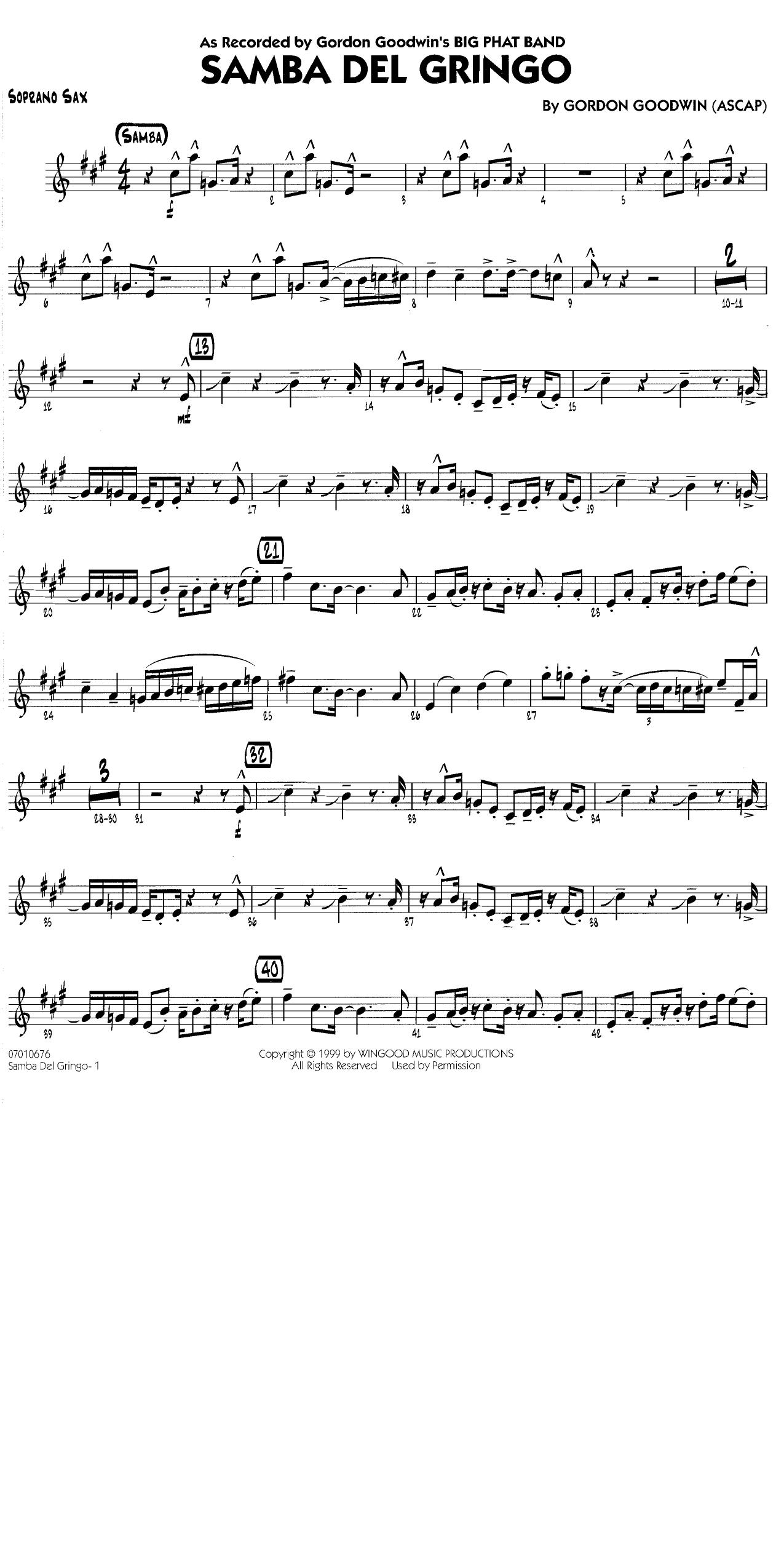
Samba Del Gringo (G.Goodwin) sheet music preview

Samba Del Gringo (G.Goodwin)

Composed by Gordon Goodwin

Arranged by Gordon Goodwin

  • Ensemble: Big Band
  • Pages: 57
  • Instruments (18): Soprano Sax, Alto Sax/Flute, Tenor Sax 1, Tenor Sax 2, Baritone Sax, Trumpet 1, Trumpet 2, Trumpet 3, Trumpet 4, Trombone 1, Trombone 2, Trombone 3, Trombone 4, Guitar, Bass, Drums, Aux. Percussion, Piano
  • Difficulty: advanced
  • Content: Individual Parts
  • Format: PDF Download (Instant)
  • Price: $24.99

Gordon Goodwin’s explosive Latin chart "Samba Del Gringo" stands as a masterclass in contemporary big band writing, capturing the high-octane energy and virtuosic flair that define the Grammy-winning Gordon Goodwin's Big Phat Band. Originally released on the ensemble's critically acclaimed debut album *Swingin' for the Fences* at the turn of the millennium, this composition revitalized the modern big band canon by fusing traditional Afro-Cuban percussion grooves with blazing West Coast contemporary jazz harmony. It represents a pinnacle of the modern big band movement, bridging the gap between classic Latin-jazz crossover idioms and the hyper-articulate precision of contemporary studio jazz. Driving forward with a relentless, high-velocity samba groove, "Samba Del Gringo" explodes out of the gate with an infectious rhythmic urgency. The piece inhabits a bright, celebratory mood, characterized by soaring brass lines, interlocking woodwind counterpoint, and a dense harmonic language rich in extended alterations and chromatic mediants. Goodwin's writing evokes the sun-drenched intensity of a Latin festival combined with the polished sheen of a Hollywood scoring stage. The rhythmic interplay between the rhythm section and the horn tiers creates an electric atmosphere, demanding absolute precision and unyielding stamina from every player on the bandstand. True to Goodwin's signature style, the arrangement showcases razor-sharp ensemble solis, intricate sax section passages, and soaring brass climaxes that test the limits of the upper register. The orchestration utilizes a dense, contemporary voicing approach where saxophones double high-register trumpet lines and trombones provide thick, percussive counter-melodies. Melodic duties are shared dynamically across the entire ensemble, moving fluidly from a roaring full-band intro into intricate woodwind unison lines. The chart features open solo spaces—traditionally tailored for piano and alto saxophone—built over driving harmonic changes that encourage adventurous, modern improvisational vocabulary before culminating in a thunderous, harmonically complex shout chorus. Executing this 57-page arrangement successfully requires an advanced ensemble capable of navigating rapid tempo shifts, complex syncopations, and demanding technical passages across all sections. High-note endurance is essential for the lead trumpet chair, while the saxophone section must possess agile finger technique to handle lightning-fast scalar runs and unison bebop-inflected lines. The rhythm section acts as the engine room, requiring a drummer adept at authentic Latin time-keeping and a pianist comfortable with comping dense, modern chord extensions. Advanced college ensembles, top-tier high school jazz bands, and professional repertory orchestras will find this chart an exhilarating centerpiece for a concert program. Its combination of crowd-pleasing rhythmic drive and sophisticated compositional architecture ensures that it commands the attention of listeners while providing an immensely rewarding, rigorous workout for serious instrumentalists. Unlocking the brilliance of "Samba Del Gringo" requires meticulous attention to articulation, balance, and rhythmic crispness. The tempo must remain relentlessly steady; any drag in the groove will dilute the chart's explosive energy. Conductors should ensure the rhythm section locks in tightly, with the bass and percussion establishing a driving, authentic samba feel underneath the punchy horn stabs. The primary technical challenge lies in the execution of the rapid, syncopated unison lines shared between the saxes and brass. These passages demand strict adherence to marked articulations—short, clipped staccatos must be crisp, and accented notes must pop without distorting the overall blend. Players should practice difficult scalar passages slowly with a metronome, gradually working up to performance speed while maintaining clean finger transitions. Brass players must pace their endurance carefully, especially the lead trumpet, as the chart features sustained high-register work leading into the climactic shout chorus. In rehearsal, isolate the rhythm section first to cement the groove before layering in the horn sections. Balance is critical during dense ensemble solis; ensure the accompanying background figures do not obscure the primary melodic voices. Utilize dynamic contrast strategically, allowing the softer, intricate interludes to set up the powerhouse tutti sections for maximum emotional impact. Q: What instruments and parts are included in this arrangement? A: This 57-page publication includes standard big band instrumentation featuring parts for 5 saxophones (Alto 1/2, Tenor 1/2, Baritone), trumpets, trombones, and a full rhythm section (piano, bass, drums, and auxiliary percussion). Q: What is the difficulty level of "Samba Del Gringo"? A: This arrangement is graded as advanced or professional level, requiring elite technical proficiency, strong high-note endurance for brass, and advanced rhythmic precision for all sections. Q: What is the musical style and historical context of this piece? A: Written and popularized by Gordon Goodwin's Big Phat Band, the piece belongs to the contemporary Latin-jazz genre, famously recorded on their debut 2001 album *Swingin' for the Fences*. Q: What makes this Gordon Goodwin arrangement unique? A: It is distinguished by its blistering tempo, intricate unison woodwind lines, dense modern harmonic voicings, and a signature high-energy shout chorus that fuses Latin grooves with West Coast big band sophistication. Q: What is the performance duration and tempo feel of the arrangement? A: The piece is performed at a very fast, driving samba tempo (typically around quarter note = 180-200+ BPM), with an approximate duration of 5 to 6 minutes depending on the length of the improvised solos.

Questions and answers

What is included in the Samba Del Gringo (G.Goodwin) PDF?
The verified current file contains individual parts across 57 pages.
How many instruments or parts are listed for Samba Del Gringo (G.Goodwin)?
The verified instrumentation list contains 18 entries for this Big Band arrangement.
Who is credited for Samba Del Gringo (G.Goodwin)?
Composer: Gordon Goodwin. Arranger: Gordon Goodwin.
What difficulty is listed for Samba Del Gringo (G.Goodwin)?
The verified difficulty level is advanced.
Can I preview Samba Del Gringo (G.Goodwin) before buying?
Yes. The product page provides a preview generated from the current PDF file.
How is Samba Del Gringo (G.Goodwin) delivered?
After successful payment, the digital PDF is made available for download. The displayed price is $24.99.

Musicians Also Search For

Samba Del Gringo Gordon Goodwin PDFSamba Del Gringo Gordon Goodwin sheet musicSamba Del Gringo arranged by Gordon GoodwinGordon Goodwin big band chartsGordon Goodwin jazz arrangements PDFSamba Del Gringo Gordon Goodwin big band arrangementsSamba Del Gringo big band arrangementsSamba Del Gringo big band PDF downloadSamba Del Gringo jazz sheet musicbig band sheet music downloadSamba Del Gringo individual parts downloadSamba Del Gringo sheet music PDFbuy Samba Del Gringo sheet musicdownload Samba Del Gringo PDFSamba Del Gringo jazz chartsbest Gordon Goodwin big band arrangementsSamba Del Gringo printable sheet musicbig band repertoire PDF

All arrangements by Gordon Goodwin All Gordon Goodwin sheet music