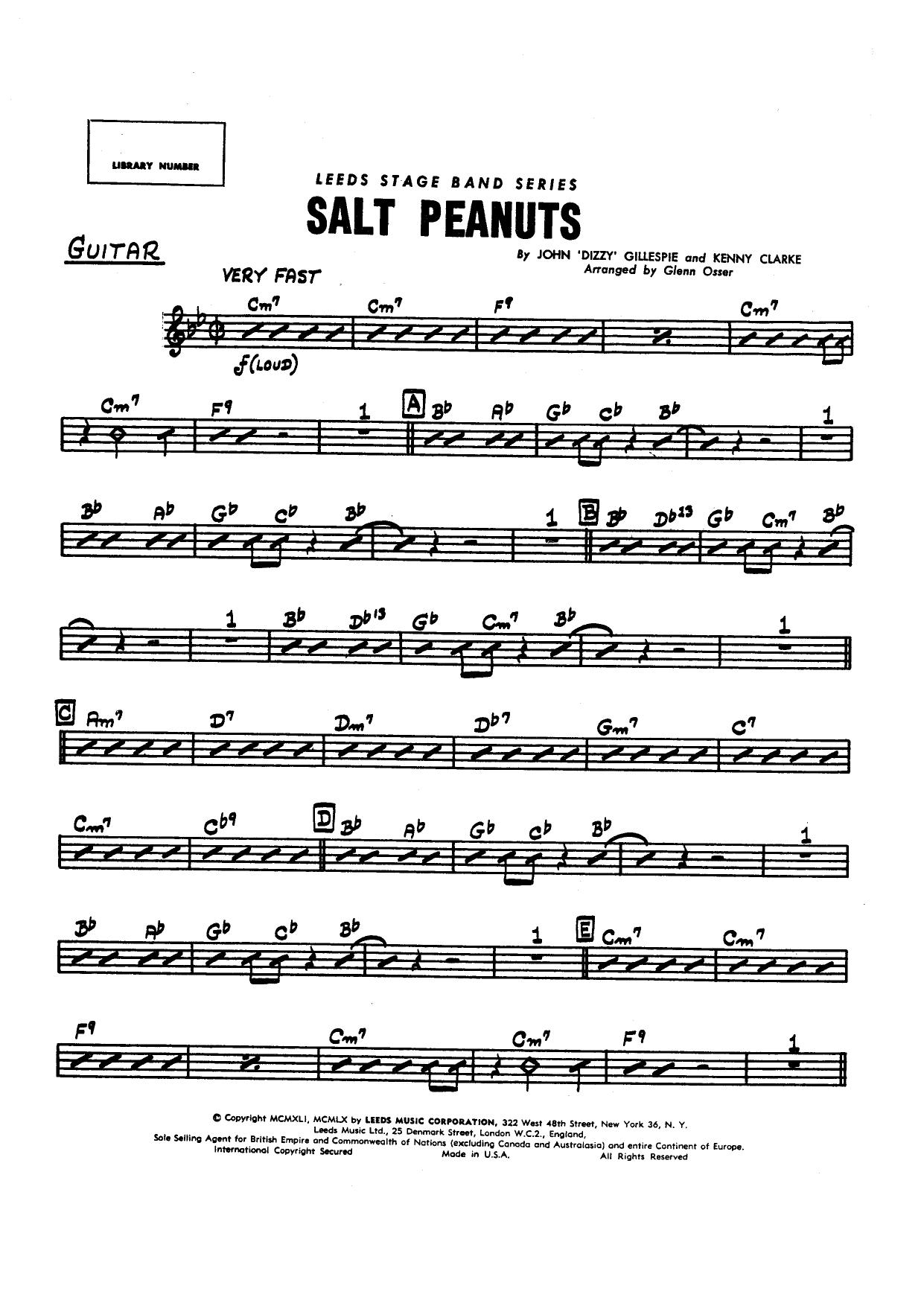
Salt Peanuts (G.Osser)
Composed by Dizzy Gillespie
Arranged by Glenn Osser
- Ensemble: Big Band
- Pages: 36
- Instruments (17): Guitar, Piano (Accordion), 1st Bb Trumpet, 2nd Bb Trumpet, 3rd Bb Trumpet, 4th Bb Trumpet, 1st Trombone, 2nd Trombone, 3rd Trombone, 4th Trombone, 1st Eb Alto Sax, 3rd Eb Alto Sax, 2nd Bb Tenor Sax, 4th Bb Tenor Sax, 5th Eb Baritone Sax, Bass (String), Drums
- Difficulty: medium
- Content: Individual Parts
- Format: PDF Download (Instant)
- Price: $24.99
Bebop’s explosive entry into the mid-1940s jazz landscape changed the trajectory of American music forever, and few anthems capture that kinetic, high-wire energy quite like Dizzy Gillespie and Kenny Clarke’s "Salt Peanuts." First recorded in 1945 by Gillespie’s groundbreaking small group featuring a young Charlie Parker, the tune immediately established itself as a cornerstone of the bebop canon. Built upon a lightning-fast rhythm-changes foundation and punctuated by its iconic, syncopated three-note vocal tag—famously chanted as "Salt Peanuts! Salt Peanuts!"—the composition demands virtuosic agility, sharp articulation, and an unyielding sense of rhythmic drive. It remains one of the ultimate litmus tests for modern jazz articulation and harmonic fluency. Glenn Osser’s masterful big band adaptation translates the frantic, bebop-infused vernacular of Gillespie’s small-group masterpiece into a roaring, harmonically rich orchestral palette. Scored in an energetic, up-tempo swing feel, Osser’s arrangement harnesses the raw, breakneck velocity of the original while injecting sophisticated brass voicings and dynamic section interplay. The mood is relentlessly buoyant, joyful, and electric, evoking the smoky, high-stakes atmosphere of mid-century 52nd Street clubs. Osser avoids simply transcribing the head for a full horn section; instead, he crafts intricate counterpoint and rich, extended harmonies that give the traditional big band instrumentation a distinctly modern, forward-thinking edge without losing the playful spirit of the original melody. The arrangement distributes thematic material democratically across the ensemble, though the brass section—particularly the lead trumpet and upper trombones—carries the brunt of the high-register bebop lines. The woodwinds double down on agile, rapid-fire scalar passages, driving the momentum forward into tightly wound ensemble solis that showcase the band's precision and articulation. Rhythmic synchronization between the rhythm section (piano, guitar, bass, and drums) and the horn ensemble is paramount, especially during the sharp stop-time figures and explosive shout choruses that characterize Osser’s climactic builds. Featured solo sections provide a vital creative outlet for frontline improvisers to stretch out over standard changes, adding a personalized, spontaneous element to a tightly orchestrated chart. Advanced high school, collegiate, and professional big bands will find this arrangement an exhilarating challenge that pushes technical boundaries while offering immense audience appeal. Because of the demanding tempo and intricate, fast-moving unison lines, the chart requires mature players who possess strong sight-reading capabilities, reliable endurance in the upper registers, and a deep-seated understanding of traditional swing and bebop articulation. Programming "Salt Peanuts" in this specific setting guarantees a show-stopping moment in any concert, rewarding diligent ensemble preparation with a timeless display of jazz brilliance. Conductors tackling Glenn Osser’s arrangement of "Salt Peanuts" must first establish a rock-solid, driving tempo that prioritizes clarity over sheer, reckless speed; a medium-up to fast bebop tempo will allow the complex scalar passages to articulate cleanly. The primary technical challenge lies in the uniform execution of eighth-note swing phrasing, ensuring that the accented upbeats and ghosted notes match precisely across the entire saxophone and brass sections. Rhythm section players should lock in tightly, with the drummer utilizing crisp ride-cymbal patterns and well-placed snare "bombs" that mimic classic 1940s bebop drumming styles without overpowering the horn lines. The pianist should comp sparsely with targeted, rootless voicings to leave ample sonic space for the horns. During rehearsal, isolate the rapid unison figures section by section at a reduced tempo before gradually ramping up to performance speed, paying close attention to dynamic contrasts leading into the shout chorus. Q: What instruments and parts are included in this big band arrangement? A: This 36-page chart is scored for a standard 17-instrument big band ensemble, including dedicated parts for guitar, piano, 3rd and 4th trombones, and a 3rd Bb trumpet, alongside the complete reed, brass, and rhythm sections. Q: What is the difficulty level of this specific arrangement? A: This arrangement is best suited for advanced high school, collegiate, and professional big bands due to its fast tempo, intricate bebop articulation, and upper-register demands for the brass section. Q: What is the musical style and historical context of the piece? A: Written in an up-tempo jazz swing style, this arrangement adapts Dizzy Gillespie's iconic 1945 bebop anthem, capturing the pioneering energy and harmonic complexity of the mid-century modern jazz era. Q: What makes Glenn Osser’s treatment of "Salt Peanuts" unique? A: Osser successfully scales up a quintessential small-group bebop tune for a full 17-piece big band by utilizing sophisticated harmonic voicings, intricate counterpoint, and dynamic shout choruses while preserving the playful spirit of the original melody. Q: What is the typical performance duration and tempo framework for this chart? A: The arrangement is designed to be performed at a brisk, energetic bebop tempo, typically clocking in around 2 to 3.5 minutes depending on the length of the open improvised solos.
Questions and answers
- What is included in the Salt Peanuts (G.Osser) PDF?
- The verified current file contains individual parts across 36 pages.
- How many instruments or parts are listed for Salt Peanuts (G.Osser)?
- The verified instrumentation list contains 17 entries for this Big Band arrangement.
- Who is credited for Salt Peanuts (G.Osser)?
- Composer: Dizzy Gillespie. Arranger: Glenn Osser.
- What difficulty is listed for Salt Peanuts (G.Osser)?
- The verified difficulty level is medium.
- Can I preview Salt Peanuts (G.Osser) before buying?
- Yes. The product page provides a preview generated from the current PDF file.
- How is Salt Peanuts (G.Osser) delivered?
- After successful payment, the digital PDF is made available for download. The displayed price is $24.99.
Musicians Also Search For
Salt Peanuts Glenn Osser PDF • Salt Peanuts Glenn Osser sheet music • Salt Peanuts arranged by Glenn Osser • Glenn Osser big band charts • Glenn Osser jazz arrangements PDF • Salt Peanuts Dizzy Gillespie sheet music • Salt Peanuts Dizzy Gillespie big band arrangements • Dizzy Gillespie big band charts • Salt Peanuts big band arrangements • Salt Peanuts big band PDF download • Salt Peanuts jazz sheet music • big band sheet music download • Salt Peanuts individual parts download • Salt Peanuts sheet music PDF • buy Salt Peanuts sheet music • download Salt Peanuts PDF • Salt Peanuts jazz charts • best Glenn Osser big band arrangements • Dizzy Gillespie arranged by Glenn Osser • Salt Peanuts printable sheet music • big band repertoire PDF