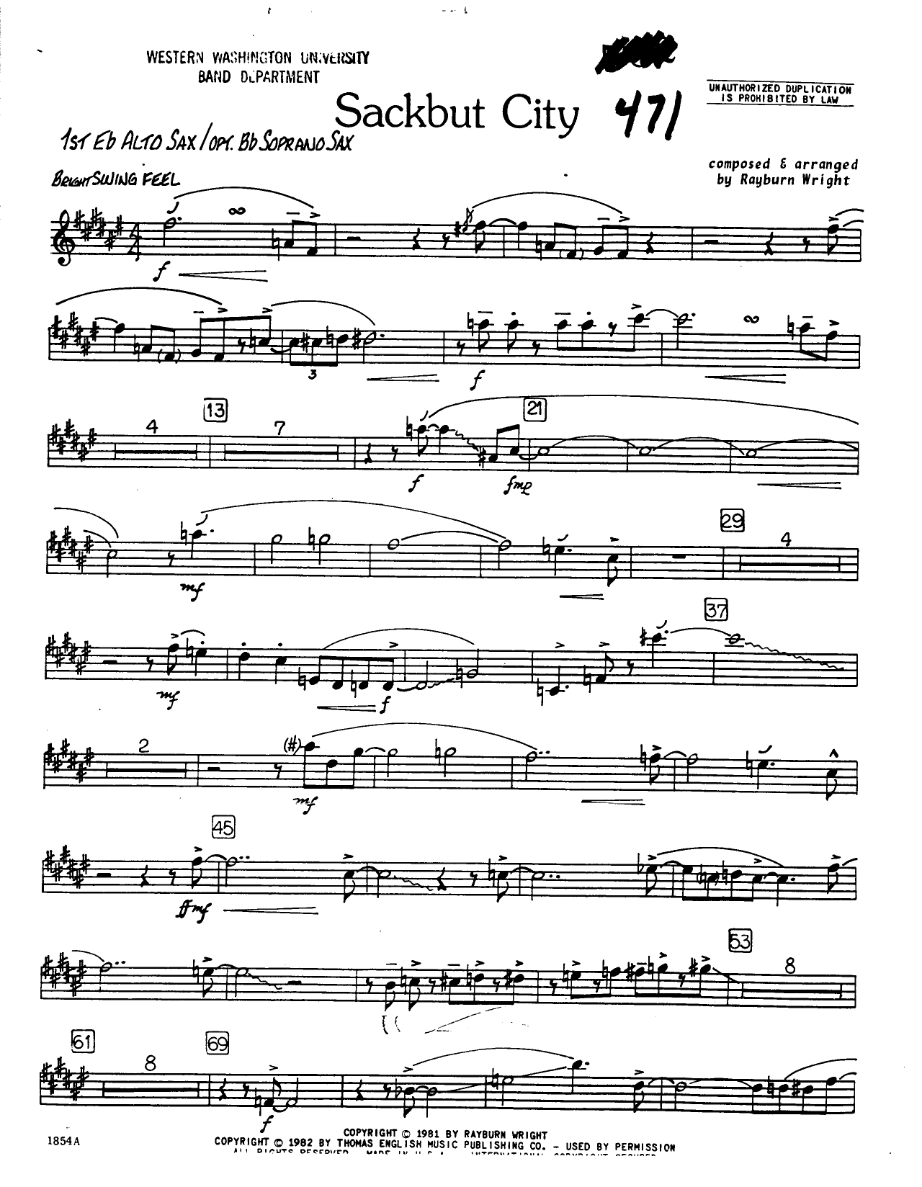
Sackbut City (R.Wright)
Composed by Rick Wright
Arranged by R.Wright
- Ensemble: Big Band
- Style: Jazz Standard
- Pages: 67
- Instruments (17): 1st Eb Alto Sax / opt. Bb Soprano Sax, 2nd Eb Alto Sax, 1st Bb Tenor Sax, 2nd Bb Tenor Sax, Eb Bari. Sax, 1st Bb Trumpet, 2nd Bb Trumpet, 3rd Bb Trumpet, 4th Bb Trumpet, 1st Trombone, 2nd Trombone, 3rd Trombone, 4th Trombone, Piano, Guitar, Bass (Acoustic), Drums
- Difficulty: advanced
- Content: Individual Parts
- Format: PDF Download (Instant)
- Price: $24.99
"Sackbut City" stands as a definitive tribute to the trombone’s historical lineage, cleverly titled after the Renaissance-era predecessor to the modern instrument. Composed and arranged by Rick Wright, this work captures the essence of the mid-century big band aesthetic while infusing it with the harmonic language of the post-bop era. Originally conceived as a vehicle to showcase the depth and agility of a full brass section, the piece has earned its place in the contemporary jazz library as a high-energy staple that bridges the gap between traditional swing and modern orchestral jazz. It represents a period where big band writing began to embrace more complex, through-composed structures while maintaining the visceral excitement of the dance hall era. The composition is anchored in a driving medium-up swing feel, typically performed at a brisk tempo that demands rhythmic precision from the entire ensemble. Set in a rich, blues-inflected key, the mood is one of sophisticated exuberance. It evokes the atmosphere of a late-night urban jazz club, characterized by a walking bass line that provides a relentless forward motion. The energy remains consistently high, building through layers of brass counterpoint that culminate in a powerful, harmonically dense climax. Listeners will recognize the interplay between the gritty, bluesy melodic fragments and the more polished, chromatic transitions that define the piece’s unique character. Rick Wright’s arranging style is on full display here, utilizing expansive 17-piece instrumentation to create a wall of sound that is both transparent and muscular. He employs sophisticated block voicings in the saxophone section and demanding, high-register hits for the trumpets that require significant lead-player stamina. A standout feature of this arrangement is the meticulous attention to the "sackbut" (trombone) section, which often leads the melodic charge with robust, unison lines before breaking into complex four-part harmony. Wright’s use of an optional Soprano Sax on the first Alto part allows for a brighter, more piercing lead color during the more intricate woodwind passages, a signature technique he uses to cut through dense brass textures. Performance-wise, the arrangement challenges the ensemble with its 67-page score depth, indicating a detailed approach with minimal reliance on repetitive vamps. While the saxophones are treated to a virtuosic soli section, the primary technical hurdle lies in the brass section’s endurance and the rhythm section’s ability to maintain a steady "four-on-the-floor" feel without rushing the syncopated figures. This arrangement is ideally suited for collegiate ensembles or professional big bands who can navigate the extended harmonies and the dynamic nuances required to make the shout chorus truly resonate. It is a rewarding endeavor for any group looking to showcase their technical proficiency and swing feel. Achieving the proper "pocket" in "Sackbut City" requires a disciplined rhythm section that emphasizes the quarter-note pulse while allowing the brass to sit slightly behind the beat for a true swing feel. The tempo should be maintained at a steady medium-up clip; rushing will muddy the intricate saxophone soli and diminish the impact of the syncopated brass kicks. Conductors should pay close attention to the dynamic markings, ensuring the brass do not overpower the woodwinds during the contrapuntal sections. Technical demands include precise execution of falls and doits in the trumpet section to punctuate the end of phrases. For the trombonists, maintaining a dark, rich tone even in the upper register is essential to honor the piece’s namesake. Rehearsal time should be dedicated to the transition into the shout chorus, where the harmonic density increases significantly and requires absolute vertical alignment. Q: What is the standard instrumentation for this arrangement? A: This is a full big band arrangement scored for 17 players, including 5 saxophones (with an optional Soprano Sax on the Alto 1 part), 4 trumpets, 4 trombones, and a 4-piece rhythm section. The 67-page score provides detailed parts for every musician, ensuring a full, orchestral jazz sound. Q: What is the difficulty level of "Sackbut City"? A: This arrangement is classified as advanced (Grade 4 to 5), making it most appropriate for collegiate jazz ensembles or professional bands. The primary challenges include high-register trumpet work, complex saxophone soli passages, and the endurance required for a long-form swing piece. Q: What musical style and era does this piece represent? A: The piece is a medium-up swing jazz standard that draws inspiration from the post-bop big band era. It combines traditional blues elements with modern harmonic structures, reflecting Rick Wright's sophisticated approach to contemporary large-ensemble writing. Q: What makes the R. Wright arrangement of this piece unique? A: This version is distinguished by its specific focus on the trombone section—a nod to the "sackbut"—and its lush, 67-page through-composed structure. The inclusion of an optional Soprano Sax part allows the conductor to alter the ensemble's color, providing a modern edge to the traditional saxophone section. Q: What is the recommended tempo and approximate duration for performance? A: The piece is intended to be performed at a medium-up swing tempo, generally ranging between 160 and 180 BPM. Depending on the length of the improvised solo sections, the performance duration typically falls between six and eight minutes.
Questions and answers
- What is included in the Sackbut City (R.Wright) PDF?
- The verified current file contains individual parts across 67 pages.
- How many instruments or parts are listed for Sackbut City (R.Wright)?
- The verified instrumentation list contains 17 entries for this Big Band arrangement.
- Who is credited for Sackbut City (R.Wright)?
- Composer: Rick Wright. Arranger: R.Wright.
- What difficulty is listed for Sackbut City (R.Wright)?
- The verified difficulty level is advanced.
- What style is listed for Sackbut City (R.Wright)?
- The catalog lists the style as Jazz Standard.
- Can I preview Sackbut City (R.Wright) before buying?
- Yes. The product page provides a preview generated from the current PDF file.
- How is Sackbut City (R.Wright) delivered?
- After successful payment, the digital PDF is made available for download. The displayed price is $24.99.
Musicians Also Search For
Sackbut City R.Wright PDF • Sackbut City R.Wright sheet music • Sackbut City arranged by R.Wright • R.Wright big band charts • R.Wright jazz arrangements PDF • Sackbut City Rick Wright sheet music • Sackbut City Rick Wright big band arrangements • Rick Wright big band charts • Sackbut City big band arrangements • Sackbut City big band PDF download • Sackbut City jazz sheet music • big band sheet music download • Sackbut City individual parts download • Sackbut City sheet music PDF • Sackbut City Jazz Standard charts • Jazz Standard big band arrangements • buy Sackbut City sheet music • download Sackbut City PDF • Sackbut City jazz charts • best R.Wright big band arrangements • Rick Wright arranged by R.Wright • Sackbut City printable sheet music • big band repertoire PDF