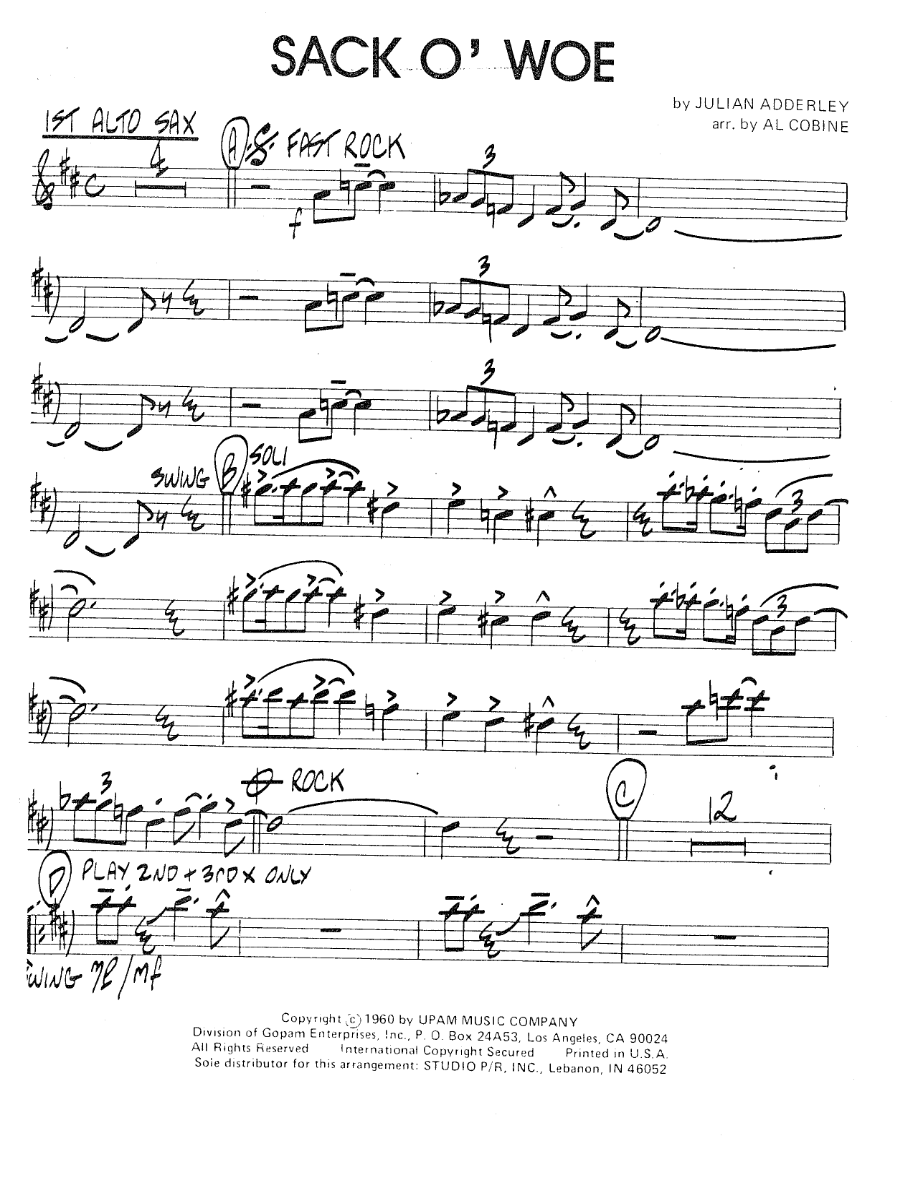
Sack O' Woe (Al Cobine) sheet music preview

Sack O' Woe (Al Cobine)

Composed by Julian "Cannonball" Adderley

Arranged by Al Cobine

  • Ensemble: Big Band
  • Style: Jazz Standard
  • Pages: 55
  • Instruments (17): Alto Saxophone 1, Alto Saxophone 2, Tenor Saxophone 1, Tenor Saxophone 2, Baritone Saxophone, Trumpet 1, Trumpet 2, Trumpet 3, Trumpet 4, Trombone 1, Trombone 2, Trombone 3, Trombone 4, Guitar, Piano, Bass, Drum Set
  • Difficulty: advanced
  • Content: Individual Parts
  • Format: PDF Download (Instant)
  • Price: $24.99

Julian "Cannonball" Adderley's iconic "Sack O' Woe" emerged from the fertile hard bop era of the late 1950s and early 1960s, first appearing on his seminal 1960 album *Them Dirty Blues*. This period marked a return to the blues and gospel roots of jazz, infused with bebop's harmonic sophistication and rhythmic drive, creating a soulful, accessible, yet highly improvisational style. "Sack O' Woe" quickly cemented its status as a jazz standard due to its infectious, blues-inflected melody, memorable chord changes, and quintessential medium-swing feel. It embodies the joyous, grooving energy that defined Cannonball's sound and continues to be a staple in the repertoire of jazz ensembles worldwide. Al Cobine's masterful big band arrangement of "Sack O' Woe" captures the original's vibrant spirit while expanding its sonic palette for a full 17-piece ensemble. Cobine, known for his meticulous scoring and ability to translate small-group intimacy to a larger format, treats this piece with a sophisticated yet authentic touch. The arrangement is set in the original key of F minor, maintaining the bluesy character, and establishes a comfortable medium-swing tempo (around quarter note = 132-144 BPM) from the outset. Cobine's signature is evident in the rich, often close-voiced saxophone soli sections that articulate the main theme, providing a powerful contrast to the brass figures. The mood is consistently energetic and soulful, evoking the original's undeniable groove and inviting both musicians and audiences to tap their feet. The arrangement features the melody initially carried by the alto saxophone section, often doubled or punctuated by brass, before opening up for featured soloists. There are ample opportunities for improvisation, typically over the standard 12-bar blues form, allowing a tenor saxophone and trumpet to shine, echoing the call-and-response tradition of the blues. Cobine builds dynamic tension throughout, culminating in a powerful shout chorus that showcases the full ensemble's might, with intricate brass lines cutting through the saxophone pads. Technical challenges include precise articulation in the brass figures, maintaining a consistent swing feel across all sections, and navigating the dynamic shifts. The rewarding aspect lies in the collective power and the opportunity for individual expression within a tightly arranged framework, making it a truly engaging performance experience. This arrangement is ideally suited for college-level jazz ensembles, advanced community big bands, and professional groups. Its demands for tight ensemble playing, strong soloists, and a nuanced understanding of the hard bop idiom make it a significant, yet highly achievable, undertaking for bands with solid fundamental skills. High school bands with exceptional lead players and a dedicated rhythm section could also tackle this, benefiting immensely from the exposure to a classic hard bop chart arranged with such clarity and drive. The 17-instrument scoring ensures a full, balanced sound, providing a robust platform for Adderley's timeless composition. Conductors should emphasize a relaxed, yet driving medium-swing feel (quarter note = 132-144 BPM) from the downbeat, focusing on a consistent quarter-note pulse in the rhythm section. Articulation is paramount: brass figures should be crisp and precise, while saxophone lines require a smooth, connected, yet swinging approach. Pay close attention to dynamics, particularly the crescendos leading into the shout chorus and the subtle swells within the sax soli sections. The bass line is foundational; ensure it locks in with the drums to establish the groove. Soloists should be encouraged to embrace the blues scale and hard bop vocabulary over the F minor blues changes. Rehearsal time should be allocated to balancing the intricate voicings, particularly in the saxophone soli, and ensuring the brass punches are unified and impactful without overpowering. No special techniques like plunger mutes or falls are explicitly notated, allowing the ensemble to focus on fundamental swing performance. Q: What instruments are included in this "Sack O' Woe" arrangement? A: This big band arrangement is scored for 17 instruments: Alto Saxophone 1, Alto Saxophone 2, Tenor Saxophone 1, Tenor Saxophone 2, Baritone Saxophone, Trumpet 1, Trumpet 2, Trumpet 3, Trumpet 4, Trombone 1, Trombone 2, Trombone 3, Bass Trombone, Piano, Bass, Drums, and Guitar. Q: What is the difficulty level of Al Cobine's "Sack O' Woe" arrangement? A: This arrangement is rated as medium-advanced, making it appropriate for college-level, advanced community, or professional big bands. It requires strong section playing, capable soloists, and a solid understanding of the hard bop style. Q: What is the musical style and historical context of "Sack O' Woe"? A: "Sack O' Woe" is a quintessential hard bop jazz standard, originally composed by Julian "Cannonball" Adderley in 1960. It embodies the soulful, blues-infused, and grooving sound characteristic of that era. Q: What makes Al Cobine's arrangement of "Sack O' Woe" unique? A: Al Cobine's treatment expands the original's small-group intimacy into a full 17-piece big band setting, featuring his signature rich saxophone soli voicings, dynamic brass figures, and a powerful shout chorus while maintaining the original's infectious medium-swing feel. Q: What is the typical performance duration or tempo for this arrangement? A: The arrangement is designed for a medium-swing tempo, typically around 132-144 BPM. A full performance, including solos, usually ranges from 4 to 6 minutes depending on the length of the improvised sections.

Musicians Also Search For

Sack O' Woe Al Cobine PDFSack O' Woe Al Cobine sheet musicSack O' Woe arranged by Al CobineAl Cobine big band chartsAl Cobine jazz arrangements PDFSack O' Woe Julian "Cannonball" Adderley sheet musicSack O' Woe Julian "Cannonball" Adderley big band arrangementJulian "Cannonball" Adderley big band chartsSack O' Woe big band arrangementSack O' Woe big band PDF downloadSack O' Woe jazz ensemble sheet musicbig band sheet music instant downloadSack O' Woe individual parts downloadSack O' Woe sheet music with partsSack O' Woe Jazz Standard chartJazz Standard big band arrangementsbuy Sack O' Woe sheet music onlinedownload Sack O' Woe PDFSack O' Woe jazz chartbest Al Cobine big band arrangementsJulian "Cannonball" Adderley songs arranged by Al CobineSack O' Woe printable sheet musicbig band repertoire PDF

All arrangements by Al Cobine All Julian "Cannonball" Adderley sheet music