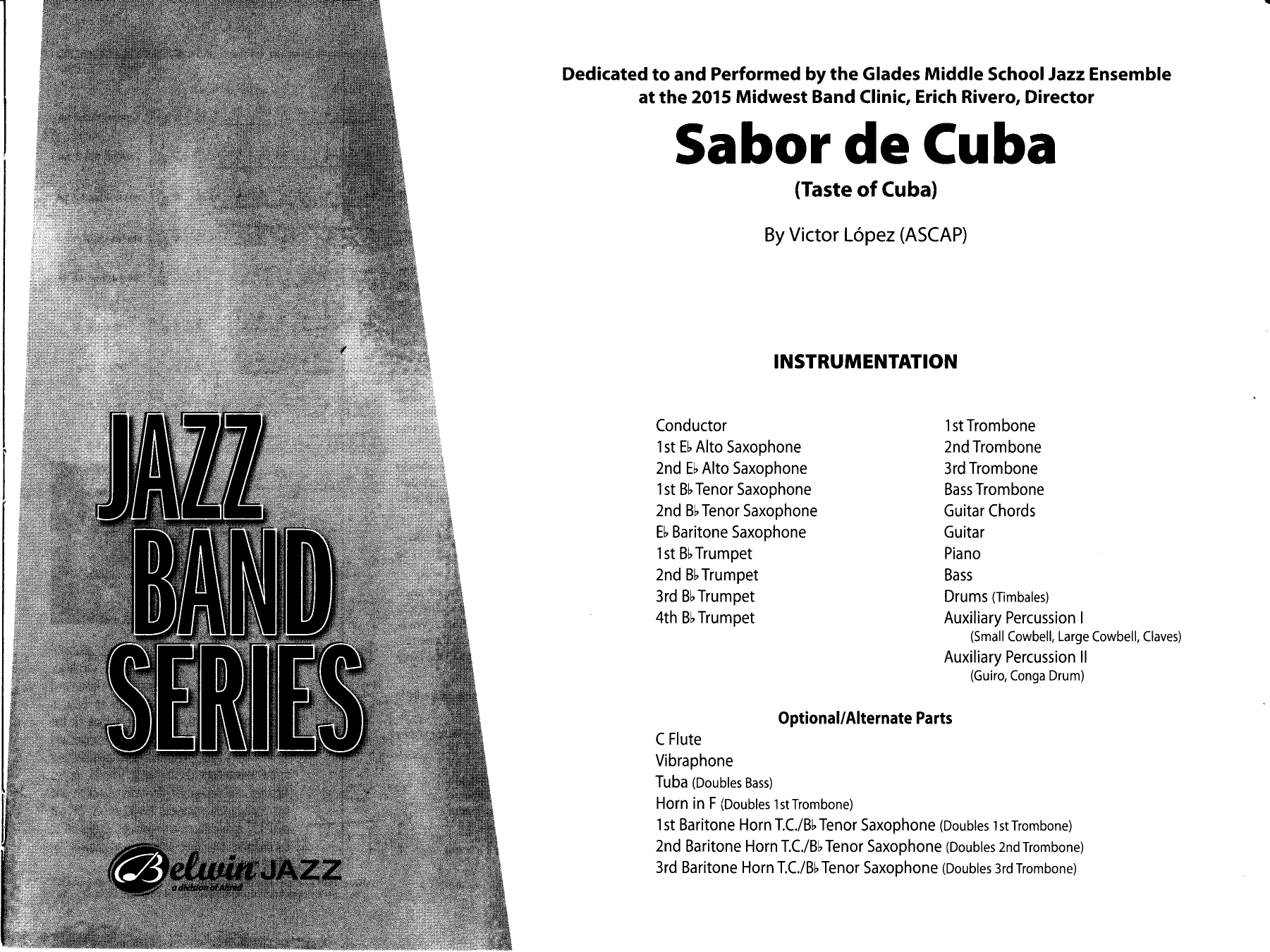
Sabor De Cuba (V.Lopez)
Composed by Victor Lopez
Arranged by Victor Lopez
- Ensemble: Big Band
- Pages: 108
- Instruments (27): Conductor, 1st Eb Alto Saxophone, 2nd Eb Alto Saxophone, 1st Bb Tenor Saxophone, 2nd Bb Tenor Saxophone, Eb Baritone Saxophone, 1st Bb Trumpet, 2nd Bb Trumpet, 3rd Bb Trumpet, 4th Bb Trumpet, 1st Trombone, 2nd Trombone, 3rd Trombone, Bass Trombone, Guitar, Piano, Bass, Drums (Timbales), Auxiliary Percussion I (Small Cowbell, Large Cowbell, Claves), Auxiliary Percussion II (Guiro, Conga Drum), C Flute, Vibraphone, Tuba, Horn in F, 1st Baritone Horn T.C. / Bb Tenor Saxophone, 2nd Baritone Horn T.C. / Bb Tenor Saxophone, 3rd Baritone Horn T.C. / Bb Tenor Saxophone
- Difficulty: advanced
- Content: Individual Parts
- Format: PDF Download (Instant)
- Price: $24.99
Imbued with the vibrant, sun-drenched energy of Caribbean-infused jazz, "Sabor De Cuba," composed and arranged by the prolific educator and composer Victor Lopez, stands as a masterclass in Latin-jazz orchestration for the modern big band. Rooted in the rich tradition where Afro-Cuban polyrhythms seamlessly merge with contemporary swing harmonies, this composition captures the kinetic spirit of Havana's mid-century golden era while utilizing a forward-thinking, contemporary pedagogical framework. Victor Lopez, widely celebrated for his authentic contributions to Latin jazz repertoire, crafts a sonic landscape that bridges traditional mambo and cha-cha feels with hard-bop harmonic sensibilities, creating an instantly recognizable cultural footprint that invigorates any concert program. Driving forward with an infectious, high-energy Latin groove in cut time, "Sabor De Cuba" immediately establishes its buoyant mood through interlocking percussion patterns and punchy brass stabs. The harmonic language is rich with extended chord structures—utilizing major-seventh, minor-ninth, and altered dominant voicings—that evoke the warmth and complexity of Latin jazz masters like Tito Puente and Arturo Sandoval. The arrangement opens with a rhythmically arresting vamp before introducing the primary melody, which is stated with authority by the trumpet and alto saxophone sections. Tonal colors shift dynamically between lush, harmonized sax solis and explosive, full-ensemble shout choruses that demand precision, crisp articulation, and deep rhythmic integration from the entire rhythm section. Victor Lopez structures the chart to showcase both ensemble cohesion and individual artistry, building in designated solo space over accessible yet stimulating chord changes that are ideal for developing improvisers. The woodwind section requires agile fingerwork on ascending scalar passages, while the brass parts feature articulate syncopation without relying on extreme upper-register demands. The rhythm section—crucial to anchoring the authentic montuno and tumbao feels—is provided with clear, idiomatic comping figures that guide the piano, bass, and percussionists away from generic swing patterns into genuine Afro-Cuban stylings. Every section shares in the narrative weight of the arrangement, culminating in a breathless, high-octane finale that leaves audiences captivated. Advanced high school, collegiate, and community big bands will find "Sabor De Cuba" to be an exceptionally rewarding addition to their libraries. It serves as an ideal vehicle for introducing students to authentic Latin-jazz phrasing, teaching them how to balance relaxed, behind-the-beat phrasing with the forward propulsion inherent in Afro-Cuban percussion. Directors looking to inject cultural diversity, rhythmic vitality, and crowd-pleasing excitement into a spring concert or festival performance will discover that Lopez’s meticulous scoring guarantees an impressive, professional-sounding result even with standard rehearsal turnaround times. Executing "Sabor De Cuba" successfully hinges on the rhythm section’s ability to establish and maintain an authentic, unhurried Afro-Cuban groove. The tempo should remain bright and danceable, but never rushed; rhythmic precision takes precedence over sheer speed. Conductors must ensure that the percussionist (congas, timbales, and auxiliary percussion) locks tightly with the acoustic bass and piano montuno figures before the horns enter. In the brass and reed sections, articulation is paramount. Short notes must be clipped and dry, contrasting sharply with the warm, sweeping legato lines found in the secondary themes. Watch out for syncopated figures crossing the bar line; players should internalize the clave to avoid rushing these anticipations. Soloists should lean into dorian and mixolydian modes associated with the Latin idiom rather than playing standard bebop lines exclusively. Finally, balance is critical during the shout choruses—ensure the rhythm section does not overpower the lead brass, allowing the intricate inner-voice countermelodies in the trombones to cut through clearly. Q: What instruments and parts are included in this big band arrangement? A: This complete 108-page arrangement is scored for a standard 17-instrument big band, including 5 saxophones (2 altos, 2 tenors, baritone), 4 trumpets, 4 trombones, piano, bass, drums, and auxiliary Latin percussion. Q: What is the difficulty level of Victor Lopez's "Sabor De Cuba"? A: This arrangement is graded as medium-advanced (approximate difficulty level 4), making it well-suited for accomplished high school ensembles, university jazz bands, and advanced community big bands. Q: What style and historical context does this piece represent? A: It is an authentic Latin-jazz composition that blends traditional Afro-Cuban rhythmic feels—such as montunos and tumbaos—with contemporary big band jazz harmony and orchestration, reminiscent of classic mid-century Havana dance bands. Q: What makes this specific arrangement by Victor Lopez unique? A: Lopez expertly balances educational accessibility with professional-grade Latin authenticity, featuring intricate horn solis, rich extended harmonies, and dedicated rhythm section accompaniment figures that avoid generic swing clichés. Q: What is the performance duration and recommended tempo for this arrangement? A: The piece runs approximately 4 to 5 minutes in duration and is designed to be performed at a brisk, energetic Latin tempo with a steady, driving groove throughout.
Questions and answers
- What is included in the Sabor De Cuba (V.Lopez) PDF?
- The verified current file contains a conductor score and individual parts across 108 pages.
- How many instruments or parts are listed for Sabor De Cuba (V.Lopez)?
- The verified instrumentation list contains 27 entries for this Big Band arrangement.
- Who is credited for Sabor De Cuba (V.Lopez)?
- Composer: Victor Lopez. Arranger: Victor Lopez.
- What difficulty is listed for Sabor De Cuba (V.Lopez)?
- The verified difficulty level is advanced.
- Can I preview Sabor De Cuba (V.Lopez) before buying?
- Yes. The product page provides a preview generated from the current PDF file.
- How is Sabor De Cuba (V.Lopez) delivered?
- After successful payment, the digital PDF is made available for download. The displayed price is $24.99.
Musicians Also Search For
Sabor De Cuba Victor Lopez PDF • Sabor De Cuba Victor Lopez sheet music • Sabor De Cuba arranged by Victor Lopez • Victor Lopez big band charts • Victor Lopez jazz arrangements PDF • Sabor De Cuba Victor Lopez big band arrangements • Sabor De Cuba big band arrangements • Sabor De Cuba big band PDF download • Sabor De Cuba jazz sheet music • big band sheet music download • Sabor De Cuba conductor score PDF • Sabor De Cuba individual parts download • Sabor De Cuba sheet music PDF • buy Sabor De Cuba sheet music • download Sabor De Cuba PDF • Sabor De Cuba jazz charts • best Victor Lopez big band arrangements • Sabor De Cuba printable sheet music • big band repertoire PDF