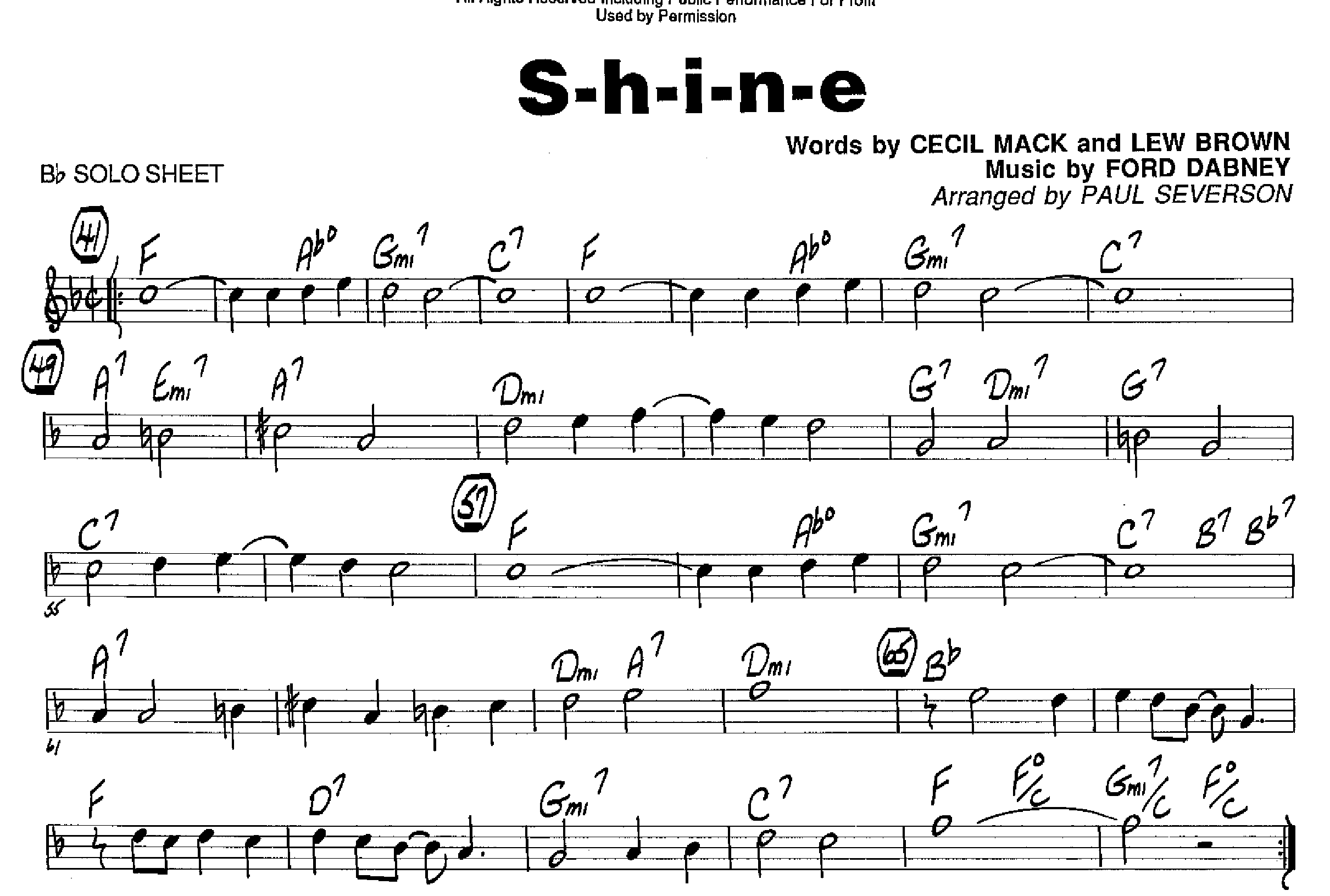
S-H-I-N-E (Severson)
Composed by Cecil Mack
Arranged by Severson
- Ensemble: Dixieland Band
- Style: Jazz Standard
- Pages: 12
- Difficulty: easy
- Content: Sheet Music
- Format: PDF Download (Instant)
- Price: $18.99
"Shine," originally titled "That's Why They Call Me Shine," is a foundational jazz standard with a rich and complex history, first published in 1910. Composed by Ford T. Dabney, with lyrics by Cecil Mack and Lew Brown, the song emerged from the Tin Pan Alley era, debuting in the African-American road show *His Honor the Barber* performed by Aida Overton Walker. Its syncopated rhythms and melodic structure quickly made it a cornerstone of early jazz repertoire, recorded over 600 times within the genre by 2020. While the original lyrics carried a nuanced message of self-affirmation amidst racial prejudice, later jazz interpretations, notably by Louis Armstrong, focused on its instrumental potential and often featured scat singing, cementing its status as a widely recognized and celebrated tune in the jazz canon. The song's enduring appeal lies in its infectious melody and harmonic simplicity, making it highly adaptable for improvisation and ensemble performance across various jazz styles. This Severson arrangement captures the vibrant, celebratory spirit of "Shine" through the lens of a classic Dixieland band. Designed for a medium-swing tempo, typically around 160-180 BPM, the arrangement is primarily in the key of C major, offering a bright and accessible harmonic landscape. The musical character is decidedly upbeat and energetic, evoking the joyous, communal feel characteristic of New Orleans jazz. The arrangement maintains a driving 4/4 meter with a pronounced swing eighth-note feel, encouraging a lively and buoyant rhythmic interpretation. It aims to transport listeners and performers alike to the bustling streets and lively dance halls where Dixieland flourished, providing a mood of unbridled exuberance and musical camaraderie. Severson's approach to "S-H-I-N-E" is a masterclass in authentic Dixieland arranging, balancing traditional elements with thoughtful ensemble writing. The arrangement features the quintessential Dixieland instrumentation, ensuring each voice contributes to the rich polyphonic texture. The melody is shared dynamically, often featuring the trumpet on the lead line, supported by clarinet counter-melodies and trombone tailgate fills. Expect classic Dixieland soli sections where the front line (clarinet, trumpet, trombone) plays intricate, interwoven melodic passages, showcasing the ensemble's tightness and blend. There are ample opportunities for featured solos, typically for clarinet, trumpet, and trombone, allowing individual musicians to express themselves within the traditional Dixieland improvisational framework. Severson skillfully incorporates call-and-response figures and a driving shout chorus that builds excitement towards the piece's rousing conclusion, making it a rewarding performance for both players and audience. This arrangement is ideally suited for high school, college, and community jazz bands seeking to explore the foundational sounds of Dixieland. Its clear articulation of parts and adherence to stylistic conventions make it an excellent educational tool for understanding the genre's interplay and improvisational language. While the technical demands are moderate, requiring solid command of articulation, rhythmic precision, and basic improvisation, the arrangement's inherent musicality and engaging structure make the effort highly rewarding. Specific musical moments, such as the initial ensemble statement of the theme, the trading fours during solo sections, and the powerful final shout chorus, are designed to stand out and provide memorable performance experiences. Conductors should emphasize a consistent, relaxed medium-swing feel throughout the piece, avoiding a rushed or stiff interpretation. The rhythmic precision of the ensemble is paramount, particularly in the syncopated figures and call-and-response sections. Encourage musicians to listen across the ensemble to achieve a balanced polyphonic texture, ensuring that lead melodies project while counter-melodies and rhythmic accompaniment provide a solid foundation. Technical challenges include clean articulation, especially in the brass, and agile melodic work for the clarinet. Trombone players should focus on authentic tailgate slides and smears to capture the Dixieland essence. Encourage soloists to embrace the melodic and rhythmic vocabulary of early jazz, utilizing blues scales and arpeggios over the provided chord changes. Rehearsal tips include isolating soli sections for blend and intonation, practicing rhythmic figures with a metronome, and allowing ample time for soloists to develop their improvisational ideas within the stylistic context. **Q: What instruments are included in this arrangement?** A: This Dixieland band arrangement typically includes parts for Clarinet, Trumpet, Trombone, Guitar/Banjo, Piano, Bass/Tuba, and Drums, providing a complete traditional Dixieland ensemble. **Q: What is the difficulty level of this arrangement?** A: This arrangement is considered medium to medium-difficult, making it appropriate for high school, college, and community jazz bands with developing to proficient musicians. **Q: What is the historical context and musical style of "S-H-I-N-E"?** A: "S-H-I-N-E" is a jazz standard originally composed in 1910 by Cecil Mack (lyrics) and Ford T. Dabney (music), and this arrangement is in the classic Dixieland style, characterized by its upbeat tempo and collective improvisation. **Q: What makes Severson's arrangement of "S-H-I-N-E" unique?** A: Severson's arrangement is distinctive for its authentic Dixieland voicings, dynamic sharing of the melody among the front-line instruments, and well-crafted soli and shout chorus sections that capture the genre's energetic and polyphonic nature. **Q: What is the typical performance duration or tempo for this piece?** A: "S-H-I-N-E" is best performed at a medium-swing tempo, generally ranging from 160 to 180 beats per minute, resulting in a performance duration of approximately 3-4 minutes depending on the number and length of solos.
Musicians Also Search For
S-H-I-N-E Severson PDF • S-H-I-N-E Severson sheet music • S-H-I-N-E arranged by Severson • Severson dixieland band charts • Severson jazz arrangements PDF • S-H-I-N-E Cecil Mack sheet music • S-H-I-N-E Cecil Mack dixieland band arrangement • Cecil Mack dixieland band charts • S-H-I-N-E dixieland band arrangement • S-H-I-N-E dixieland band PDF download • S-H-I-N-E jazz ensemble sheet music • dixieland band sheet music instant download • S-H-I-N-E sheet music with parts • S-H-I-N-E Jazz Standard chart • Jazz Standard dixieland band arrangements • buy S-H-I-N-E sheet music online • download S-H-I-N-E PDF • S-H-I-N-E jazz chart • best Severson dixieland band arrangements • Cecil Mack songs arranged by Severson • S-H-I-N-E printable sheet music • dixieland band repertoire PDF