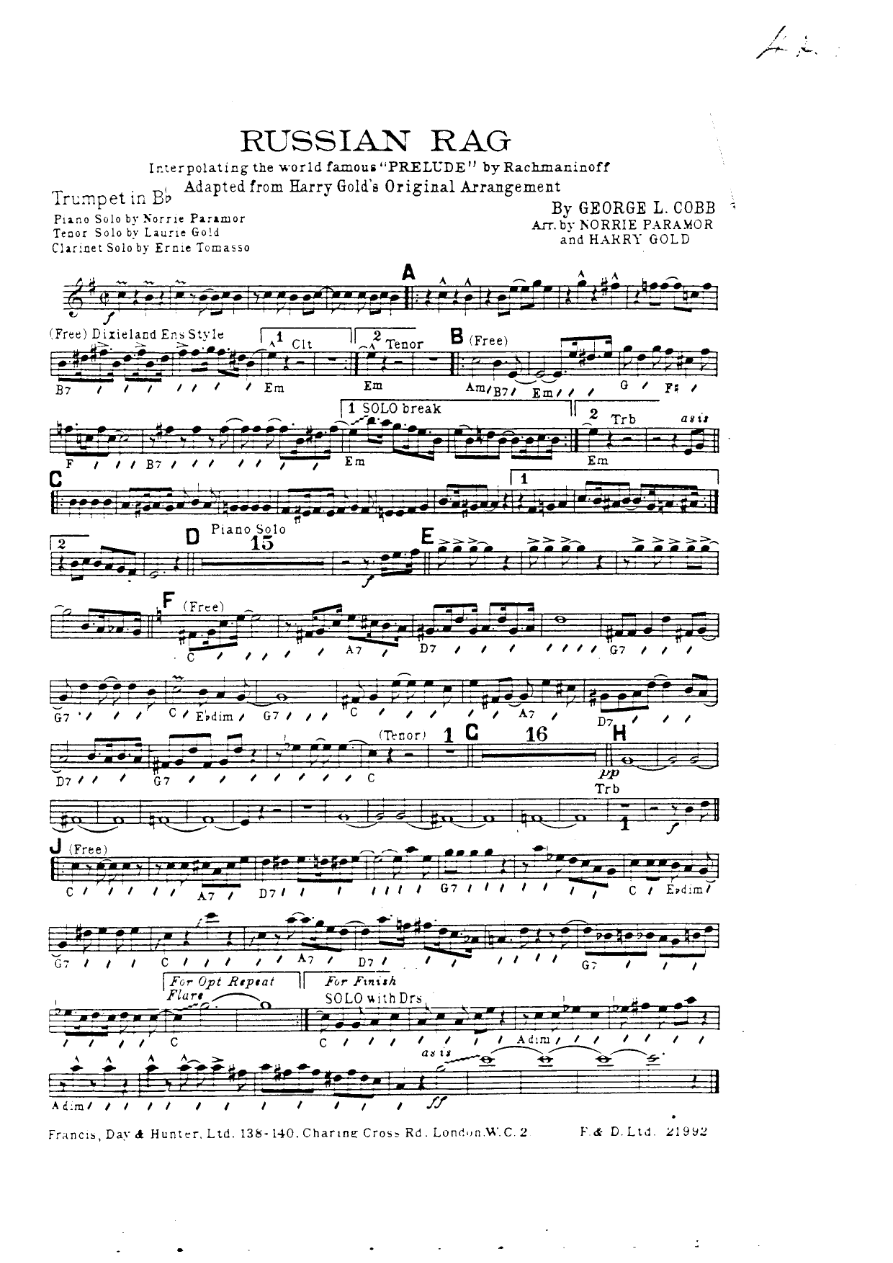
Russian Rag (G.Cobb)
Composed by George L. Cobb
Arranged by George L. Cobb
- Ensemble: Dixieland Band
- Style: Dixieland
- Pages: 17
- Instruments (8): Trumpet in Bb, Drums, Piano Conductor, Bb Clarinet, Trombone, Tenor Sax, Bass, Guitar
- Difficulty: easy
- Content: Individual Parts
- Format: PDF Download (Instant)
- Price: $18.99
George L. Cobb's "Russian Rag" stands as a foundational pillar of the Dixieland repertoire, a vibrant echo from the early 20th century, specifically composed in 1918. This piece masterfully blends the intricate syncopations of ragtime with the emerging improvisational spirit of hot jazz, capturing the exuberant energy of an era where American popular music was rapidly evolving. While not a traditional "jazz standard" in the improvisational sense of later bebop or swing, "Russian Rag" is a Dixieland standard, celebrated for its memorable melodic lines and its clever, often humorous, integration of Russian folk melodies—most notably a distinct nod to Tchaikovsky's Piano Concerto No. 1. Its popularity soared in the 1920s, becoming a staple for early jazz and novelty ragtime ensembles, embodying the lively, often whimsical character of the Roaring Twenties. Musically, this arrangement of "Russian Rag" is an up-tempo, spirited romp in 4/4 time, typically performed with a driving, two-beat Dixieland feel. The primary key is often C Major, allowing for bright, open voicings and a clear, ringing texture. The mood is unequivocally joyful and energetic, evoking images of bustling dance halls and spirited parades. Cobb’s original composition is characterized by its infectious, march-like rhythm and its playful melodic development, which seamlessly transitions between original ragtime themes and the recognizable classical snippets. The arrangement maintains this jovial spirit, emphasizing crisp articulation and a relentless forward momentum that is both exhilarating and technically engaging. George L. Cobb, as both composer and arranger of this work, approaches "Russian Rag" with an intimate understanding of the Dixieland idiom. His treatment is faithful to the original, highlighting the ensemble's collective improvisation feel while providing structured melodic statements. The arrangement features the traditional Dixieland front line—trumpet, clarinet, and trombone—carrying the primary melodic and counter-melodic duties. The trumpet typically leads with the main melody, while the clarinet weaves intricate obbligato lines above it, and the trombone provides rhythmic and harmonic counterpoint, often employing tailgate glissandi. There are no extended solo sections in the modern jazz sense; rather, the "solos" are embedded within the ensemble texture as call-and-response phrases or short, virtuosic breaks for individual instruments. The arrangement culminates in a rousing shout chorus, bringing all instruments together for a powerful, harmonized statement of the main theme, ensuring a thrilling and definitive conclusion. Performing "Russian Rag" is immensely rewarding, offering musicians a chance to delve into the historical roots of jazz. The technical challenges lie in maintaining the relentless tempo with precision, achieving clean articulation, and mastering the stylistic nuances of Dixieland, such as collective improvisation textures and precise ensemble breaks. This arrangement is ideally suited for high school, college, and community Dixieland bands seeking an authentic and exciting piece that showcases the ensemble's cohesion and individual instrumental flair. Its historical significance and undeniable charm make it a standout selection for any concert program or festival. "Russian Rag" demands a bright, unflagging tempo, typically around quarter note = 180-200 BPM, with a strong two-beat Dixieland feel in the rhythm section. Emphasize crisp, short articulations, especially in the front line, to maintain the ragtime character. The key technical challenges include precise ensemble breaks and the clarinet's virtuosic obbligato lines, which require nimble fingerwork and excellent breath support. The trombone should utilize stylistic glissandi (tailgate style) where indicated, adding authentic flavor. Rehearsal should focus on rhythmic accuracy and achieving a balanced blend, particularly in the collective improvisation sections where individual voices must shine without overpowering the ensemble. Encourage a light, buoyant feel throughout, ensuring the piece never drags. Q: What instruments and parts are included in this arrangement? A: This arrangement for Dixieland Band typically includes parts for Trumpet, Clarinet, Trombone, Piano, Bass (or Tuba), and Drums. Specific instrumentation may vary slightly but adheres to the standard Dixieland front line and rhythm section. Q: What is the difficulty level of this arrangement? A: This arrangement is rated as Medium-Difficult. It requires proficient instrumentalists capable of playing at a fast tempo with precise articulation, strong ensemble cohesion, and stylistic understanding of early jazz and ragtime. Q: What is the historical and stylistic context of "Russian Rag"? A: "Russian Rag" was composed by George L. Cobb in 1918 and is a classic example of the Dixieland and ragtime styles. It's known for its energetic feel and clever integration of classical melodies, representing the vibrant early jazz era. Q: What makes George L. Cobb's arrangement of "Russian Rag" unique? A: As the original composer, Cobb's arrangement is uniquely authentic, preserving the piece's original character. It emphasizes the collective improvisation feel of Dixieland, features prominent melodic roles for the front line, and culminates in a powerful shout chorus that captures the era's exuberance. Q: What is the typical performance duration and tempo for this piece? A: The typical performance duration for "Russian Rag" is approximately 2 to 3 minutes, depending on the chosen tempo. It is meant to be performed at a brisk, up-tempo pace, generally around quarter note = 180-200 BPM, with a driving two-beat Dixieland feel.
Questions and answers
- What is included in the Russian Rag (G.Cobb) PDF?
- The verified current file contains a conductor score and individual parts across 17 pages.
- How many instruments or parts are listed for Russian Rag (G.Cobb)?
- The verified instrumentation list contains 8 entries for this Dixieland Band arrangement.
- Who is credited for Russian Rag (G.Cobb)?
- Composer: George L. Cobb. Arranger: George L. Cobb.
- What difficulty is listed for Russian Rag (G.Cobb)?
- The verified difficulty level is easy.
- What style is listed for Russian Rag (G.Cobb)?
- The catalog lists the style as Dixieland.
- Can I preview Russian Rag (G.Cobb) before buying?
- Yes. The product page provides a preview generated from the current PDF file.
- How is Russian Rag (G.Cobb) delivered?
- After successful payment, the digital PDF is made available for download. The displayed price is $18.99.
Musicians Also Search For
Russian Rag George L. Cobb PDF • Russian Rag George L. Cobb sheet music • Russian Rag arranged by George L. Cobb • George L. Cobb dixieland band charts • George L. Cobb jazz arrangements PDF • Russian Rag George L. Cobb dixieland band arrangements • Russian Rag dixieland band arrangements • Russian Rag dixieland band PDF download • Russian Rag jazz sheet music • dixieland band sheet music download • Russian Rag conductor score PDF • Russian Rag individual parts download • Russian Rag sheet music PDF • Russian Rag Dixieland charts • Dixieland dixieland band arrangements • buy Russian Rag sheet music • download Russian Rag PDF • Russian Rag jazz charts • best George L. Cobb dixieland band arrangements • Russian Rag printable sheet music • dixieland band repertoire PDF