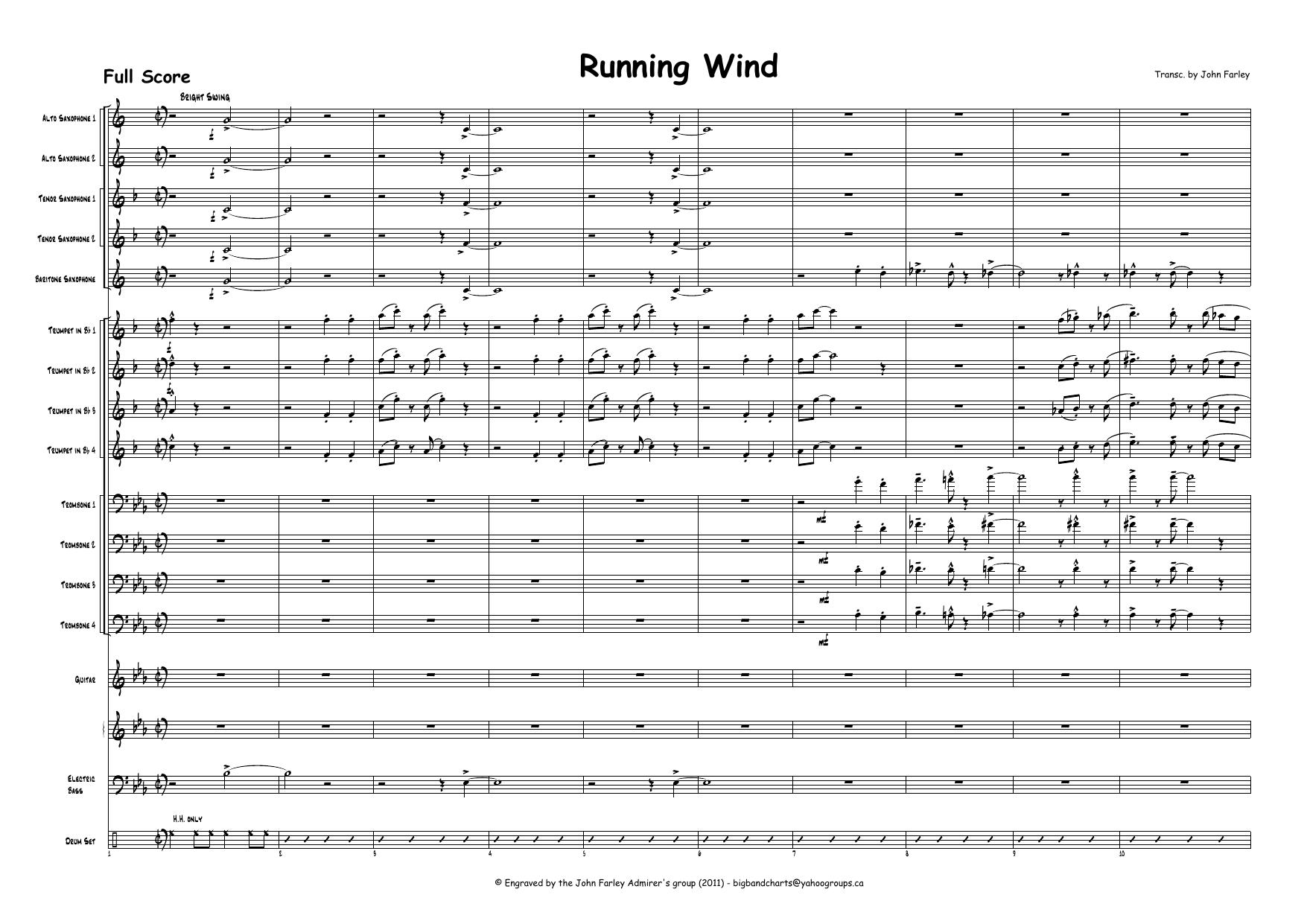
Running Wild (J.Farley)
Composed by Arthur Gibbs
Arranged by John Farley
- Ensemble: Big Band
- Pages: 68
- Instruments (17): Alto Saxophone 1, Alto Saxophone 2, Tenor Saxophone 1, Tenor Saxophone 2, Baritone Saxophone, Trumpet in Bb 1, Trumpet in Bb 2, Trumpet in Bb 3, Trumpet in Bb 4, Trombone 1, Trombone 2, Trombone 3, Trombone 4, Guitar, Piano, Electric Bass, Drum Set
- Difficulty: advanced
- Content: Individual Parts
- Format: PDF Download (Instant)
- Price: $24.99
Arthur Gibbs’s iconic 1922 Tin Pan Alley composition "Running Wild"—famously popularized by Marilyn Monroe in the 1959 film *Some Like It Hot* and canonized across the swing era by legends like Duke Ellington and Benny Goodman—serves as the high-octane foundation for this dynamic big band vehicle. Rooted in the roaring energy of early jazz and roaring twenties syncopation, the tune transitions seamlessly into a powerhouse swing-era chart that bridges the gap between classic Dixieland exuberance and mid-century big band sophistication. Driving forward at a brisk, breathless tempo, John Farley’s arrangement captures an atmosphere of unbridled kinetic energy and mischievous joy. Set in a bright, brass-heavy key that exploits the brilliant upper registers of the trumpet and alto sections, the chart opens with a rhythmic, cascading motif before launching into a relentless four-on-the-floor swing feel. The mood is celebratory, theatrical, and fiercely driving, evoking smoky, packed dance halls of the 1930s while maintaining a crisp, modern crispness in its harmonic vocabulary. Farley’s distinctive arranging approach breathes fresh life into the standard by injecting sophisticated, extended dominant voicings and a tightly woven counterpoint that recalls the clever interplay of the Fletcher Henderson orchestra. Rather than relying on a straightforward head-arrangement model, Farley constructs a magnificent sax soli that glides effortlessly over a cushioned rhythm section, followed by a towering, harmonically adventurous shout chorus. This climactic section utilizes cross-section voicing—interlocking brass and reeds—to build maximum tension before resolving into a roaring, high-energy coda. The melody is initially stated by a unison trumpet and alto saxophone pairing before being tossed playfully across the entire ensemble. Featured blowing changes are provided for lead tenor saxophone and lead trumpet, allowing capable soloists to stretch out over traditional rhythm changes with modern ii-V-I substitutions. Technical demands center primarily on maintaining clean articulation and precise fingerwork at high speeds, particularly in the rapid-fire saxophone lines and high-register trumpet passages. The reward for the ensemble lies in the sheer momentum of the chart; every section has a vital, rhythmic voice that keeps both performers and audiences utterly engaged. Advanced high school ensembles with strong section leaders, collegiate jazz orchestras, and professional community big bands will find this chart to be an exceptional centerpiece for a concert program or festival performance. It demands an ensemble comfortable with stamina-building up-tempo swing, precise dynamic contrast, and stylistic articulation, making it a stellar showcase for a band ready to push its technical and stylistic boundaries. Conductors should approach John Farley’s setting of "Running Wild" with a strict focus on rhythmic precision and lightweight, driving time. The quarter note should feel permanently anchored, preventing the tempo from dragging during complex tutti passages or rushing during high-energy shout choruses. The primary technical challenge lies in the execution of the fast, articulated swing eighth notes in the saxophone and trombone sections; players must utilize crisp tongue-placement ("doo-dat") rather than heavy slurring to maintain clarity at high speeds. Brass players should make judicious use of cup mutes and engineered falls where indicated, ensuring that stylistic effects enhance rather than muddy the texture. Rehearsal should begin by separating the rhythm section to lock in the relentless, conversational swing groove before introducing the horns. Drill the saxophone soli at half-tempo with a metronome, gradually increasing velocity only when absolute unison intonation is achieved across all parts. Q: What instruments and parts are included in this arrangement? A: This complete 17-instrument big band arrangement includes full instrumentation for Alto Saxophone 1 & 2, Tenor Saxophone 1 & 2, Baritone Saxophone, 4 Trumpets, 4 Trombones, Piano, Guitar, Bass, and Drums, alongside a comprehensive 68-page conductor score. Q: What is the difficulty level of this chart? A: This arrangement is graded as advanced, making it ideal for skilled high school jazz bands, collegiate ensembles, and professional community big bands that possess strong technical facility and up-tempo endurance. Q: What is the historical style and context of this piece? A: Based on Arthur Gibbs's 1922 standard popularized during the swing era, this arrangement reimagines early jazz exuberance through the lens of 1930s big band orchestration, heavily influenced by the swinging traditions of Fletcher Henderson and Benny Goodman. Q: What makes John Farley’s arrangement unique compared to other versions of "Running Wild"? A: Farley’s version stands out due to its clever cross-section voicing, an intricate and harmonically rich saxophone soli, and a towering shout chorus that injects modern extended harmonies into a classic prohibition-era melody. Q: What is the approximate performance duration and tempo feel? A: The arrangement runs for approximately 3 to 4 minutes and is designed to be performed at a brisk, driving medium-up swing tempo that demands high energy and precise time-keeping from the rhythm section.
Questions and answers
- What is included in the Running Wild (J.Farley) PDF?
- The verified current file contains a conductor score and individual parts across 68 pages.
- How many instruments or parts are listed for Running Wild (J.Farley)?
- The verified instrumentation list contains 17 entries for this Big Band arrangement.
- Who is credited for Running Wild (J.Farley)?
- Composer: Arthur Gibbs. Arranger: John Farley.
- What difficulty is listed for Running Wild (J.Farley)?
- The verified difficulty level is advanced.
- Can I preview Running Wild (J.Farley) before buying?
- Yes. The product page provides a preview generated from the current PDF file.
- How is Running Wild (J.Farley) delivered?
- After successful payment, the digital PDF is made available for download. The displayed price is $24.99.
Musicians Also Search For
Running Wild John Farley PDF • Running Wild John Farley sheet music • Running Wild arranged by John Farley • John Farley big band charts • John Farley jazz arrangements PDF • Running Wild Arthur Gibbs sheet music • Running Wild Arthur Gibbs big band arrangements • Arthur Gibbs big band charts • Running Wild big band arrangements • Running Wild big band PDF download • Running Wild jazz sheet music • big band sheet music download • Running Wild conductor score PDF • Running Wild individual parts download • Running Wild sheet music PDF • buy Running Wild sheet music • download Running Wild PDF • Running Wild jazz charts • best John Farley big band arrangements • Arthur Gibbs arranged by John Farley • Running Wild printable sheet music • big band repertoire PDF