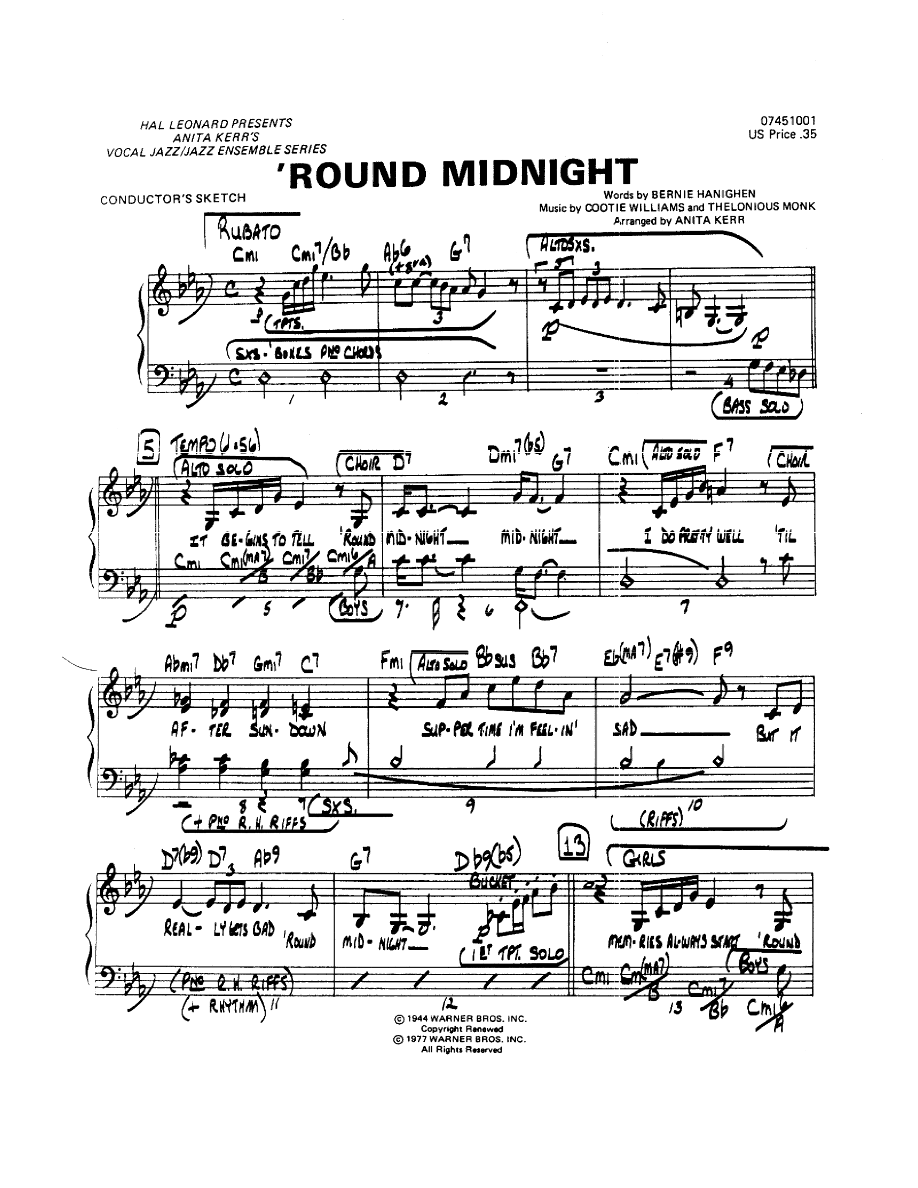
'Round Midnight (T.Monk) sheet music preview

'Round Midnight (T.Monk)

Composed by Thelonious Monk

Arranged by Thelonious Monk (arr.C.Byars)

  • Ensemble: Big Band
  • Pages: 33
  • Instruments (16): Conductor's Sketch, 1st Eb Alto Saxophone, 2nd Eb Alto Saxophone, 1st Bb Tenor Saxophone, 2nd Bb Tenor Saxophone, Eb Baritone Saxophone, 1st Bb Trumpet, 2nd Bb Trumpet, 3rd Bb Trumpet, 1st Trombone, 2nd Trombone, 3rd Trombone, Guitar / Piano, Bass, Drums, Vocal (SATB)
  • Difficulty: medium
  • Content: Individual Parts
  • Format: PDF Download (Instant)
  • Price: $24.99

Composed around 1943 by high priest of bebop pianist Thelonious Monk, "’Round Midnight" stands as the most-recorded jazz standard written by any jazz pianist, immortalized through legendary recordings by Cootie Williams, Miles Davis, and countless others. Representing the birth of modern harmonic exploration out of the late swing era, this haunting masterpiece is anchored by its iconic, descending chromatic minor-second intervals and a deeply melancholic, contemplative atmosphere. Its enduring appeal lies in the delicate tension between its noir-drenched, nocturnal mood and its sophisticated, angular bebop architecture, capturing the quintessential late-night vibe of 1940s Harlem after-hours jam sessions. In this masterful compact big band adaptation crafted by C. Byars, the chart strips away bloated traditional orchestration to focus on an agile eight-instrument ensemble (Alto Saxophone, Tenor Saxophone, Trumpet, Trombone, Piano, Guitar, Bass, and Drums). The tempo is established as a moody, spacious slow ballad feel in 4/4 time, though it requires an inner pulse that breathes with rubato-esque freedom during thematic statements. The arrangement evokes a cinematic, smoke-filled late-night solitude, contrasting dense, dissonant cluster voicings with moments of stark, exposed counterpoint that highlight Monk's signature angularity without sacrificing lush ensemble depth. Byars approaches Monk’s idiosyncratic harmonies with profound respect, utilizing tight horn voicings and clever interval spacing to simulate a full 17-piece big band soundscape using only a fraction of the players. The arrangement features sophisticated chord extensions, subtle chromatic passing tones, and sparse, highly textural background figures that never crowd the soloist. The primary melody is initially introduced with haunting vulnerability by the horns over a sophisticated piano-and-guitar vamp, before opening up into a deeply felt featured solo section for tenor saxophone and piano. Technical challenges center primarily on intonation across the tight chord clusters, maintaining absolute rhythmic cohesion during rubato transitions, and capturing the authentic, unhurried blues-inflected articulation required to bring Monk’s idiom to life. Advanced high school ensembles, collegiate jazz combos with horns, and professional pocket big bands will find this arrangement exceptionally rewarding for festival programs or intimate club settings. Because of its transparent eight-instrument scoring, every player is exposed, demanding high-level listening skills, precise balance, and mature stylistic awareness. Musicians will relish how effectively this chart translates Monk's eccentric piano-centric world into a unified horn-and-rhythm texture, offering a masterclass in modern jazz economy, tension, and release. Executing this arrangement successfully requires a deep commitment to ensemble listening and stylistic restraint. Conductor and bandleaders should establish a sluggish, hypnotic tempo that feels heavy with emotion rather than stagnant; avoid rushing the pickup notes into the primary phrases. The primary technical challenge lies in tuning the dense, minor-second clusters that define Byars's harmonic palette—spend dedicated rehearsal time balancing internal voices so the fundamental root and sharp-elevenths don't overpower the essential triad structures. Rhythm section players must approach the accompaniment with extreme subtlety. The pianist should reference Monk's characteristic sparse, percussive comping style, avoiding over-playing during horn statements, while the bassist provides a deep, anchoring pulse that grounds the chromatic wanderings of the upper voices. Horn players should utilize minimal vibrato, favoring a clean, modern tone with expressive fall-offs and controlled breath support on long sustained notes. Pay close attention to dynamic markings; the contrast between whispered, subterranean pianissimo passages and sudden, stabbing forte accents is what gives this chart its dramatic, noir-inspired narrative arc. Q: What specific instruments and parts are included in this 33-page set? A: This arrangement is scored for an eight-instrument ensemble consisting of Alto Saxophone, Tenor Saxophone, Trumpet, Trombone, Piano, Guitar, Acoustic Bass, and Drum Set, complete with a full conductor's score and individual instrumental parts. Q: What is the overall difficulty level of this arrangement? A: This chart is graded as advanced, primarily suited for collegiate musicians, advanced high school jazz ensembles, and professional pocket big bands due to its intricate harmonic clusters, intonation demands, and requirement for mature stylistic interpretation. Q: What is the historical and stylistic context of this piece? A: Written by bebop pioneer Thelonious Monk in 1943, "’Round Midnight" is the most recorded jazz standard by a jazz composer, and this arrangement honors that legacy by maintaining the nocturnal, blues-drenched atmosphere of the early modern jazz era. Q: What makes this specific arrangement by C. Byars unique? A: Byars successfully captures the rich, expansive sonic footprint of a full 17-piece big band using only eight instruments through brilliant voice-leading, sparse counterpoint, and clever re-harmonizations that preserve Monk's idiosyncratic angularity. Q: What is the performance duration and recommended tempo feel? A: The arrangement performs at approximately 4 to 5 minutes depending on solo extensions, played at a slow, contemplative ballad tempo in 4/4 time that demands a relaxed, breathing swing feel.

Questions and answers

What is included in the 'Round Midnight (T.Monk) PDF?
The verified current file contains a conductor score and individual parts across 33 pages.
How many instruments or parts are listed for 'Round Midnight (T.Monk)?
The verified instrumentation list contains 16 entries for this Big Band arrangement.
Who is credited for 'Round Midnight (T.Monk)?
Composer: Thelonious Monk. Arranger: Thelonious Monk (arr.C.Byars).
What difficulty is listed for 'Round Midnight (T.Monk)?
The verified difficulty level is medium.
Can I preview 'Round Midnight (T.Monk) before buying?
Yes. The product page provides a preview generated from the current PDF file.
How is 'Round Midnight (T.Monk) delivered?
After successful payment, the digital PDF is made available for download. The displayed price is $24.99.

Musicians Also Search For

'Round Midnight Thelonious Monk (arr.C.Byars) PDF'Round Midnight Thelonious Monk (arr.C.Byars) sheet music'Round Midnight arranged by Thelonious Monk (arr.C.Byars)Thelonious Monk (arr.C.Byars) big band chartsThelonious Monk (arr.C.Byars) jazz arrangements PDF'Round Midnight Thelonious Monk sheet music'Round Midnight Thelonious Monk big band arrangementsThelonious Monk big band charts'Round Midnight big band arrangements'Round Midnight big band PDF download'Round Midnight jazz sheet musicbig band sheet music download'Round Midnight conductor score PDF'Round Midnight individual parts download'Round Midnight sheet music PDFbuy 'Round Midnight sheet musicdownload 'Round Midnight PDF'Round Midnight jazz chartsbest Thelonious Monk (arr.C.Byars) big band arrangementsThelonious Monk arranged by Thelonious Monk (arr.C.Byars)'Round Midnight printable sheet musicbig band repertoire PDF

All arrangements by Thelonious Monk (arr.C.Byars) All Thelonious Monk sheet music