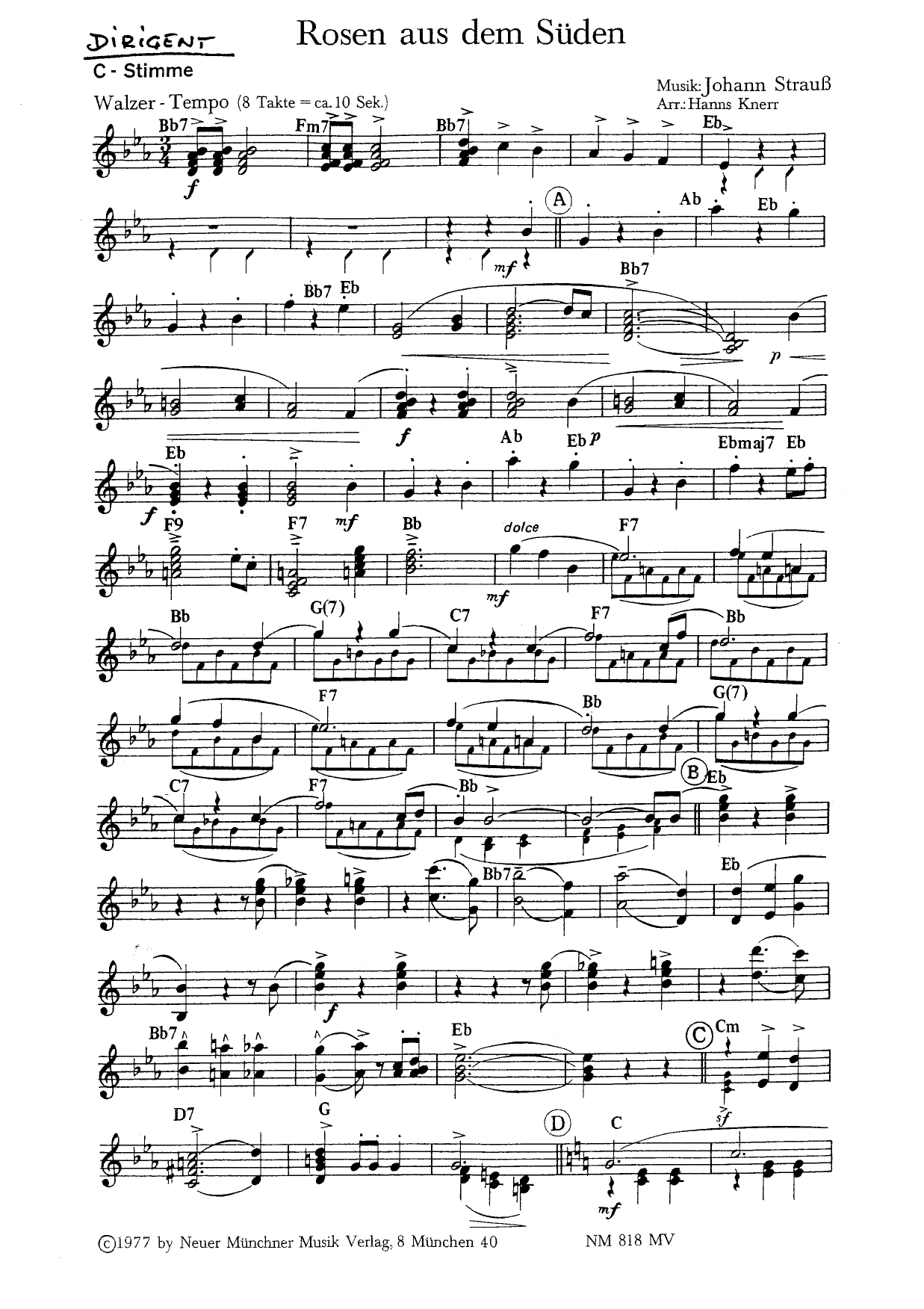
Rosen Aus Dem Suden (H.Knerr)
Composed by Johann Strauss II
Arranged by H.Knerr
- Ensemble: Big Band Dance
- Style: Jazz Standard
- Pages: 32
- Instruments (16): Dirigent C-Stimme, 1. Alt Saxophon in Es, 2. Alt Saxophon in Es, 1. Tenor Saxophon in B, 2. Tenor Saxophon in B, Bariton Saxophon in Es, 1. Trompete in B, 2. Trompete in B, 3. Trompete in B, 1. Posaune, 2. Posaune, 3. Posaune, Piano, Gitarre, Baß, Schlagzeug
- Difficulty: medium
- Content: Individual Parts
- Format: PDF Download (Instant)
- Price: $24.99
Johann Strauss II’s beloved 1888 Viennese waltz *Rosen aus dem Süden* (Roses from the South), Op. 388, undergoes a brilliant transatlantic metamorphosis in this sophisticated big band dance arrangement by H.Knerr. Originally conceived for the opulent ballrooms of late-19th-century Vienna and immortalized by the Vienna Philharmonic, Strauss’s iconic melodies are brilliantly re-imagined through the lens of classic jazz and dance orchestra idioms. This chart bridges the elegance of European romanticism with the infectious swing and harmonic sophistication of the mid-century big band tradition, transforming a pillar of classical repertoire into a genuinely unique jazz standard-style performance piece. H.Knerr’s treatment brilliantly balances the tripartite waltz-derived phrasing of the original themes with a sophisticated dance orchestra groove. While maintaining the buoyant, sweeping momentum characteristic of Strauss’s writing, the arrangement infuses the score with rich extended harmonies, clever countermelodies, and dynamic section interplay. The mood shifts fluidly from lush, romantic nostalgia to high-energy swing, evoking the sophisticated atmosphere of a grand 1930s hotel ballroom or a polished radio broadcast stage. The brass and reed voicings utilize classic closed-position harmonies that give the ensemble a warm, vintage acoustic profile while leaving ample room for modern rhythmic vitality. Throughout the 32-page score, the melodic weight is shared democratically across the ensemble. The saxophones introduce several of Strauss’s most memorable motifs with lush, rubato-leaning phrasing before settling into crisp, rhythmic backgrounds. Brass sections answer with punchy, articulated figures, driving the momentum forward into exhilarating ensemble shout choruses. Technical demands center primarily on stylistic versatility; players must seamlessly pivot between executing legato, classically-inflected lines and sharp, swinging articulations. The inclusion of subtle dynamic shifts and clever tempo pacing ensures that performers remain deeply engaged, while audiences will immediately recognize the masterwork's DNA filtered through a fresh, swinging sonic palette. Advanced high school, collegiate, and professional community jazz orchestras will find this arrangement an ideal vehicle for showcasing section blend, stylistic breadth, and nuanced dynamic control. Because it avoids overly frantic tempos in favor of graceful, swinging momentum, it serves as an exceptional showcase piece for concert programs that seek to bridge the classical and jazz worlds. It offers an engaging educational opportunity for students to explore cross-genre adaptation while delivering a guaranteed crowd-pleaser for sophisticated concert audiences. Conductors approaching *Rosen aus dem Süden* must prioritize stylistic flexibility, as the success of the chart hinges on the ensemble's ability to transition between traditional European lilt and American jazz swing. Establish a confident, danceable tempo that honors the waltz-time origins while allowing the rhythm section to propel the swing feel naturally. The rhythm section should avoid heavy-handed block chords; instead, the pianist and guitarist should lean into lighter, transparent voicings that mimic early-to-mid jazz orchestration styles. Horn players must pay close attention to articulation markings, ensuring that legato phrases do not blur into one another and that accented notes pop with clarity. Balance is critical during the transitional modal shifts—ensure the counterlines in the tenor and baritone saxophones do not overpower the primary melody carried by the lead alto and trumpets. Rehearsal should begin by isolating the transitional interludes, ensuring the ensemble breathes together during rubato-esque pull-backs before snapping back into strict time. Q: What instruments and parts are included in this arrangement? A: The 32-page score supports a standard 15-instrument big band instrumentation, featuring Alto Saxophone 1, Alto Saxophone 2, Tenor Saxophone 1, Tenor Saxophone 2, and Baritone Saxophone, alongside the full brass and rhythm sections, plus a comprehensive conductor score. Q: What is the difficulty level of H.Knerr's arrangement? A: This chart is best suited for advanced high school, collegiate, and professional community big bands due to its subtle stylistic demands, intricate section interplay, and the requirement to balance classical phrasing with jazz articulation. Q: What is the historical context of this specific piece? A: It adapts Johann Strauss II’s 1888 classical masterpiece *Rosen aus dem Süden*, filtering the iconic Viennese waltz traditions through the creative lens of mid-century jazz and dance orchestra arranging. Q: What makes this particular arrangement unique? A: H.Knerr successfully bridges European romanticism and swing-era jazz by transforming traditional waltz themes into sophisticated dance orchestra charts complete with extended harmonies and dynamic shout choruses. Q: What is the performance duration and tempo feel of the piece? A: The arrangement generally runs between 4 to 5 minutes, maintaining a buoyant, dance-oriented tempo feel that gracefully balances swinging grooves with lyrical, sweeping phrasing.
Questions and answers
- What is included in the Rosen Aus Dem Suden (H.Knerr) PDF?
- The verified current file contains individual parts across 32 pages.
- How many instruments or parts are listed for Rosen Aus Dem Suden (H.Knerr)?
- The verified instrumentation list contains 16 entries for this Big Band Dance arrangement.
- Who is credited for Rosen Aus Dem Suden (H.Knerr)?
- Composer: Johann Strauss II. Arranger: H.Knerr.
- What difficulty is listed for Rosen Aus Dem Suden (H.Knerr)?
- The verified difficulty level is medium.
- What style is listed for Rosen Aus Dem Suden (H.Knerr)?
- The catalog lists the style as Jazz Standard.
- Can I preview Rosen Aus Dem Suden (H.Knerr) before buying?
- Yes. The product page provides a preview generated from the current PDF file.
- How is Rosen Aus Dem Suden (H.Knerr) delivered?
- After successful payment, the digital PDF is made available for download. The displayed price is $24.99.
Musicians Also Search For
Rosen Aus Dem Suden H.Knerr PDF • Rosen Aus Dem Suden H.Knerr sheet music • Rosen Aus Dem Suden arranged by H.Knerr • H.Knerr big band dance charts • H.Knerr jazz arrangements PDF • Rosen Aus Dem Suden Johann Strauss II sheet music • Rosen Aus Dem Suden Johann Strauss II big band dance arrangements • Johann Strauss II big band dance charts • Rosen Aus Dem Suden big band dance arrangements • Rosen Aus Dem Suden big band dance PDF download • Rosen Aus Dem Suden jazz sheet music • big band dance sheet music download • Rosen Aus Dem Suden individual parts download • Rosen Aus Dem Suden sheet music PDF • Rosen Aus Dem Suden Jazz Standard charts • Jazz Standard big band dance arrangements • buy Rosen Aus Dem Suden sheet music • download Rosen Aus Dem Suden PDF • Rosen Aus Dem Suden jazz charts • best H.Knerr big band dance arrangements • Johann Strauss II arranged by H.Knerr • Rosen Aus Dem Suden printable sheet music • big band dance repertoire PDF