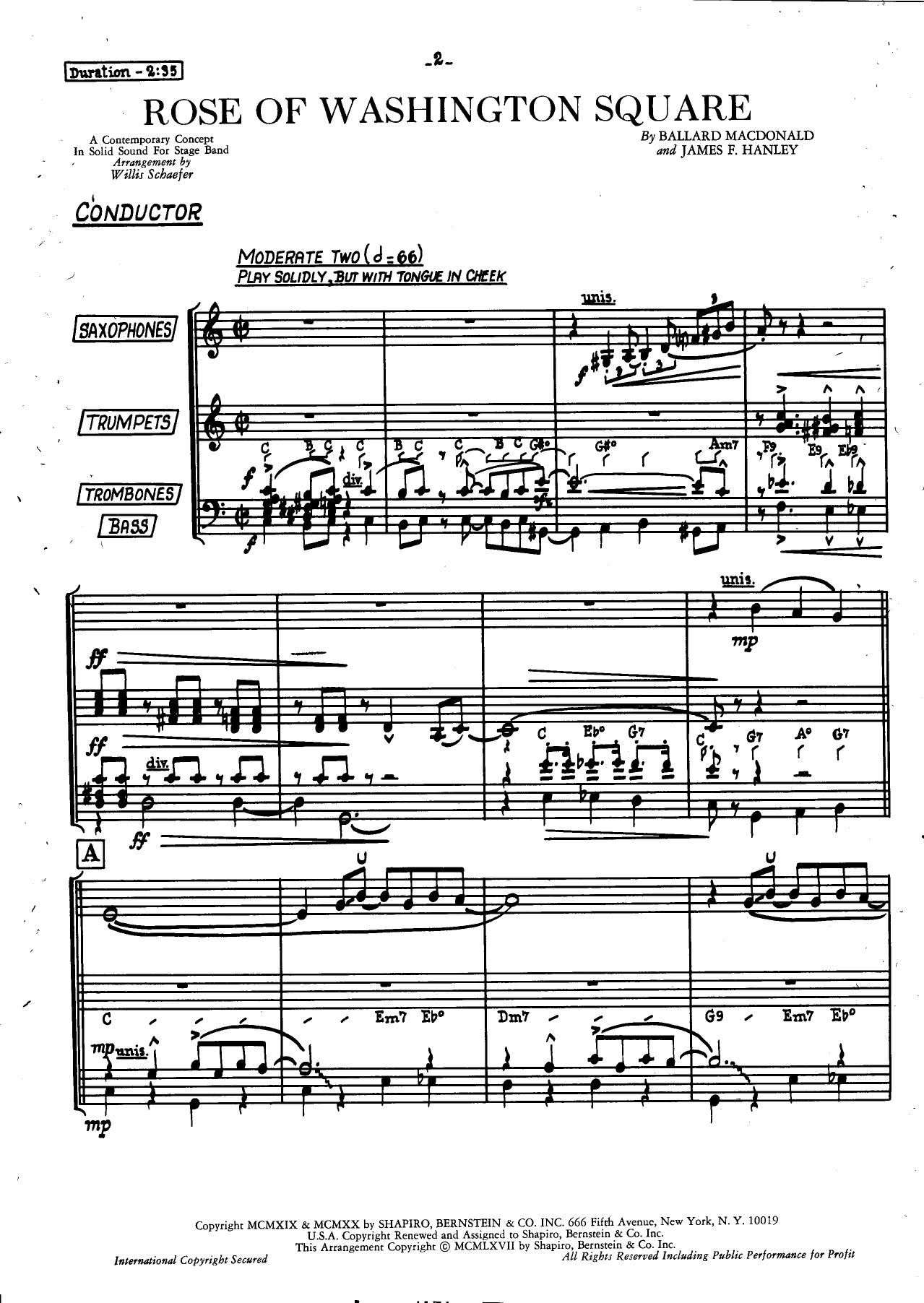
Rose Of Washington Square (W.Schaefer) sheet music preview

Rose Of Washington Square (W.Schaefer)

Composed by George W. Meyer

Arranged by W.Schaefer

  • Ensemble: Big Band
  • Style: Jazz Standard
  • Pages: 41
  • Instruments (17): Conductor, 1st Eb Alto Saxophone, 3rd Eb Alto Saxophone, 2nd Bb Tenor Saxophone, 4th Bb Tenor Saxophone, 5th Eb Baritone Saxophone, 1st Bb Trumpet, 2nd Bb Trumpet, 3rd Bb Trumpet, 4th Bb Trumpet, 1st Trombone, 2nd Trombone, 3rd Trombone, 4th Trombone, Piano, Bass (String) (or Fender), Drums
  • Difficulty: advanced
  • Content: Individual Parts
  • Format: PDF Download (Instant)
  • Price: $24.99

Composed originally in 1919 by George W. Meyer with lyrics by Ballard MacDonald, "Rose of Washington Square" emerged from the heart of Tin Pan Alley and quickly transcended its Broadway origins to become a staple of early jazz and swing repertoire. Immortalized by legendary interpreters like Fanny Brice and later adopted by traditional jazz revivalists and swing orchestras, the tune captures the bittersweet, theatrical nostalgia of New York’s Lower East Side bohemian culture. Its enduring melodic contour and inherent harmonic flexibility make it a prime vehicle for big band exploration, bridging late-Victorian parlor song sensibilities with the syncopated vitality of the jazz age. W.Schaefer’s masterful big band arrangement breathes new life into this classic, anchoring it firmly in a vibrant medium-swing feel driven by a infectious walking bassline and crisp, understated cymbal work. The harmonic landscape balances nostalgic, vintage diatonicism with sophisticated secondary dominants and lush extended voicings in the brass, evoking a late-night subterranean speakeasy atmosphere. The emotional trajectory shifts seamlessly from smoky, introspective melancholy in the muted brass verses to an exuberant, high-energy tutti shout chorus that showcases the full dynamic and tonal spectrum of the modern jazz orchestra. Schaefer constructs the arrangement with meticulous attention to instrumental color, utilizing rich saxophone soli passages to carry the primary thematic material while the brass provide punchy, conversational counter-melodies. The writing features dynamic contrast as a core structural element, moving gracefully from delicate, whispered reed textures to roaring, brass-heavy climaxes without ever losing its period authenticity. Featured solo space allows improvisers to stretch out over traditional changes, while tightly integrated ensemble figures demand crisp articulation, excellent section blending, and an innate sense of early swing phrasing. Advanced high school ensembles, collegiate jazz orchestras, and professional community big bands will find this chart to be an exceptionally rewarding addition to their repertoire. While the technical demands on individual players are accessible to proficient students, the true challenge and educational value lie in achieving stylistic cohesion, stylistic swing subdivision, and nuanced balance across all 16 instruments. Conductor and ensemble alike will relish the opportunity to deliver a performance that honors the historical roots of early jazz while capitalizing on the sophisticated punch of Schaefer’s contemporary big band architecture. Success with W.Schaefer’s arrangement of "Rose of Washington Square" hinges on achieving an authentic, relaxed medium-swing feel anchored by the rhythm section. Avoid rushing; the tempo should maintain a confident strut rather than a frantic dash. The saxophone section must prioritize a warm, blended tone during the soli passages, using light vibrato that nods to the late-swing era without sounding dated. Brass players should make ample use of cup and harmon mutes where indicated in the opening choruses to capture that smoky, intimate period aesthetic, transitioning to open, resonant tones with controlled vibrato for the climactic shout chorus. Pay close attention to dynamic markings; the contrast between the understated, rhythmic background figures and the roaring ensemble swells is what gives this chart its dramatic arc. Rehearsals should initially isolate the rhythm section to lock in the underlying groove before layering in the horn sections, ensuring that articulation (specifically the placement of accented syncopations on the upbeat) remains uniform across all chairs. Q: What instruments and parts are included in this arrangement? A: The complete 69-page package is scored for a 16-instrument big band lineup, featuring Alto Saxophone 1, Alto Saxophone 3, Tenor Saxophone 2, Tenor Saxophone 4, Baritone Saxophone 5, alongside standard brass and rhythm sections, and includes a comprehensive full conductor score. Q: What is the difficulty level of this chart? A: This arrangement is well-suited for advanced high school, collegiate, and professional community big bands, offering manageable technical passages for individual players while demanding high-level ensemble listening, blend, and stylistic swing articulation. Q: What is the historical style and context of this piece? A: Based on George W. Meyer’s 1919 Tin Pan Alley classic, this arrangement reimagines the tune through a classic medium-swing jazz lens, capturing the nostalgic, theatrical mood of the early jazz era with a sophisticated modern orchestration. Q: What makes W.Schaefer’s arrangement unique? A: Schaefer distinctively balances smoky, muted brass textures and intimate saxophone solis with a roaring, high-energy shout chorus, combining vintage melodic charm with rich, extended big band harmonies. Q: What is the recommended performance tempo and duration? A: The arrangement is set in a comfortable medium-swing tempo (approximately 116–124 BPM) in 4/4 time, resulting in a performance duration of roughly 3 to 4 minutes depending on the length of improvised solos.

Questions and answers

What is included in the Rose Of Washington Square (W.Schaefer) PDF?
The verified current file contains a conductor score and individual parts across 41 pages.
How many instruments or parts are listed for Rose Of Washington Square (W.Schaefer)?
The verified instrumentation list contains 17 entries for this Big Band arrangement.
Who is credited for Rose Of Washington Square (W.Schaefer)?
Composer: George W. Meyer. Arranger: W.Schaefer.
What difficulty is listed for Rose Of Washington Square (W.Schaefer)?
The verified difficulty level is advanced.
What style is listed for Rose Of Washington Square (W.Schaefer)?
The catalog lists the style as Jazz Standard.
Can I preview Rose Of Washington Square (W.Schaefer) before buying?
Yes. The product page provides a preview generated from the current PDF file.
How is Rose Of Washington Square (W.Schaefer) delivered?
After successful payment, the digital PDF is made available for download. The displayed price is $24.99.

Musicians Also Search For

Rose Of Washington Square W.Schaefer PDFRose Of Washington Square W.Schaefer sheet musicRose Of Washington Square arranged by W.SchaeferW.Schaefer big band chartsW.Schaefer jazz arrangements PDFRose Of Washington Square George W. Meyer sheet musicRose Of Washington Square George W. Meyer big band arrangementsGeorge W. Meyer big band chartsRose Of Washington Square big band arrangementsRose Of Washington Square big band PDF downloadRose Of Washington Square jazz sheet musicbig band sheet music downloadRose Of Washington Square conductor score PDFRose Of Washington Square individual parts downloadRose Of Washington Square sheet music PDFRose Of Washington Square Jazz Standard chartsJazz Standard big band arrangementsbuy Rose Of Washington Square sheet musicdownload Rose Of Washington Square PDFRose Of Washington Square jazz chartsbest W.Schaefer big band arrangementsGeorge W. Meyer arranged by W.SchaeferRose Of Washington Square printable sheet musicbig band repertoire PDF

All arrangements by W.Schaefer All George W. Meyer sheet music