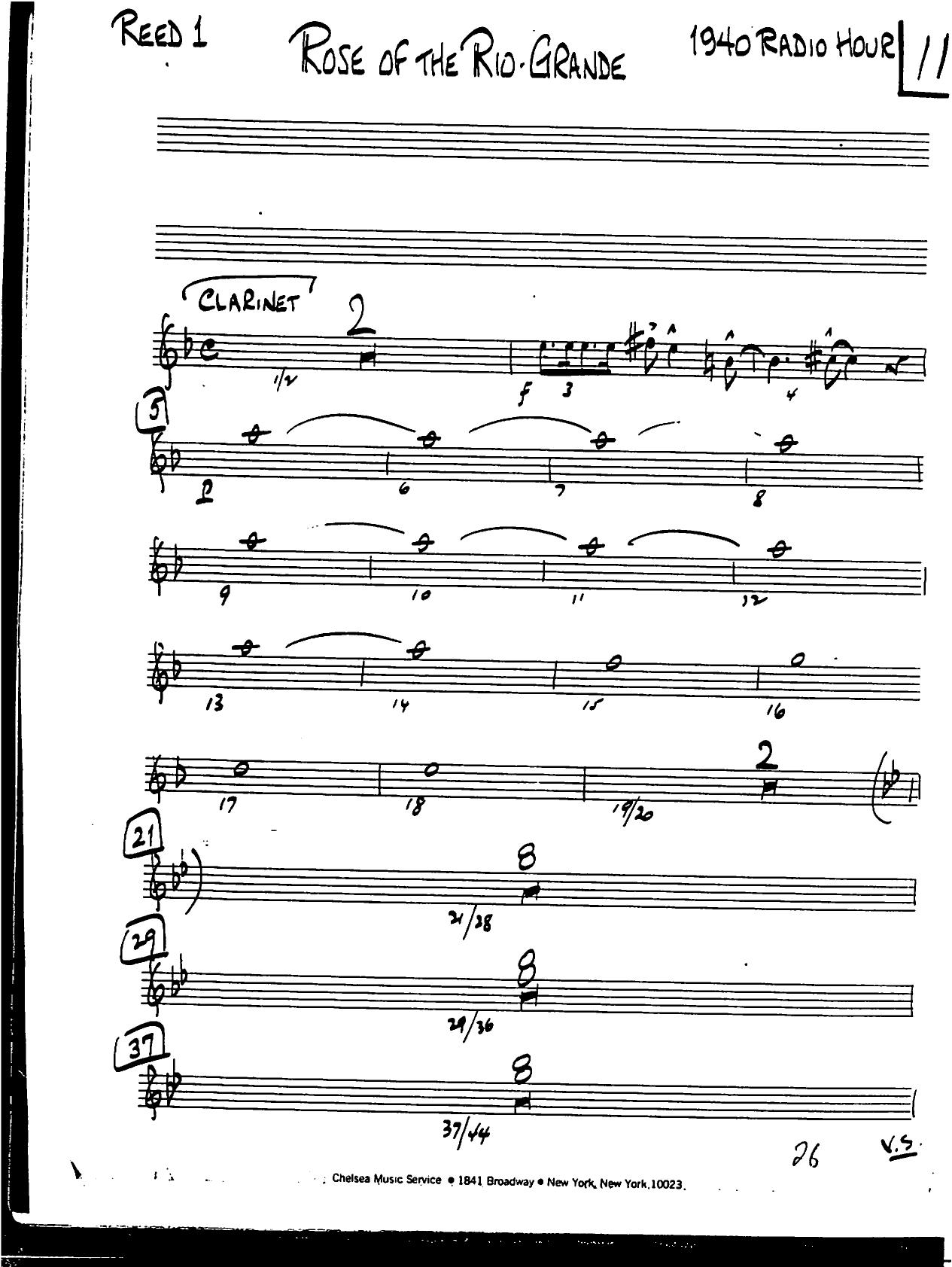
Rose Of The Rio Grande
Composed by Harry Warren
Arranged by George Van Leaman
- Ensemble: Big Band
- Style: Jazz Standard
- Pages: 62
- Instruments (17): Reed 1 (Clarinet), Reed 2 (Alto Saxophone, Clarinet), Reed 3 (Clarinet), Reed 4 (Tenor Saxophone, Clarinet), Reed 5 (Baritone Saxophone, Clarinet), Trumpet 1, Trumpet 2, Trumpet 3, Trumpet 4, Trombone 1, Trombone 2, Trombone 3, Drums, Bass, Guitar, Piano-Conductor, Vocal
- Difficulty: advanced
- Content: Individual Parts
- Format: PDF Download (Instant)
- Price: $24.99
Harry Warren’s timeless melody "Rose of the Rio Grande," penned originally with lyricist Edgar Leslie and standard-bearer Al Dubin in 1922, occupies a fascinating transitional space between early Tin Pan Alley songcraft and the sophisticated harmonic palette of the mid-century swing era. While initially conceived as a romantic, exoticized ballad of the American Southwest, the tune found its true footing in the jazz canon when adopted by luminaries like Duke Ellington, Count Basie, and later, master interpreters of the Great American Songbook. Its intrinsic structural malleability—resting upon a haunting, minor-tinged verse and a sweeping, cinematic chorus—made it an ideal vehicle for jazz arrangers seeking to inject atmospheric texture, textural contrast, and rich developmental potential into a standard big band format. Rooted in a sultry, medium-tempo Latin-swing hybrid feel, this arrangement treats the ensemble to an evocative blend of simmering grooves and lush, impressionistic harmonies. The mood shifts effortlessly from mysterious, whispered nocturnal tension to soaring, brass-heavy warmth, evoking the wide-open expanses and romanticized mystique of its namesake region. The key centers are handled with subtle sophistication, utilizing chromatic passing chords and deceptive cadences that give the harmony a distinctly modern bite while respecting the vintage integrity of Warren's original 1920s architecture. The structural blueprint of the chart showcases a masterclass in dynamic contrast and section interplay. The opening statement of the theme is carried predominantly by the reed section, with the clarinet taking an authentic, featured role that harks back to early-swing orchestration, underscored by muted brass cushions and a subtle, undulating rhythm section vamp. As the chart builds, the arranger deploys rich sax solis that weave dense, interlocking counterlines beneath the lead alto, utilizing upper-structure triads to color the familiar changes. The climax erupts into a meticulously crafted shout chorus, where the full 15-piece ensemble unleashes tightly voiced, harmonically adventurous block chords that balance aggressive brass power with shimmering reed upper extensions. Featured solo space allows a designated horn player to stretch out over standard changes that invite both lyrical phrasing and blues-inflected exploration. Advanced high school ensembles with strong section players, as well as collegiate and professional community jazz orchestras, will find this 62-page manuscript an exceptionally rewarding addition to their library. The chart requires refined intonation, disciplined balance within the reed choir, and a mature sense of stylistic restraint, particularly during the more delicate, atmospheric passages. Directors looking to program a sophisticated, historically resonant standard that breaks away from standard up-tempo swappers will discover that this arrangement offers substantial artistic depth and guaranteed audience engagement. The primary technical challenge in executing "Rose of the Rio Grande" lies in maintaining a consistent, relaxed momentum through the hybrid Latin-swing feels without rushing the tempo. Conductors should establish a crisp, unhurried groove where the underlying percussion or ride cymbal drives the tune subtly rather than aggressively. Brass players will encounter frequent requirements for cup and straight mutes; ensure section uniformity in mute brands where possible to preserve a unified timbre during the sultry ensemble passages. The saxophone section must pay close attention to dynamic balance during the soli sections, ensuring that the inner voices do not mask the lead alto's articulation and phrasing. Rehearsals should initially isolate the rubato-leaning transitions between major structural sections, ensuring the ensemble breathes together during tempo shifts and modulations. Pay meticulous attention to the subtle dynamic swells marked throughout the shout chorus; overblowing these passages will muddy the advanced harmonic extensions and obscure the counterpoint. Q: What instruments and parts are included in this arrangement? A: The 15-instrument orchestration features a standard big band lineup including Clarinet, Alto Saxophone, Tenor Saxophone, Baritone Saxophone, multiple Trumpet parts (starting with Trumpet 1), trombone voices, and a full rhythm section. A comprehensive 62-page conductor score is also included to facilitate complete oversight during rehearsals. Q: What is the difficulty level of this arrangement? A: This chart is best suited for advanced high school, collegiate, and professional community big bands. It requires strong section playing, precise intonation on sophisticated harmonic extensions, and a mature command of stylistic dynamic contrast. Q: What is the historical style and context of the piece? A: Originating as a 1922 composition by Harry Warren, this piece is treated here as a sophisticated jazz standard. The arrangement bridges early-era exoticized Tin Pan Alley charm with the rich, textured harmonic approaches popularized by mid-century swing orchestras. Q: What makes this specific arrangement unique? A: It stands out through its authentic inclusion of a featured clarinet voice, a sultry Latin-swing groove, and a masterfully crafted shout chorus that utilizes upper-structure triads and dense block-voicing techniques to reinterpret a classic melody. Q: What is the recommended performance tempo and duration? A: The arrangement is designed for a sultry, medium-tempo groove that typically yields a performance duration of approximately 4 to 5 minutes, depending on the length of the improvised solo sections.
Questions and answers
- What is included in the Rose Of The Rio Grande PDF?
- The verified current file contains a conductor score and individual parts across 62 pages.
- How many instruments or parts are listed for Rose Of The Rio Grande?
- The verified instrumentation list contains 17 entries for this Big Band arrangement.
- Who is credited for Rose Of The Rio Grande?
- Composer: Harry Warren. Arranger: George Van Leaman.
- What difficulty is listed for Rose Of The Rio Grande?
- The verified difficulty level is advanced.
- What style is listed for Rose Of The Rio Grande?
- The catalog lists the style as Jazz Standard.
- Can I preview Rose Of The Rio Grande before buying?
- Yes. The product page provides a preview generated from the current PDF file.
- How is Rose Of The Rio Grande delivered?
- After successful payment, the digital PDF is made available for download. The displayed price is $24.99.
Musicians Also Search For
Rose Of The Rio Grande George Van Leaman PDF • Rose Of The Rio Grande George Van Leaman sheet music • Rose Of The Rio Grande arranged by George Van Leaman • George Van Leaman big band charts • George Van Leaman jazz arrangements PDF • Rose Of The Rio Grande Harry Warren sheet music • Rose Of The Rio Grande Harry Warren big band arrangements • Harry Warren big band charts • Rose Of The Rio Grande big band arrangements • Rose Of The Rio Grande big band PDF download • Rose Of The Rio Grande jazz sheet music • big band sheet music download • Rose Of The Rio Grande conductor score PDF • Rose Of The Rio Grande individual parts download • Rose Of The Rio Grande sheet music PDF • Rose Of The Rio Grande Jazz Standard charts • Jazz Standard big band arrangements • buy Rose Of The Rio Grande sheet music • download Rose Of The Rio Grande PDF • Rose Of The Rio Grande jazz charts • best George Van Leaman big band arrangements • Harry Warren arranged by George Van Leaman • Rose Of The Rio Grande printable sheet music • big band repertoire PDF