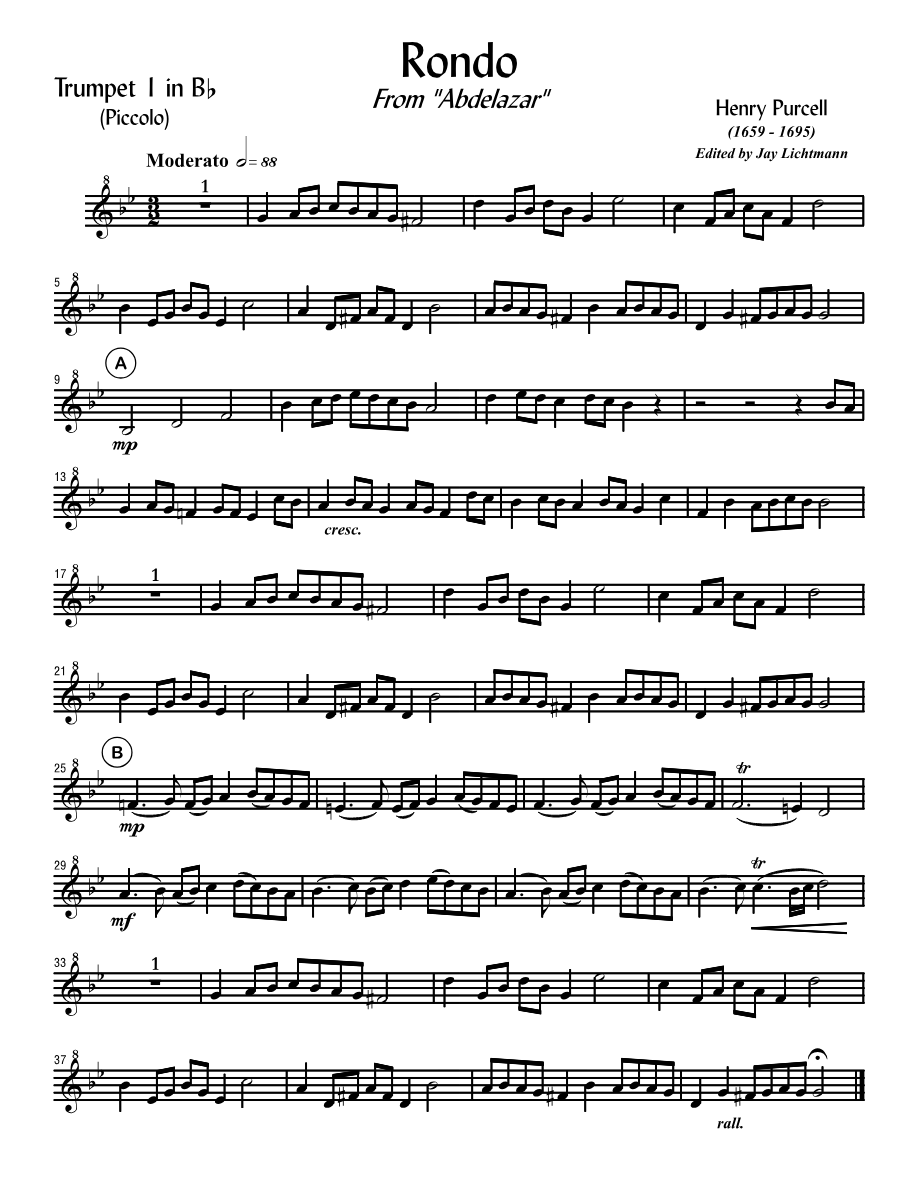
Rondo sheet music preview

Rondo

Composed by Traditional

Arranged by Jay Lichtmann

  • Ensemble: Small Ensemble
  • Style: Traditional
  • Pages: 5
  • Instruments (5): Trumpet 1 in Bb (Piccolo), Trumpet 2 in Bb, Trumpet 3 in Bb, Trumpet 4 in Bb, Trumpet 2 in Eb
  • Difficulty: easy
  • Content: Individual Parts
  • Format: PDF Download (Instant)
  • Price: $12.99

The traditional melody known as "Rondo" has resonated through various cultural and musical landscapes for centuries, its origins often traced back to European folk traditions and classical forms. While not a jazz standard in the conventional sense, its inherent melodicism and cyclical structure have made it a fertile ground for jazz interpretation, particularly within the traditional jazz and early swing eras. This particular arrangement reimagines the timeless "Rondo" theme through a classic small ensemble lens, evoking the lively, communal spirit of early 20th-century jazz. It captures the essence of a bygone era where improvisation and collective interplay were paramount, making it an excellent choice for ensembles seeking to explore the foundational elements of jazz. This arrangement establishes a bright, medium-up swing feel from the outset, set firmly in the key of C Major. The mood is unequivocally ebullient and infectious, designed to get feet tapping and spirits soaring. The energy is consistently high, driven by a buoyant rhythm section and spirited horn lines. The arrangement opens with a full ensemble statement of the main theme, immediately establishing its traditional jazz character with clear, unadorned voicings that prioritize melodic clarity and rhythmic precision. The subsequent sections feature a blend of ensemble passages and opportunities for soloists, maintaining a dynamic flow that keeps both performers and listeners engaged. The Unknown Arranger's approach to "Rondo" is characterized by a deep respect for the traditional source material while infusing it with authentic jazz sensibilities. Rather than relying on complex harmonic substitutions, the arrangement focuses on rhythmic drive, call-and-response patterns, and clear melodic development. The voicings are intentionally transparent, allowing each instrument's voice to be heard within the collective texture, a hallmark of small ensemble traditional jazz. There are well-placed soli sections that showcase the interplay between the front-line instruments, often featuring harmonized melodic fragments that build excitement. While there isn't a specific "shout chorus" in the big band sense, the climactic ensemble passages achieve a similar effect through rhythmic unison and dynamic intensity. The arrangement does not feature dramatic modulations, instead relying on rhythmic variation and solo improvisation to provide contrast. Performance of "Rondo" is a rewarding experience for a small ensemble. The melody is primarily carried by the lead trumpet or clarinet, often doubled or harmonized by other horns. There are designated solo sections, typically over the AABA form of the main theme, providing ample space for improvisation for trumpet, clarinet, and trombone. Technical challenges include maintaining a consistent, driving swing feel, precise articulation in the ensemble passages, and navigating the sometimes intricate melodic lines with clarity. The piece is particularly suitable for high school and community college jazz ensembles looking to develop their traditional jazz vocabulary, as well as for professional groups seeking an authentic and spirited addition to their repertoire. Its relatively straightforward harmonic structure makes it accessible, while its rhythmic demands offer a satisfying challenge. The collective improvisation feel and the joyous character of the piece make it a standout musical moment. "Rondo" requires a consistent, driving medium-up swing feel throughout. Emphasize a light, buoyant quarter note in the rhythm section, avoiding a heavy or plodding pulse. Articulation is key: encourage crisp, short notes in the ensemble figures to maintain clarity and energy, especially in the soli sections. Horn players should focus on precise rhythmic unison and blend, particularly when doubling melodic lines. For soloists, encourage improvisation rooted in the traditional jazz idiom, focusing on melodic invention and rhythmic phrasing over complex harmonic alterations. The harmony is diatonic and accessible. The arrangement does not require special techniques like plunger mutes or doits, but expressive vibrato and nuanced dynamics will enhance the authentic traditional jazz sound. Rehearsal should focus on solidifying the swing feel, achieving tight ensemble articulation, and developing confident, stylistically appropriate soloists. Pay close attention to dynamic contrasts to build excitement. Q: What instruments/parts are included in this "Rondo" arrangement? A: This small ensemble arrangement typically includes parts for Trumpet, Clarinet, Trombone, Piano, Bass, and Drums, providing a classic traditional jazz lineup. Q: What is the difficulty level of this arrangement of "Rondo"? A: This arrangement is rated as Intermediate. It offers accessible harmonic structures suitable for developing musicians but requires solid rhythmic precision and stylistic understanding for an authentic performance. Q: What musical style and historical context does this arrangement represent? A: This arrangement of "Rondo" is in the Traditional Jazz style, evoking the lively and communal spirit of early 20th-century jazz, focusing on melodic clarity and a bright swing feel. Q: What makes this specific arrangement of "Rondo" unique? A: The Unknown Arranger's treatment is unique for its authentic traditional jazz voicings, clear melodic presentation, and well-structured opportunities for improvisation within a classic small ensemble format, honoring the original melody while infusing it with jazz character. Q: What is the typical performance duration and tempo for this piece? A: "Rondo" is designed for a medium-up swing tempo, typically around 160-180 BPM, resulting in a performance duration of approximately 3-4 minutes, depending on the number and length of improvised solos.

Questions and answers

What is included in the Rondo PDF?
The verified current file contains individual parts across 5 pages.
How many instruments or parts are listed for Rondo?
The verified instrumentation list contains 5 entries for this Small Ensemble arrangement.
Who is credited for Rondo?
Composer: Traditional. Arranger: Jay Lichtmann.
What difficulty is listed for Rondo?
The verified difficulty level is easy.
What style is listed for Rondo?
The catalog lists the style as Traditional.
Can I preview Rondo before buying?
Yes. The product page provides a preview generated from the current PDF file.
How is Rondo delivered?
After successful payment, the digital PDF is made available for download. The displayed price is $12.99.

Musicians Also Search For

Rondo Jay Lichtmann PDFRondo Jay Lichtmann sheet musicRondo arranged by Jay LichtmannJay Lichtmann small ensemble chartsJay Lichtmann jazz arrangements PDFRondo Traditional sheet musicRondo Traditional small ensemble arrangementsTraditional small ensemble chartsRondo small ensemble arrangementsRondo small ensemble PDF downloadRondo jazz sheet musicsmall ensemble sheet music downloadRondo individual parts downloadRondo sheet music PDFRondo Traditional chartsTraditional small ensemble arrangementsbuy Rondo sheet musicdownload Rondo PDFRondo jazz chartsbest Jay Lichtmann small ensemble arrangementsTraditional arranged by Jay LichtmannRondo printable sheet musicsmall ensemble repertoire PDF

All arrangements by Jay Lichtmann All Traditional sheet music