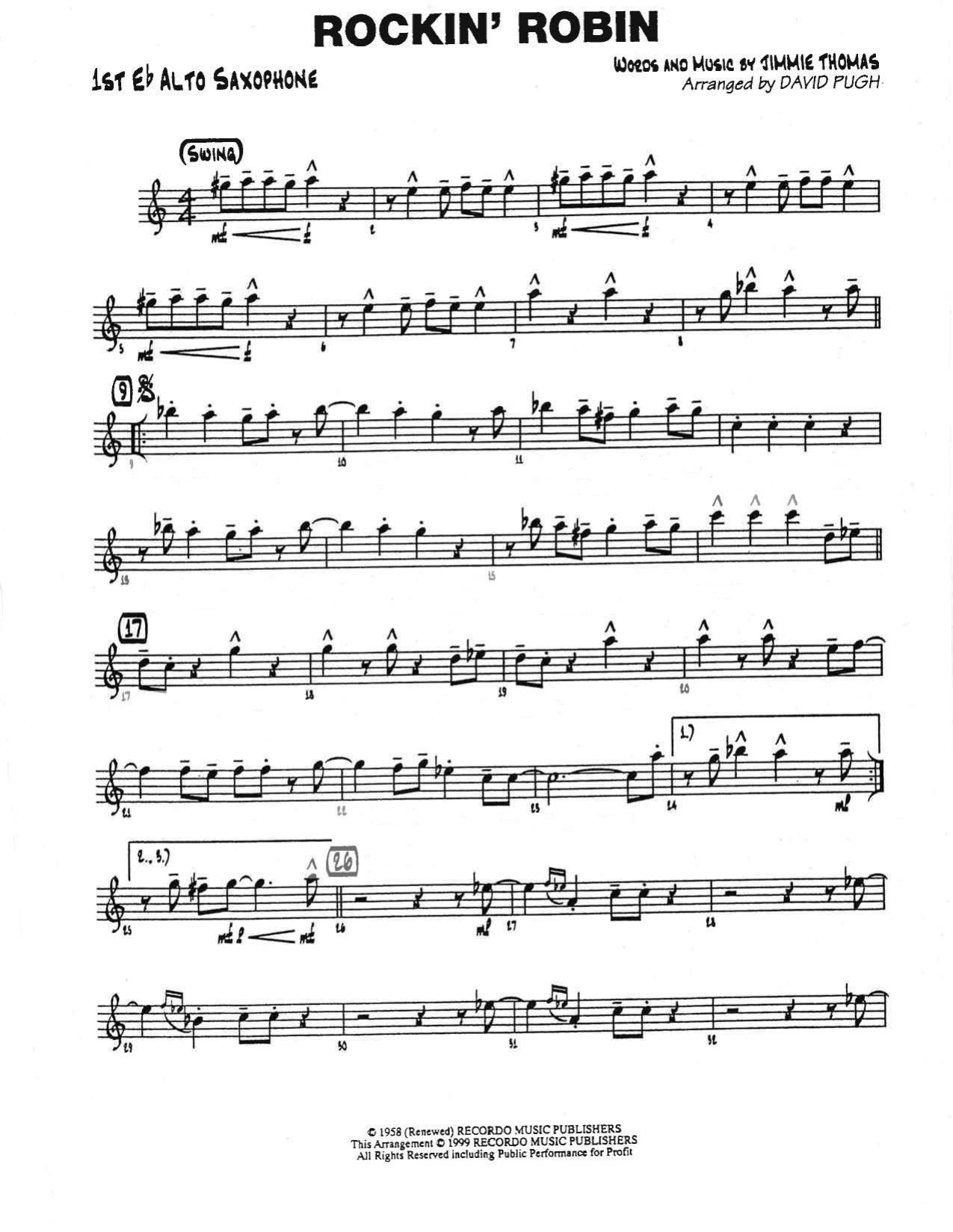
Rockin' Robin (D.Pugh)
Composed by Leon René
Arranged by D.Pugh
- Ensemble: Big Band
- Style: Jazz Standard
- Pages: 33
- Instruments (16): 1st Eb Alto Saxophone, 2nd Eb Alto Saxophone, 1st Bb Tenor Saxophone, 2nd Bb Tenor Saxophone, Eb Baritone Saxophone, 1st Bb Trumpet, 2nd Bb Trumpet, 3rd Bb Trumpet, 4th Bb Trumpet, 1st Trombone, 2nd Trombone, 3rd Trombone, 4th Trombone, Piano, Guitar, Drums
- Difficulty: medium
- Content: Individual Parts
- Format: PDF Download (Instant)
- Price: $24.99
Leon René originally penned "Rockin' Robin" in 1958 under the pseudonym Jimmie Thomas, capturing the irrepressible energy of early rock and roll before Bobby Day's iconic recording catapulted the tune into the American cultural consciousness. While fundamentally rooted in mid-century rhythm and blues, the infectious melody and blues-inflected structural framework have long made it a fertile playground for jazz arrangers seeking to bridge the gap between traditional swing and early vocal pop. This timeless composition represents a golden era of groove-oriented songwriting, where simplicity of form allows for sophisticated harmonic and textural reimagining within a large ensemble setting. Energized by a driving medium-up swing feel infused with a distinct dance-party vitality, this big band interpretation crackles with buoyant optimism and vibrant syncopation. Operating in a bright, festive key that maximizes the brass section's natural brilliance, the mood is relentlessly upbeat, shifting effortlessly between playful, walking-bass-driven verses and explosive, high-octane tutti explosions. The arrangement evokes the smoky, high-spirited atmosphere of a 1950s jitterbug dance hall filtered through the sophisticated lens of modern big band arranging, balancing accessible, toe-tapping motifs with clever harmonic twists that keep both listeners and performers thoroughly engaged. Arranger D.Pugh breathes fresh life into the familiar material by utilizing crisp, contrapuntal horn writing and clever sectional interleavings that avoid the predictability typical of standard pop-to-chart translations. Pugh builds momentum through rich, extended dominant voicings in the lower reeds and tightly knit brass block harmonies that recall the classic Count Basie and Quincy Jones blueprints. A dynamic sax soli section showcases the reed department's dexterity with cascading bebop-infused scalar runs, while the transition into the final shout chorus employs subtle chromatic mediant shifts that elevate the emotional peak of the chart without alienating the audience. Melody distribution is democratic across the ensemble, though the trumpet and alto saxophone sections frequently take the lead, supported by punchy, off-beat comping from the piano and guitar. Open solo space is provided over accessible blues-based changes, allowing developing improvisers to stretch out comfortably while giving advanced players room to explore rhythmic displacement. Technically rewarding due to its crisp articulation demands and bright tempo, the chart requires a tight rhythm section capable of maintaining an unyielding pocket. Advanced high school, collegiate, and community jazz orchestras will find this chart an absolute crowd-pleaser that demands precision, dynamic contrast, and an authentic, swinging attitude. Success with this chart hinges on maintaining a relentless, forward-moving medium-up swing tempo without rushing the quarter-note pulse. The rhythm section must anchor the groove, with the drummer utilizing a crisp ride cymbal pattern and clean hi-hat chokes on beats two and four to drive the band. Horn players should pay meticulous attention to articulations; short notes must be clipped and punchy, while accented longer notes require a warm, supported core tone rather than a forced blast. In the saxophone soli, ensure that balance heavily favors the lead alto, with inner voices blending seamlessly to create a unified organ-like sound. Brass players should incorporate stylistic plunger effects, gentle doits, and controlled falls where indicated, ensuring these embellishments enhance rather than obscure the melodic line. During rehearsals, isolate the rhythm section first to lock in the groove before layering in the horns section by section, paying special attention to the dynamic drop just before the final shout chorus to maximize the impact of the ultimate tutti peak. Q: What instruments and parts are included in this big band arrangement? A: The 16-instrument instrumentation includes standard big band scoring: 2 alto saxophones, 2 tenor saxophones, 1 baritone saxophone, parts for the brass and rhythm sections, totaling 33 pages of comprehensive sheet music. Q: What is the difficulty level of this chart? A: This arrangement is graded as medium-advanced, making it ideal for accomplished high school ensembles, collegiate jazz bands, and community big bands looking for a solid technical challenge that rewards precision and stylistic awareness. Q: How does this chart fit into the jazz repertoire and historical context? A: It transforms Leon René's 1958 rock and roll classic popularized by Bobby Day into a sophisticated jazz standard style, blending vintage rhythm and blues roots with swinging big band harmonic language. Q: What makes D.Pugh's arrangement unique? A: Pugh distinguishes this chart through clever contrapuntal horn interleavings, a brilliant saxophone soli with bebop-infused lines, and a soaring shout chorus driven by sophisticated extended harmonies and chromatic shifts. Q: What is the recommended performance tempo and duration? A: The chart is designed for a bright, energetic medium-up swing feel (approximately 168 to 176 BPM) and typically runs around 3 to 4 minutes in performance length, depending on the number of open solo choruses taken.
Questions and answers
- What is included in the Rockin' Robin (D.Pugh) PDF?
- The verified current file contains individual parts across 33 pages.
- How many instruments or parts are listed for Rockin' Robin (D.Pugh)?
- The verified instrumentation list contains 16 entries for this Big Band arrangement.
- Who is credited for Rockin' Robin (D.Pugh)?
- Composer: Leon René. Arranger: D.Pugh.
- What difficulty is listed for Rockin' Robin (D.Pugh)?
- The verified difficulty level is medium.
- What style is listed for Rockin' Robin (D.Pugh)?
- The catalog lists the style as Jazz Standard.
- Can I preview Rockin' Robin (D.Pugh) before buying?
- Yes. The product page provides a preview generated from the current PDF file.
- How is Rockin' Robin (D.Pugh) delivered?
- After successful payment, the digital PDF is made available for download. The displayed price is $24.99.
Musicians Also Search For
Rockin' Robin D.Pugh PDF • Rockin' Robin D.Pugh sheet music • Rockin' Robin arranged by D.Pugh • D.Pugh big band charts • D.Pugh jazz arrangements PDF • Rockin' Robin Leon René sheet music • Rockin' Robin Leon René big band arrangements • Leon René big band charts • Rockin' Robin big band arrangements • Rockin' Robin big band PDF download • Rockin' Robin jazz sheet music • big band sheet music download • Rockin' Robin individual parts download • Rockin' Robin sheet music PDF • Rockin' Robin Jazz Standard charts • Jazz Standard big band arrangements • buy Rockin' Robin sheet music • download Rockin' Robin PDF • Rockin' Robin jazz charts • best D.Pugh big band arrangements • Leon René arranged by D.Pugh • Rockin' Robin printable sheet music • big band repertoire PDF