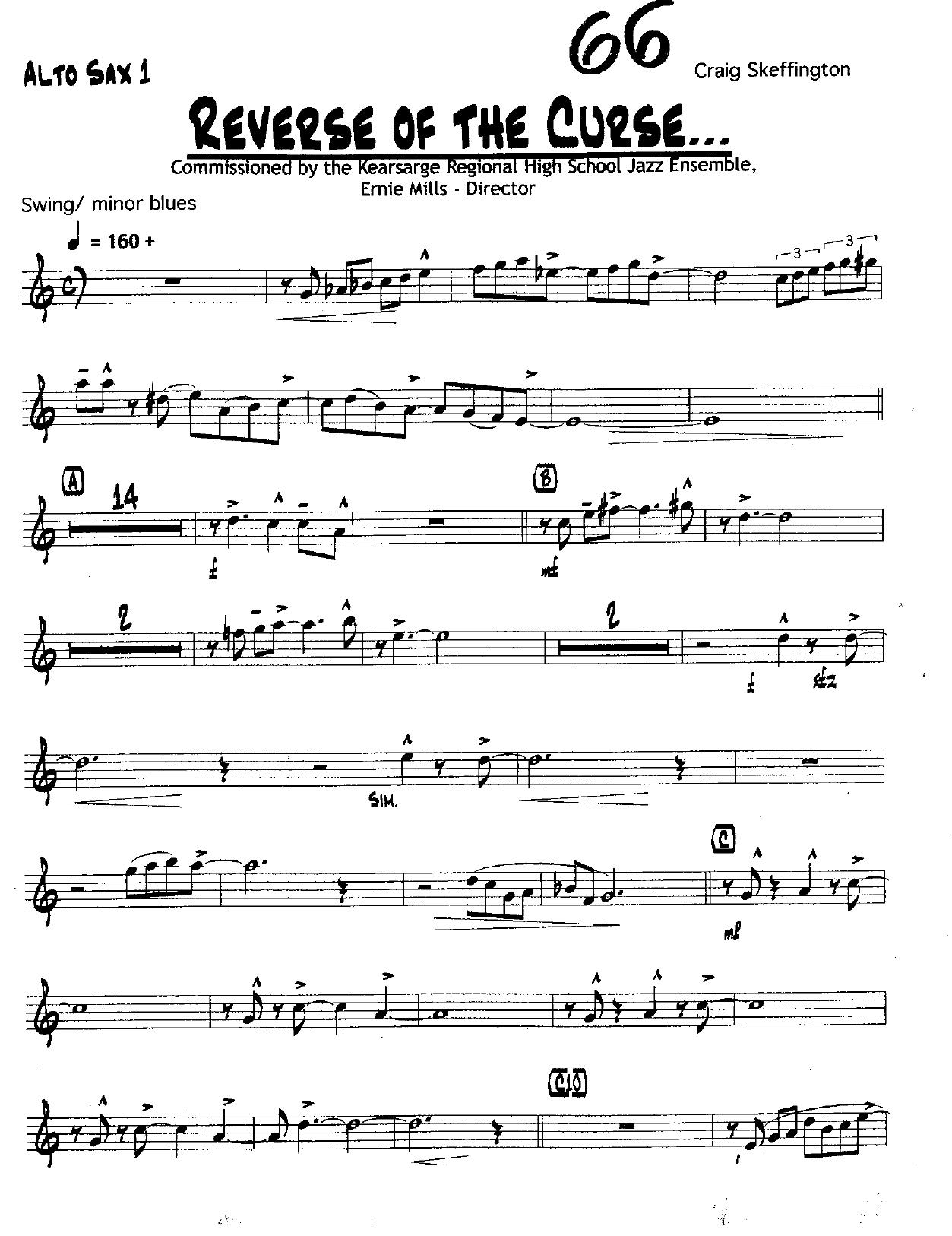
Reverse Of The Curse (C.Skeffington)
Composed by Chris Skeffington
Arranged by C.Skeffington
- Ensemble: Big Band
- Style: Jazz Standard
- Pages: 48
- Instruments (16): Alto Sax 1, Alto Sax 2, Tenor Sax 1, Tenor Sax 2, Bari Sax, Trumpet 1, Trumpet 2, Trumpet 3, Trumpet 4, Trombone 1, Trombone 2, Trombone 3, Trombone 4, Piano, Bass, Drums
- Difficulty: medium
- Content: Individual Parts
- Format: PDF Download (Instant)
- Price: $24.99
"Reverse Of The Curse," composed by Chris Skeffington, stands as a compelling entry in the modern jazz canon, drawing heavily from the sophisticated post-bop and contemporary big band traditions of the late 20th and early 21st centuries. While building upon the structural foundations laid by legendary writers like Thad Jones and Bob Mintzer, Skeffington infuses the composition with a distinct harmonic language characterized by dense, extended voicings and restless, driving rhythmic motifs. This piece captures the restless energy of contemporary urban jazz, blending intricate compositional counterpoint with high-octane swing sections that demand both intellectual engagement and visceral performance from the ensemble. Driven by an infectious, pulsing medium-up swing feel in 4/4 time, the musical character of "Reverse Of The Curse" shifts dynamically between tense, angular unison lines and expansive, lushly harmonized modal plateaus. The mood is urgent, sophisticated, and ultimately triumphant, evoking the relentless forward motion of modern city life. Skeffington constructs the arrangement with meticulous attention to textural contrast, pitting a whisper-quiet, harmonically suspended saxophone soli against roaring, full-ensemble shout choruses that utilize vertical cluster voicings to maximize acoustic impact. The harmony frequently navigates through unexpected chromatic mediants and modal shifts, creating a sense of harmonic ambiguity that resolves into moments of blazing, triumphant brilliance. In this definitive chart by C.Skeffington, the melodic weight is shared democratically across the ensemble, though the woodwinds—anchored by aggressive, agile writing for both alto saxophones and the baritone saxophone—frequently drive the thematic statements. Open solo sections are provided for tenor saxophone and trumpet, allowing featured improvisers to stretch over sophisticated modal changes that reward a linear, bebop-informed vocabulary. Technically, the arrangement demands high proficiency across all sections: the brass face considerable upper-register demands and intricate rhythmic interjections, while the rhythm section must maintain an unwavering, elastic time-feel underneath shifting metric subdivisions. The rhythm section parts—specifically piano and bass—rely on comping figures that outline advanced altered dominants, making it an exceptional vehicle for developing modern ensemble interplay. Advanced college ensembles, top-tier high school bands with exceptional lead players, and professional community big bands will find "Reverse Of The Curse" an invigorating challenge that pushes technical boundaries while offering immense musical reward. The 48-page score and 16-instrument instrumentation provide a rich, uncompressed blueprint for a mature big band looking to showcase its technical precision, stylistic versatility, and command of contemporary jazz vocabulary in a concert or festival setting. Conductors approaching "Reverse Of The Curse" should establish a rock-solid, driving medium-up swing tempo where the quarter note acts as an energetic engine rather than a static metronomic pulse. The primary technical hurdle lies in the execution of complex syncopated figures and unisons between the brass and saxophones; precision in articulation—particularly short, crisp staccatos and controlled, gradual crescendos into accented peaks—is vital to maintaining the chart's momentum. Ensure the rhythm section keeps the underlying ride cymbal pattern buoyant and avoids heavy-handed downbeats. Brass players should utilize subtle falls and doits only where explicitly marked, preserving the sophisticated, modern European-flavored cleanliness of Skeffington's harmonic structures. During rehearsal, isolate the dense saxophone soli and practice it at a slower tempo to lock in intonation before layering in the dynamic shading. The conductor must carefully balance the accompanying background figures during the open solo sections to ensure the soloists can project without forcing their tone over the brass counter-lines. Q: What specific instruments and parts are included in this 16-instrument big band arrangement? A: The instrumentation comprises a standard 16-piece big band layout featuring Alto Saxophone 1, Alto Saxophone 2, Tenor Saxophone 1, Tenor Saxophone 2, Baritone Saxophone, four trumpets, four trombones, and a full rhythm section including piano, bass, and drums. Q: What is the overall difficulty level of "Reverse Of The Curse"? A: This arrangement is graded as advanced, making it best suited for college music department ensembles, professional regional big bands, and elite high school jazz orchestras with strong lead players and experienced rhythm section members. Q: What is the musical style and historical context of this piece? A: Composed by Chris Skeffington, the piece is a contemporary jazz standard drawing heavily from post-bop and modern big band traditions, characterized by sophisticated harmonies, energetic swing grooves, and intricate compositional counterpoint. Q: What makes C.Skeffington's arrangement uniquely challenging and rewarding? A: The arrangement stands out for its dense, extended chord voicings, chromatic mediant modulations, and a demanding saxophone soli that requires exceptional intonation, rhythmic unison, and stylistic cohesion across the section. Q: What is the performance duration and tempo feel of the arrangement? A: The piece is written in a driving 4/4 time signature with a medium-up swing feel, and typical performance execution runs approximately 5 to 6 minutes depending on the length of the open improvised solos.
Questions and answers
- What is included in the Reverse Of The Curse (C.Skeffington) PDF?
- The verified current file contains individual parts across 48 pages.
- How many instruments or parts are listed for Reverse Of The Curse (C.Skeffington)?
- The verified instrumentation list contains 16 entries for this Big Band arrangement.
- Who is credited for Reverse Of The Curse (C.Skeffington)?
- Composer: Chris Skeffington. Arranger: C.Skeffington.
- What difficulty is listed for Reverse Of The Curse (C.Skeffington)?
- The verified difficulty level is medium.
- What style is listed for Reverse Of The Curse (C.Skeffington)?
- The catalog lists the style as Jazz Standard.
- Can I preview Reverse Of The Curse (C.Skeffington) before buying?
- Yes. The product page provides a preview generated from the current PDF file.
- How is Reverse Of The Curse (C.Skeffington) delivered?
- After successful payment, the digital PDF is made available for download. The displayed price is $24.99.
Musicians Also Search For
Reverse Of The Curse C.Skeffington PDF • Reverse Of The Curse C.Skeffington sheet music • Reverse Of The Curse arranged by C.Skeffington • C.Skeffington big band charts • C.Skeffington jazz arrangements PDF • Reverse Of The Curse Chris Skeffington sheet music • Reverse Of The Curse Chris Skeffington big band arrangements • Chris Skeffington big band charts • Reverse Of The Curse big band arrangements • Reverse Of The Curse big band PDF download • Reverse Of The Curse jazz sheet music • big band sheet music download • Reverse Of The Curse individual parts download • Reverse Of The Curse sheet music PDF • Reverse Of The Curse Jazz Standard charts • Jazz Standard big band arrangements • buy Reverse Of The Curse sheet music • download Reverse Of The Curse PDF • Reverse Of The Curse jazz charts • best C.Skeffington big band arrangements • Chris Skeffington arranged by C.Skeffington • Reverse Of The Curse printable sheet music • big band repertoire PDF