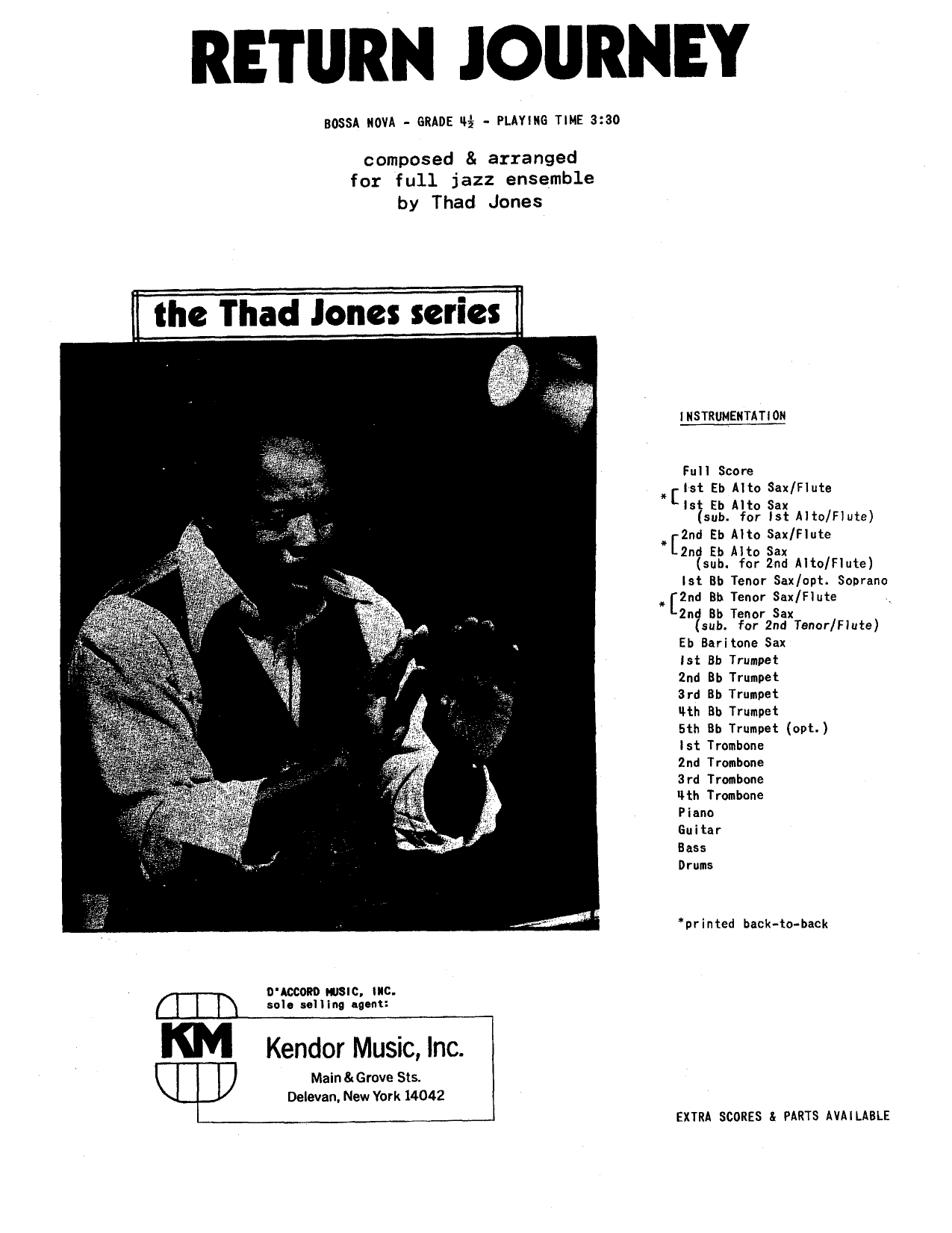
Return Journey Bossa (T.Lewis)
Composed by Thad Lewis
Arranged by Thad Jones-Mel Lewis
- Ensemble: Big Band
- Pages: 43
- Instruments (18): 1st Eb Alto Saxophone / Flute, 2nd Eb Alto Saxophone / Flute, 1st Bb Tenor Saxophone (opt. Sopr.), 2nd Bb Tenor Saxophone / Flute, Eb Baritone Saxophone, 1st Bb Trumpet (opt. Flugel or Tpt. in stand), 2nd Bb Trumpet (opt. Flugel or Tpt. in stand), 3rd Bb Trumpet (opt. Flugel or Tpt. in stand), 4th Bb Trumpet (opt. Flugel or Tpt. in stand), 5th Bb Trumpet (opt. Flugel or Tpt. in stand) Optional, 1st Trombone, 2nd Trombone, 3rd Trombone, 4th Trombone, Bass, Guitar, Piano, Drums
- Difficulty: medium
- Content: Individual Parts
- Format: PDF Download (Instant)
- Price: $24.99
The sophisticated interplay of Brazilian rhythm and post-bop harmonic complexity defines "Return Journey Bossa," a masterclass in large-ensemble writing born from the legendary collaborative ecosystem of the Thad Jones-Mel Lewis Orchestra. Emerging during the late 1960s and 1970s—a golden era of creative big band jazz spearheaded by composer-arranger Thad Jones and drummer Mel Lewis from their Monday night residency at the Village Vanguard—this composition bridges the rhythmic warmth of the bossa nova with the adventurous, extended chord structures of modern jazz. While rooted in the traditional Brazilian dance grooves popularized by Antonio Carlos Jobim and Stan Getz, the Jones-Lewis treatment elevates the form through sophisticated counterpoint, lush horn voicings, and an irrepressible forward momentum that challenges the traditional boundaries of Latin-jazz fusion. At a measured, undulating medium-up bossa tempo in 4/4 time, the piece opens with a hypnotic, undulating percussion and rhythm section groove that immediately establishes an atmosphere of breezy sophistication tinged with subtle melancholic longing. The arrangement unfolds through a series of masterfully orchestrated tension-and-release cycles, shifting seamlessly between intimate sectional interplay and roaring, brass-heavy climaxes. The harmonic language relies heavily on augmented dominants, suspended chords, and chromatic passing tones, creating a rich sonic tapestry that sounds simultaneously lush and biting. The saxophones, anchored by a robust baritone voice, often carry flowing, serpentine counter-melodies, while the trumpets and trombones weave dense, opaque harmonic pads that evoke the hazy warmth of a metropolitan evening skyline. Thad Jones’s signature arranging fingerprint is stamped indelibly across every measure, characterized by conversational call-and-response figures between the saxes and brass, fluid meter implications, and a complete avoidance of predictable block-chord writing. Instead, Jones utilizes independent voice-leading that gives each player a distinct linear responsibility. Featured solo space allows improvisers to stretch out over modal vamps and sophisticated harmonic turnarounds, demanding a player who can blend lyricism with modern harmonic vocabulary. The rhythm section—particularly the drummer—must master the delicate balance between authentic bossa nova subdivision and the loose, driving swing feel intrinsic to the Mel Lewis aesthetic, avoiding heavy-handedness while maintaining a relentless, hypnotic pulse. Advanced collegiate ensembles, premier high school jazz bands with mature section players, and professional big bands will find this 43-page chart an immensely rewarding centerpiece for a concert program. Because the arrangement demands acute listening across sections, precise dynamic control, and a sophisticated grasp of Latin-jazz articulation, it serves as an exceptional pedagogical tool for developing ensemble blend and stylistic versatility. The interplay between relaxed, laid-back melodic statements and fiery, harmonically dense ensemble passages ensures that both performers and audiences remain utterly captivated from the opening beat to the final, shimmering chord. The primary technical challenge in "Return Journey Bossa" lies in executing the subtle micro-rhythms of the style without rushing the tempo. The rhythm section must establish a transparent, driving bossa groove where the bass plays a steady, undulating two-beat pattern and the piano and guitar interject with crisp, syncopated chordal comping. Horn players must approach their entrances with a relaxed, behind-the-beat articulation, ensuring that accented notes do not sound harsh or overblown. Pay meticulous attention to the dynamic markings in the sax soli sections; balance is critical because inner voices carry essential chromatic movement that defines the altered harmonies. Directors should rehearse the ensemble in smaller sections first, isolating the intricate counter-melodies before merging the brass and reeds. Encourage the soloist to build their melodic narrative gradually, utilizing the modal spaces of the form before navigating the denser harmonic turnarounds. Q: What instruments and parts are included in this arrangement? A: This chart is scored for an 8-instrument core ensemble format featuring Alto Saxophone, Tenor Saxophone, Baritone Saxophone, Trumpet, and Trombone parts, fully supported by a complete rhythm section rhythm score across its 43 pages. Q: What is the difficulty level of this arrangement? A: This arrangement is rated as advanced, making it best suited for college jazz ensembles, advanced high school bands, and professional orchestras that possess strong section-playing and improvisational skills. Q: What is the musical style and historical context of this piece? A: Written in the style of the legendary Thad Jones-Mel Lewis Orchestra, this piece blends traditional Brazilian bossa nova grooves with sophisticated post-bop harmonies and advanced big band orchestration techniques from the late 1960s and 1970s. Q: What makes this arrangement unique? A: It distinguishes itself through Thad Jones's signature independent voice-leading, intricate cross-sectional conversations, and a seamless fusion of Latin rhythmic warmth with complex, extended modern jazz harmonies. Q: What is the expected performance tempo and duration? A: The arrangement is set at a relaxed, medium-up bossa nova tempo in 4/4 time, with a typical performance duration of approximately 5 to 7 minutes depending on solo choruses.
Questions and answers
- What is included in the Return Journey Bossa (T.Lewis) PDF?
- The verified current file contains a conductor score and individual parts across 43 pages.
- How many instruments or parts are listed for Return Journey Bossa (T.Lewis)?
- The verified instrumentation list contains 18 entries for this Big Band arrangement.
- Who is credited for Return Journey Bossa (T.Lewis)?
- Composer: Thad Lewis. Arranger: Thad Jones-Mel Lewis.
- What difficulty is listed for Return Journey Bossa (T.Lewis)?
- The verified difficulty level is medium.
- Can I preview Return Journey Bossa (T.Lewis) before buying?
- Yes. The product page provides a preview generated from the current PDF file.
- How is Return Journey Bossa (T.Lewis) delivered?
- After successful payment, the digital PDF is made available for download. The displayed price is $24.99.
Musicians Also Search For
Return Journey Bossa Thad Jones-Mel Lewis PDF • Return Journey Bossa Thad Jones-Mel Lewis sheet music • Return Journey Bossa arranged by Thad Jones-Mel Lewis • Thad Jones-Mel Lewis big band charts • Thad Jones-Mel Lewis jazz arrangements PDF • Return Journey Bossa Thad Lewis sheet music • Return Journey Bossa Thad Lewis big band arrangements • Thad Lewis big band charts • Return Journey Bossa big band arrangements • Return Journey Bossa big band PDF download • Return Journey Bossa jazz sheet music • big band sheet music download • Return Journey Bossa conductor score PDF • Return Journey Bossa individual parts download • Return Journey Bossa sheet music PDF • buy Return Journey Bossa sheet music • download Return Journey Bossa PDF • Return Journey Bossa jazz charts • best Thad Jones-Mel Lewis big band arrangements • Thad Lewis arranged by Thad Jones-Mel Lewis • Return Journey Bossa printable sheet music • big band repertoire PDF