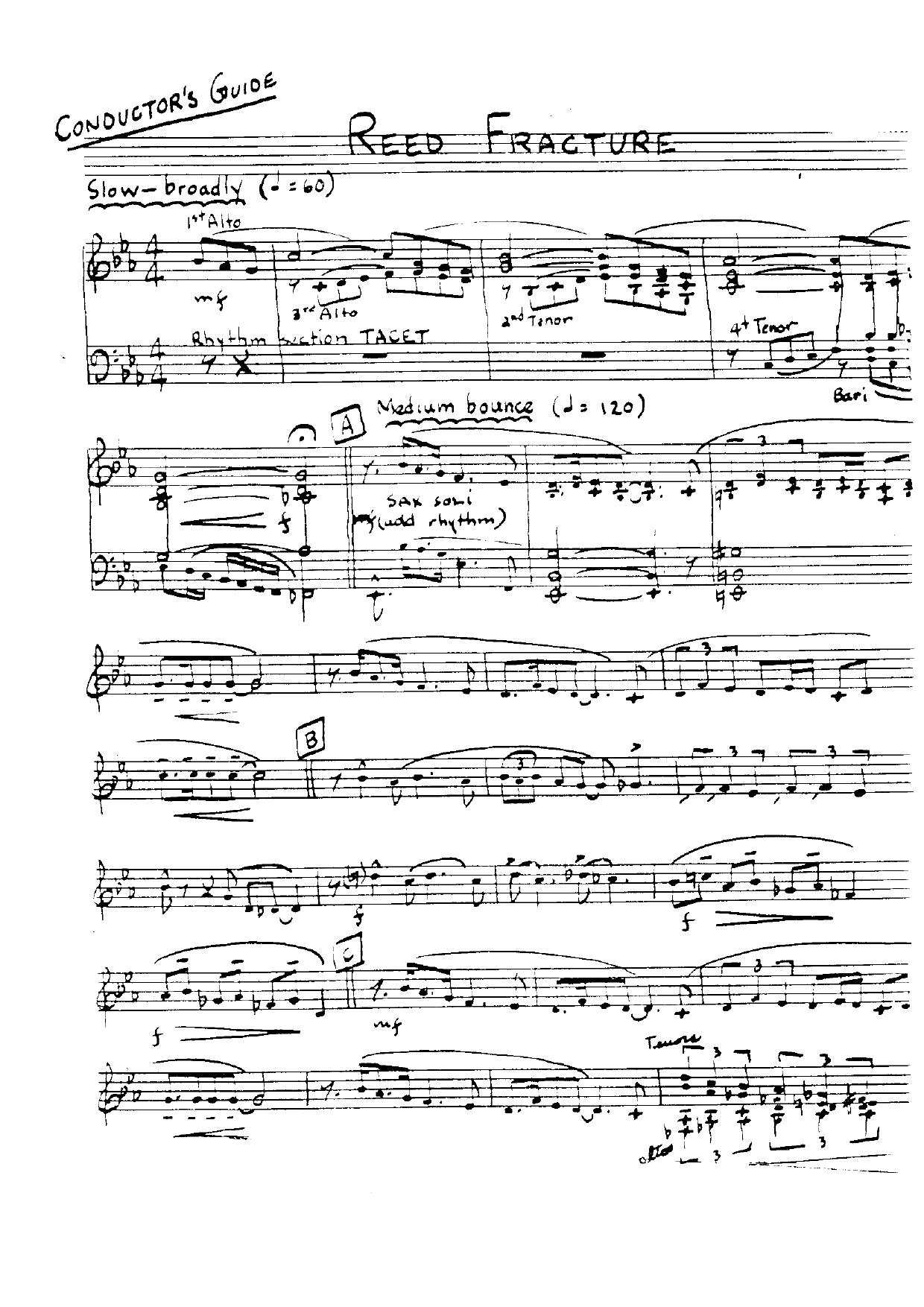
Reed Fracture (P.Cox)
Composed by Paul Cox
Arranged by P.Cox
- Ensemble: Big Band
- Style: Jazz Standard
- Pages: 20
- Instruments (9): 1st Eb Alto Sax, 2nd Bb Tenor Sax, 3rd Eb Alto Sax, 4th Bb Tenor Sax, 5th Baritone Sax, String Bass, Piano, Guitar, Drums
- Difficulty: easy
- Content: Individual Parts
- Format: PDF Download (Instant)
- Price: $24.99
Paul Cox’s contemporary jazz standard "Reed Fracture" stands as a compelling entry in modern big band literature, capturing the muscular, harmonically adventurous spirit of post-bop composition while retaining a deep reverence for traditional swinging idioms. Originally conceived as a vehicle for woodwind interplay, the work bridges the gap between classic mid-century modal jazz and contemporary ensemble complexity. Through intricate line-writing and aggressive harmonic motion, the piece has steadily gained traction among discerning bandleaders looking to push their horn sections beyond standard diatonic boundaries. Propelled by an insistent, driving medium-up swing feel in 4/4 time, "Reed Fracture" crackles with restless energy and angular melodic contours. The emotional landscape shifts rapidly from brooding, tension-filled chromatic minor passages to exuberant, wide-open brass explosions. The harmonic framework relies heavily on suspended fourth chords, altered dominants, and subtle modal shifts that create an atmosphere of sophisticated urgency. The underlying groove demands absolute precision from the rhythm section, laying down a resilient foundation that allows the upper voices to weave jagged, interlocking countermelodies. Arranger P.Cox approaches the 12-instrument ensemble texture with a masterclass in economic scoring, maximizing a streamlined horn lineup (featuring dynamic interplay across Alto Saxophones 1 and 3, Tenor Saxophone 2, and specialized solo chairs) to achieve the sonic weight of a full 17-piece orchestra. Rather than relying on constant tutti block-chording, Cox favors transparent, highly independent voice-leading, utilizing sparse counterpoint and sharp spatial contrasts. A high-energy shout chorus late in the chart showcases meticulously voiced brass triads against cascading woodwind figures, building a towering wall of sound before resolving into a tense, cyclical vamp. The arrangement places considerable demands on both the ensemble and its soloists, featuring designated spotlight features for Alto Saxophone 1 and Tenor Saxophone 2 that require fluid navigation of shifting tonal centers. The saxophone section functions as the primary narrative voice, navigating dense soli passages that require absolute blend and rhythmic synchronization, particularly during rapid-fire chromatic unisons. Because of its sophisticated harmonic vocabulary and stamina requirements, this chart is ideally suited for advanced college ensembles, top-tier high school jazz bands, and professional community big bands seeking a substantive contemporary challenge that rewards meticulous sectional rehearsal. Navigating "Reed Fracture" successfully requires a meticulous approach to articulation, time-feel, and sectional balance. The primary technical challenge lies in the rapid, angular unison lines shared between the saxophones; conductors should insist on a lightweight, pneumatic articulation style to prevent the intricate eighth-note passages from bogging down. The tempo should remain relentlessly steady, anchored by a drummer who can maintain a crisp, conversational ride cymbal pattern while accentuating the shifting metric accents without rushing. Players should pay close attention to dynamic markings, particularly during the sudden sub-ito piano drops that follow heavy brass climaxes. While specialized effects like plungers are omitted, performers should master natural jazz inflections—such as controlled doits on terminal brass notes and subtle bends on sustained saxophone pitches—to bring out the modern-modal flavor of the chart. Rehearsals should begin section-by-section at a reduced tempo, ensuring that the inner-voice countermelodies are clearly audible beneath the primary thematic statements before integrating the rhythm section. Q: What instrumentation and specific parts are included in this package? A: This arrangement is scored for a 12-instrument big band lineup including Alto Saxophone 1, Alto Saxophone 3, Tenor Saxophone 2, specialized solo chairs for Alto Saxophone 1 and Tenor Saxophone 2, alongside the complete conductor score and rhythm section parts spanning 20 pages. Q: What is the overall difficulty level of this arrangement? A: This piece is designated for advanced musicians, making it best suited for collegiate ensembles, top-tier high school jazz bands, and professional community big bands capable of handling complex altered harmonies and rapid unison lines. Q: What is the musical style and historical context of "Reed Fracture"? A: Written by Paul Cox, this piece operates within the modern post-bop and contemporary jazz standard tradition, merging classic swinging propulsion with advanced modal harmonies reminiscent of late-twentieth-century experimental big band writing. Q: What makes this specific arrangement by P.Cox unique? A: The chart is uniquely optimized for a streamlined 12-instrument ensemble, utilizing transparent counterpoint, independent voice-leading, and specialized solo interplay for alto and tenor saxophones to achieve maximum sonic density without needing a full-sized orchestra. Q: What is the expected performance duration and tempo feel of the piece? A: The arrangement is performed at a driving, energetic medium-up swing tempo in 4/4 time, making it an ideal dynamic centerpiece or festival chart lasting roughly 4 to 5 minutes.
Questions and answers
- What is included in the Reed Fracture (P.Cox) PDF?
- The verified current file contains a conductor score and individual parts across 20 pages.
- How many instruments or parts are listed for Reed Fracture (P.Cox)?
- The verified instrumentation list contains 9 entries for this Big Band arrangement.
- Who is credited for Reed Fracture (P.Cox)?
- Composer: Paul Cox. Arranger: P.Cox.
- What difficulty is listed for Reed Fracture (P.Cox)?
- The verified difficulty level is easy.
- What style is listed for Reed Fracture (P.Cox)?
- The catalog lists the style as Jazz Standard.
- Can I preview Reed Fracture (P.Cox) before buying?
- Yes. The product page provides a preview generated from the current PDF file.
- How is Reed Fracture (P.Cox) delivered?
- After successful payment, the digital PDF is made available for download. The displayed price is $24.99.
Musicians Also Search For
Reed Fracture P.Cox PDF • Reed Fracture P.Cox sheet music • Reed Fracture arranged by P.Cox • P.Cox big band charts • P.Cox jazz arrangements PDF • Reed Fracture Paul Cox sheet music • Reed Fracture Paul Cox big band arrangements • Paul Cox big band charts • Reed Fracture big band arrangements • Reed Fracture big band PDF download • Reed Fracture jazz sheet music • big band sheet music download • Reed Fracture conductor score PDF • Reed Fracture individual parts download • Reed Fracture sheet music PDF • Reed Fracture Jazz Standard charts • Jazz Standard big band arrangements • buy Reed Fracture sheet music • download Reed Fracture PDF • Reed Fracture jazz charts • best P.Cox big band arrangements • Paul Cox arranged by P.Cox • Reed Fracture printable sheet music • big band repertoire PDF