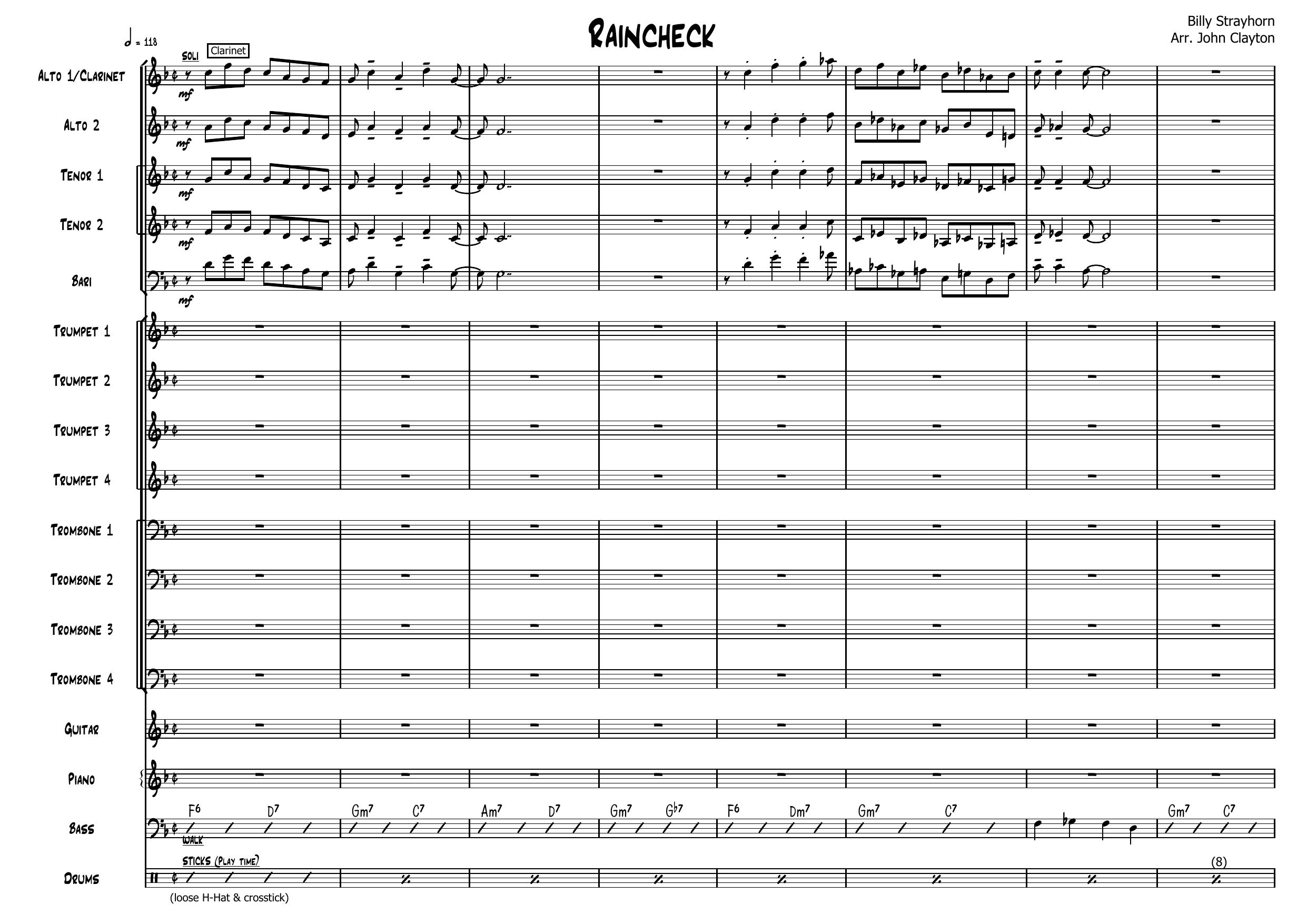
Raincheck (J.Clayton)
Composed by Billy Strayhorn
Arranged by Big Band Notes много
- Ensemble: Big Band
- Pages: 90
- Instruments (17): Alto 1/Clarinet, Alto 2, Tenor 1, Tenor 2, Baritone Saxophone/Bass Clarinet, Trumpet 1, Trumpet 2, Trumpet 3, Trumpet 4, Trombone 1, Trombone 2, Trombone 3, Trombone 4, Guitar, Piano, Bass, Drums
- Difficulty: advanced
- Content: Individual Parts
- Format: PDF Download (Instant)
- Price: $24.99
Billy Strayhorn’s sophisticated compositional voice defined the golden era of the Duke Ellington Orchestra, and "Raincheck," penned by Strayhorn in 1941, stands as one of the quintessential swing-era instrumentals. Originally recorded by Ellington’s landmark 1940s band featuring luminaries like Johnny Hodges, Ben Webster, and Ray Nance, the tune showcases Strayhorn’s signature blend of dense, Ellingtonian harmonic structures and infectious, driving momentum. Unlike the moody, impressionistic palettes of "Take the 'A' Train" or "Chelsea Bridge," "Raincheck" leans into a brisk, blues-infused grammar that highlights the interplay between razor-sharp brass punches and swirling woodwind textures, securing its status as a revered vehicle for advanced big band exploration. Driving with a bright, relentless medium-up swing feel, this arrangement captures the sophisticated swagger and urbane energy of the Harlem jazz scene. The thematic material bounces with an irrepressible buoyancy, shifting between sleek, interconnected melodic fragments and powerful, roaring ensemble tuttis. Strayhorn’s original harmonic architecture evokes a mood of midnight transit and late-night club sophistication, balancing high-octane excitement with cool, calculated poise. The emotional trajectory moves dynamically from taut, anticipatory tension in the rhythm section to ecstatic releases during full-ensemble passages. The Big Band Notes много interpretation honors Strayhorn’s meticulous craftsmanship while expanding the timbral breadth for a modern 17-piece ensemble. The arrangement utilizes lush, extended voicings in the saxophone section—bolstered by versatile doublings including clarinet and bass clarinet—to recreate the rich, orchestral colors historically favored by the Ellington tradition. Soli sections are tightly integrated, featuring intricate counterpoint that weaves through the brass sections without obscuring the harmonic framework. The shout chorus builds organically through clever sequential modulations and rhythmic displacement, driving the momentum forward with modern big band punch while retaining the unmistakable mid-century Ellingtonian aesthetic. Melodic duties are shared democratically across the ensemble, though the alto and tenor saxophones frequently carry the primary thematic weight, punctuated by crisp brass responses. Featured solo spaces allow proficient improvisers to stretch out over standard changes that reward both linear bebop phrasing and blues-drenched lyricism. Technical demands include rapid articulated figures in the woodwinds, precise lip slurs in the brass, and an advanced understanding of swung eighth-note subdivisions. Advanced college ensembles, professional repertory orchestras, and top-tier high school jazz bands with strong section cohesion will find this chart deeply rewarding to program. Navigating this arrangement requires strict rhythmic discipline, particularly in maintaining a buoyant, unhurried medium-up swing tempo. The primary technical challenge lies in the execution of tight ensemble unisons and rapid cross-section counterlines that must breathe together despite fast subdivisions. Conductors should ensure the rhythm section anchors a steady, conversational pulse without rushing the peaks of the phrases. Saxophone players must balance their tone carefully during multi-phonic soli sections to allow the inner voices to project clearly through the texture. Brass players should utilize subtle, stylized inflections—such as controlled falls and warm, non-aggerated doits—to emulate the vocal quality of the original 1940s recordings without resorting to caricature. Rehearsals should begin section by section at a reduced tempo, focusing on the seamless transition of swung eighth-note feels before integrating the dynamic swells of the shout chorus. Q: What instruments and parts are included in this arrangement? A: The package is scored for a standard 17-piece big band instrumentation consisting of 5 saxophones (Alto 1/Clarinet, Alto 2, Tenor 1, Tenor 2, and Baritone/Bass Clarinet), 4 trumpets, 4 trombones, and a 4-piece rhythm section, alongside a comprehensive 90-page conductor score. Q: What is the difficulty level of this chart? A: This arrangement is tailored for advanced high school, collegiate, and professional big bands due to its intricate woodwind doublings, brisk tempo, and demanding ensemble reading requirements. Q: What is the historical style and musical context of "Raincheck"? A: Composed by Billy Strayhorn in 1941 for the Duke Ellington Orchestra, the piece represents the height of swing-era sophistication, blending blues-rooted energy with advanced, impressionistic harmonies. Q: What makes this specific arrangement by Big Band Notes много unique? A: It features expanded modern voicings and specialized woodwind doublings while faithfully preserving the Ellingtonian counterpoint, sophisticated soli writing, and driving momentum of the original composition. Q: What is the performance duration and tempo feel of the piece? A: The arrangement is set to a bright, energetic medium-up swing tempo (approximately quarter note = 180–190 BPM) and typically runs for roughly 3.5 to 4.5 minutes depending on open solo rotations.
Questions and answers
- What is included in the Raincheck (J.Clayton) PDF?
- The verified current file contains a conductor score and individual parts across 90 pages.
- How many instruments or parts are listed for Raincheck (J.Clayton)?
- The verified instrumentation list contains 17 entries for this Big Band arrangement.
- Who is credited for Raincheck (J.Clayton)?
- Composer: Billy Strayhorn. Arranger: Big Band Notes много.
- What difficulty is listed for Raincheck (J.Clayton)?
- The verified difficulty level is advanced.
- Can I preview Raincheck (J.Clayton) before buying?
- Yes. The product page provides a preview generated from the current PDF file.
- How is Raincheck (J.Clayton) delivered?
- After successful payment, the digital PDF is made available for download. The displayed price is $24.99.
Musicians Also Search For
Raincheck Big Band Notes много PDF • Raincheck Big Band Notes много sheet music • Raincheck arranged by Big Band Notes много • Big Band Notes много big band charts • Big Band Notes много jazz arrangements PDF • Raincheck Billy Strayhorn sheet music • Raincheck Billy Strayhorn big band arrangements • Billy Strayhorn big band charts • Raincheck big band arrangements • Raincheck big band PDF download • Raincheck jazz sheet music • big band sheet music download • Raincheck conductor score PDF • Raincheck individual parts download • Raincheck sheet music PDF • buy Raincheck sheet music • download Raincheck PDF • Raincheck jazz charts • best Big Band Notes много big band arrangements • Billy Strayhorn arranged by Big Band Notes много • Raincheck printable sheet music • big band repertoire PDF