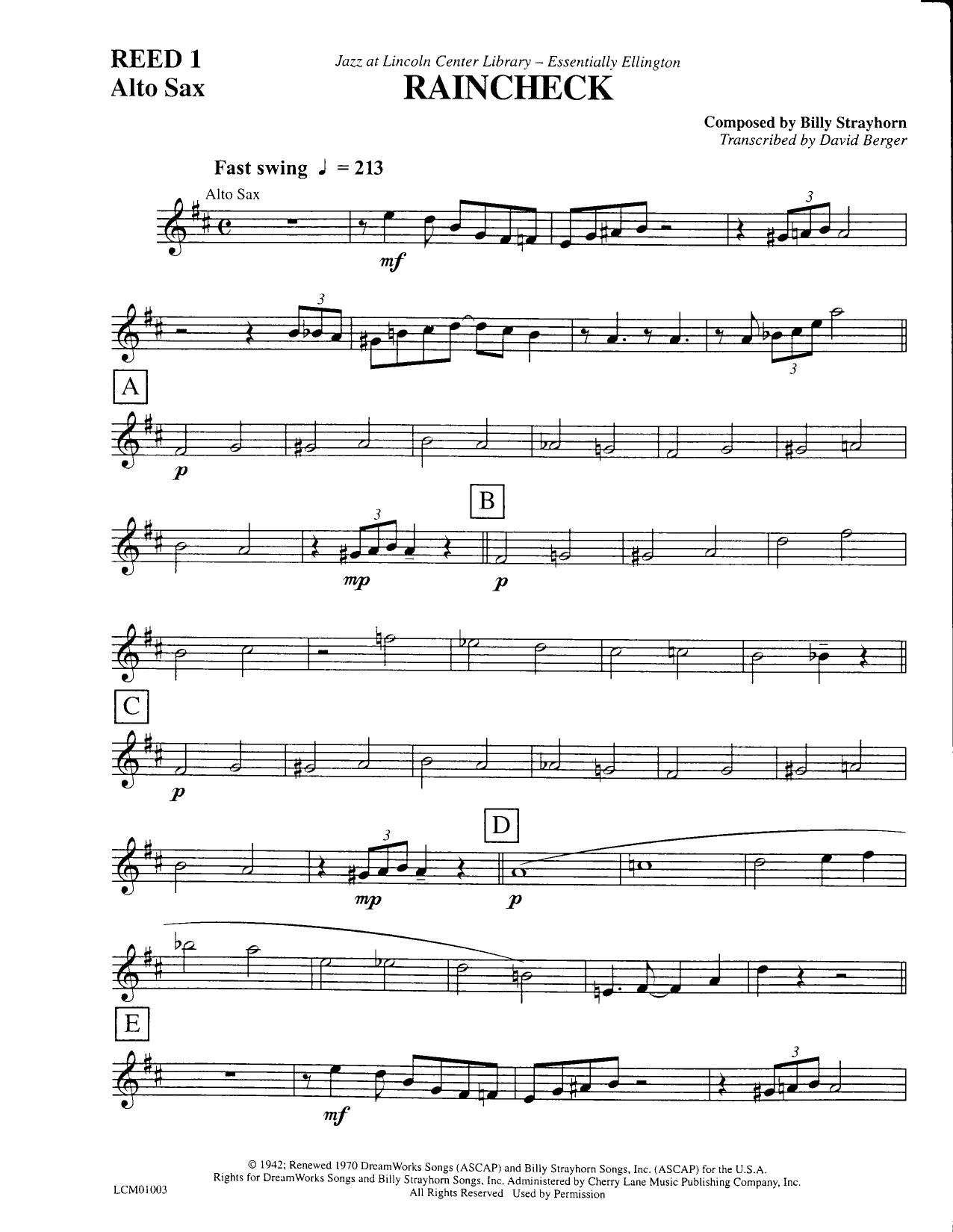
Raincheck (B.Strayhorn) D.Berger)
Composed by Billy Strayhorn
Arranged by Duke Ellington & B.Strayhorn.D.Berger
- Ensemble: Big Band
- Pages: 32
- Instruments (14): Reed 1 Alto Sax, Reed 2 Alto Sax, Reed 3 Tenor Sax/Clarinet, Reed 4 Tenor Sax, Reed 5 Bari Sax, Trumpet 1, Trumpet 2, Trumpet 3 (Cornet), Trombone 1, Trombone 2, Trombone 3 (Valve), Guitar, Bass, Drums
- Difficulty: medium
- Content: Individual Parts
- Format: PDF Download (Instant)
- Price: $24.99
Composed by Billy Strayhorn during his early, highly innovative tenure with the Duke Ellington Orchestra, "Raincheck" stands as a brilliant monument of the 1941 swing era. First recorded by Ellington’s legendary ensemble in December of that year, and later revisited on the triumphant 1967 tribute album *And His Mother Called Him Bill*, the piece highlights Strayhorn's distinct compositional voice—one that balanced traditional big band architecture with strikingly modern, chromatic harmonic concepts. Though it shares the spotlight with staples like "Take the 'A' Train", "Raincheck" offers a sophisticated, angular melodic profile that challenged conventional big band writing of its time, incorporating quartal voicings and intricate sequential motivic development that bridge classic swing with proto-bebop sensibilities. Driven by a crisp, energetic medium-fast swing feel, the chart opens with an iconic, ascending motif featuring fourths and major triads that immediately establishes an upbeat, sophisticated mood. The emotional landscape is buoyant, clever, and intellectually stimulating, relying on brisk rhythmic shifts and dynamic contrast rather than heavy-handed blues tropes. David Berger’s meticulous transcription captures every nuance of the original Ellington recording, maintaining the sparkling interplay between sections. The arrangement relies heavily on tight, harmonized woodwind textures—often utilizing clarinet doubles—and punchy brass punctuations that propel the relentless momentum forward from the first downbeat to the final explosive chord. The arrangement shines a spotlight on individual voices while keeping the ensemble engaged in tight conversational counterpoint. Solos are designated for trombone and tenor saxophone, offering ample space for players to stretch out over changes that demand agile melodic thinking. A standout feature of the chart is its brilliant sax soli, which requires precise articulation, clean blend, and nimble fingerwork to navigate Strayhorn’s winding lines. Technical challenges include maintaining a light, buoyant time-feel at a brisk tempo, executing accurate section blends across unconventional chord voicings, and negotiating swift chromatic shifts without letting the swing pulse drag or rush. Ensembles at the advanced high school, collegiate, and professional levels will find this publication exceptionally rewarding to perform. It serves as an ideal vehicle for teaching students how to interpret historic Ellingtonia with stylistic authenticity, demanding both listening maturity and technical precision. Working musicians will appreciate how faithfully this 32-page publication [from the comprehensive instrument lineup spanning Alto Saxophone 1, Alto Saxophone 2, Tenor Saxophone, Baritone Saxophone, Trumpet 1, and beyond] preserves the original genius of two jazz masters while providing a formidable, crowd-pleasing showcase for modern big band programming. Conductors should establish a comfortable, driving medium-fast swing tempo, ensuring that the rhythm section maintains an insistent, lightweight ride cymbal pulse without rushing the syncopated figures. The primary technical hurdle involves the complex, sequential harmonic lines; brass players must keep their attacks clean and voiced compactly to mimic the vocal-like timbre of the original Ellington section. Pay close attention to dynamic balance during the woodwind soli passages, allowing the inner voices to project clearly beneath the lead alto. Saxophonists should practice their scalar runs with a smooth, connected articulation to achieve the required lightness. Rehearsals should isolate the interplay between the rhythm section and the brass punch-accents to ensure razor-sharp rhythmic synchronization across changing meters and harmonic pivots. Q: What instruments and parts are included in this arrangement? A: This big band arrangement includes 13 core instruments, featuring two alto saxophones, a tenor saxophone, a baritone saxophone, multiple trumpets (starting with Trumpet 1), trombones, a rhythm section (piano, guitar, bass, drums), and traditional clarinet auxiliary doubling options as scored in the original Ellington library. Q: What is the difficulty level of this chart? A: This piece is graded as advanced (approximate Grade 4 / Medium-Advanced), making it well-suited for accomplished high school, collegiate, and professional jazz ensembles that possess strong section blend and nimble soloists. Q: What is the historical background of "Raincheck"? A: Composed by Billy Strayhorn and recorded by the Duke Ellington Orchestra in December 1941, "Raincheck" is an essential swing-era standard that highlights Strayhorn's distinct modernist compositional voice before it fully merged with Ellington's collective style. Q: What makes this specific David Berger transcription unique? A: Transcribed directly from historical Duke Ellington recordings, this edition preserves the authentic articulations, quartal harmony voicings, and intricate sectional balances that defined the Ellington band's signature sound. Q: What is the style and performance tempo of the piece? A: The arrangement is a swinging, fast-tempo jazz chart driven by a bright medium-swing feel, requiring a performance duration of approximately 3 to 4 minutes depending on the length of the open trombone and tenor saxophone solos.
Questions and answers
- What is included in the Raincheck (B.Strayhorn) D.Berger) PDF?
- The verified current file contains individual parts across 32 pages.
- How many instruments or parts are listed for Raincheck (B.Strayhorn) D.Berger)?
- The verified instrumentation list contains 14 entries for this Big Band arrangement.
- Who is credited for Raincheck (B.Strayhorn) D.Berger)?
- Composer: Billy Strayhorn. Arranger: Duke Ellington & B.Strayhorn.D.Berger.
- What difficulty is listed for Raincheck (B.Strayhorn) D.Berger)?
- The verified difficulty level is medium.
- Can I preview Raincheck (B.Strayhorn) D.Berger) before buying?
- Yes. The product page provides a preview generated from the current PDF file.
- How is Raincheck (B.Strayhorn) D.Berger) delivered?
- After successful payment, the digital PDF is made available for download. The displayed price is $24.99.
Musicians Also Search For
Raincheck Duke Ellington & B.Strayhorn.D.Berger PDF • Raincheck Duke Ellington & B.Strayhorn.D.Berger sheet music • Raincheck arranged by Duke Ellington & B.Strayhorn.D.Berger • Duke Ellington & B.Strayhorn.D.Berger big band charts • Duke Ellington & B.Strayhorn.D.Berger jazz arrangements PDF • Raincheck Billy Strayhorn sheet music • Raincheck Billy Strayhorn big band arrangements • Billy Strayhorn big band charts • Raincheck big band arrangements • Raincheck big band PDF download • Raincheck jazz sheet music • big band sheet music download • Raincheck individual parts download • Raincheck sheet music PDF • buy Raincheck sheet music • download Raincheck PDF • Raincheck jazz charts • best Duke Ellington & B.Strayhorn.D.Berger big band arrangements • Billy Strayhorn arranged by Duke Ellington & B.Strayhorn.D.Berger • Raincheck printable sheet music • big band repertoire PDF