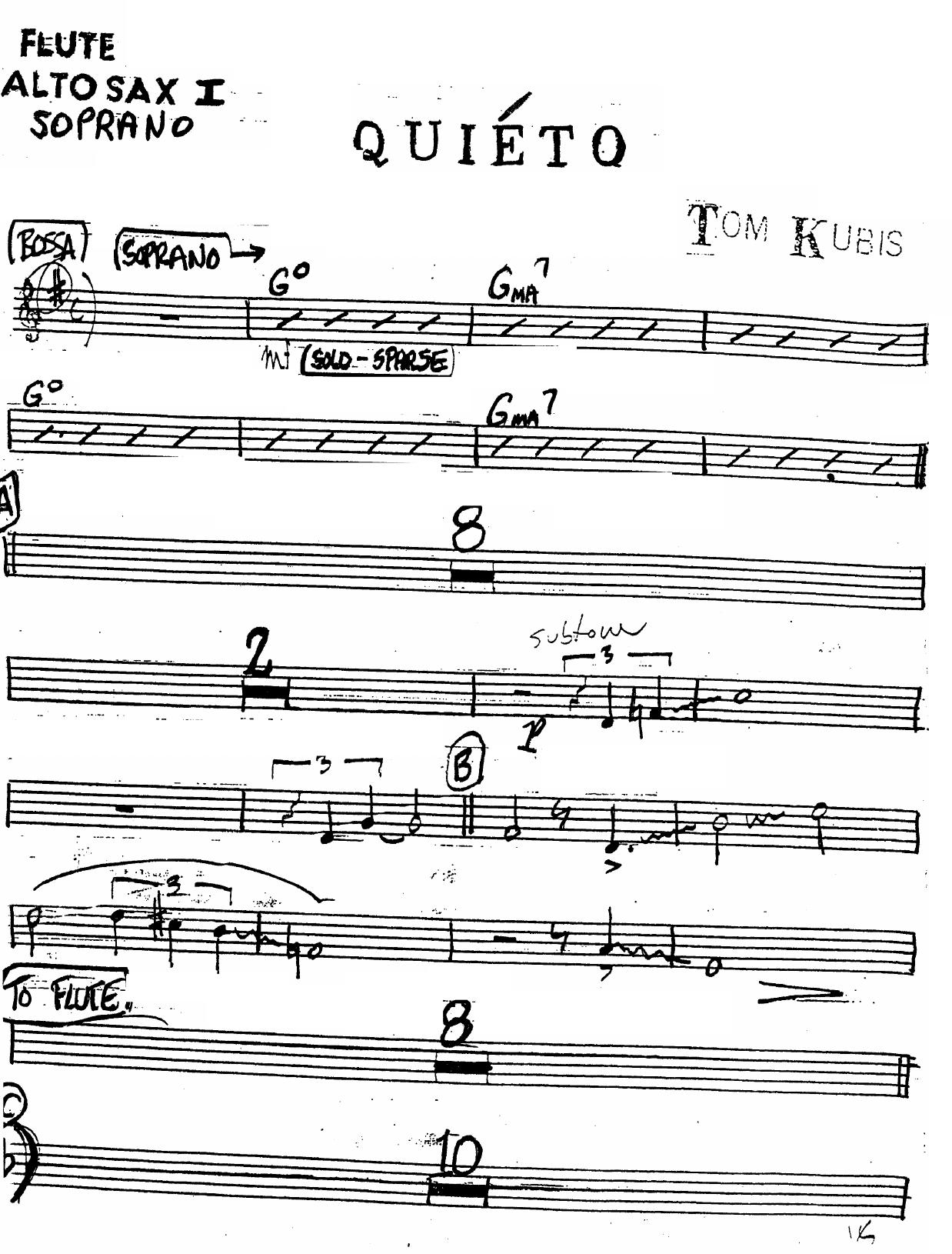
Quieto (T.Kubis)
Composed by Tom Kubis
Arranged by Tom Kubis
- Ensemble: Big Band
- Pages: 53
- Instruments (20): Alto Saxophone 1, Alto Saxophone 2, Tenor Saxophone 1, Tenor Saxophone 2, Baritone Saxophone, Soprano Saxophone, Flute, Trumpet 1, Trumpet 2, Trumpet 3, Trumpet 4, Flugelhorn, Trombone 1, Trombone 2, Trombone 3, Trombone 4, Piano, Bass, Guitar, Drums
- Difficulty: advanced
- Content: Individual Parts
- Format: PDF Download (Instant)
- Price: $24.99
Master composer and arranger Tom Kubis delivers a sophisticated masterclass in modern big band writing with "Quieto," an inventive contemporary jazz chart that showcases his trademark wit, intricate harmonic language, and buoyant rhythmic drive. Emerging from the vibrant Southern California studio jazz scene where Kubis has long been a defining voice, this composition bridges the gap between classic swing-era voicings and modern harmonic exploration. While not a traditional pre-war standard, Kubis's original works have achieved classic status within contemporary wind ensemble and collegiate jazz repertoires, celebrated for their clever thematic development and demanding yet rewarding architectural design. Driven by an infectious, forward-moving groove, "Quieto" balances moments of cool, understated reflection with high-octane ensemble pyrotechnics. The piece opens with an inviting, breezy mood that establishes an effortless pocket before expanding into rich, harmonically dense textures. Kubis utilizes extended chord structures—frequently incorporating sharp elevenths, thirteenths, and altered dominants—to create a sophisticated tonal landscape that evokes the sun-drenched sophistication of West Coast jazz while retaining a muscular, driving big band pulse. The emotional trajectory shifts seamlessly from playful, intricate melodic statements to sweeping, cinematic crescendos that demand absolute precision and collective breath control from the entire ensemble. True to the arranger’s signature style, this chart features meticulous counterpoint, clever section-writing, and a brilliant distribution of melodic material across the entire big band. The front line—anchored by versatile woodwind doubling including flute and soprano saxophone alongside traditional alto, tenor, and baritone saxophones—carries much of the initial thematic weight through tight, harmonically rich solis. Brass sections are treated with equal ingenuity; the trumpets and trombones navigate punchy, syncopated figures that act both as rhythmic counterweights and melodic drivers. A textbook Kubis shout chorus serves as the structural climax, building tension through clever sequential modulation and dynamic contrast before resolving into a triumphant final cadence. Advanced collegiate, high-level community, and professional big bands will find "Quieto" an exceptional vehicle for showcasing technical polish, stylistic versatility, and section cohesion. The chart features designated solo space for featured improvisers—typically tailored for alto saxophone or piano—allowing individual voices to shine against a meticulously crafted, moving backdrop. Technical demands center on tight articulation, precise stylistic interpretation of contemporary jazz phrasing, and the endurance required to maintain high energy levels through shifting dynamic plateaus. For conductors seeking a sophisticated, crowd-pleasing modern jazz work that challenges every section equally, this 53-page publication stands as a definitive benchmark of contemporary big band arranging. Navigating "Quieto" successfully requires a high degree of rhythmic crispness and attentive internal listening across all sections. The tempo must remain steady and driving, anchored firmly by the rhythm section; avoid dragging during the softer, more exposed transitional passages. Saxophone doubles, particularly flute and soprano sax, must be tuned carefully against the brass pads to ensure the complex extended harmonies bloom correctly. Articulation is paramount: short notes must be clipped and uniform, while longer, accented lines need a warm, vocal quality without excessive edge. Conductors should focus early rehearsals on the inner voice movement within the sax and trombone solis, ensuring that the harmonic motion is clearly articulated beneath the primary melody. Brass players should approach high register entrances with controlled air support rather than brute force, maintaining warmth even at forte dynamics. The rhythm section acts as the primary engine; the drummer should utilize a crisp, modern ride cymbal pattern with tasteful, interactive comping, while the bassist locks in tightly with the left-hand piano voicings to maintain the forward momentum of Kubis's intricate harmonic shifts. Q: What specific instruments and parts are included in this 53-page big band arrangement? A: The instrumentation comprises a standard 20-instrument big band setup, featuring a versatile reed section with flute, soprano saxophone, two alto saxophones, tenor saxophone, and baritone saxophone, alongside standard brass (four trumpets, four trombones) and a full rhythm section (piano, guitar, bass, drums). Q: What is the difficulty level of "Quieto," and is it suitable for high school bands? A: This arrangement is graded as advanced (Level 4/5), making it best suited for advanced collegiate, top-tier high school jazz ensembles, and professional big bands due to its complex extended harmonies, technical demands, and required woodwind doubles. Q: What is the musical style and historical background of this piece? A: Written by renowned West Coast composer Tom Kubis, "Quieto" is a contemporary big band jazz chart that blends modern harmonic voicings with a driving, sophisticated groove characteristic of modern Los Angeles studio jazz writing. Q: What makes this specific arrangement unique within Tom Kubis's catalog? A: It is celebrated for its brilliant integration of woodwind color—utilizing flute and soprano saxophone alongside traditional reeds—and its masterclass balance of intricate, harmonically dense ensemble passages with accessible, high-energy swing motifs. Q: What is the performance duration and general tempo feel of the piece? A: While performance time varies slightly based on the length of improvised solos, the piece runs approximately 5 to 6 minutes and is anchored by a brisk, medium-up tempo feel that requires a steady, energetic pocket from the rhythm section.
Questions and answers
- What is included in the Quieto (T.Kubis) PDF?
- The verified current file contains individual parts across 53 pages.
- How many instruments or parts are listed for Quieto (T.Kubis)?
- The verified instrumentation list contains 20 entries for this Big Band arrangement.
- Who is credited for Quieto (T.Kubis)?
- Composer: Tom Kubis. Arranger: Tom Kubis.
- What difficulty is listed for Quieto (T.Kubis)?
- The verified difficulty level is advanced.
- Can I preview Quieto (T.Kubis) before buying?
- Yes. The product page provides a preview generated from the current PDF file.
- How is Quieto (T.Kubis) delivered?
- After successful payment, the digital PDF is made available for download. The displayed price is $24.99.
Musicians Also Search For
Quieto Tom Kubis PDF • Quieto Tom Kubis sheet music • Quieto arranged by Tom Kubis • Tom Kubis big band charts • Tom Kubis jazz arrangements PDF • Quieto Tom Kubis big band arrangements • Quieto big band arrangements • Quieto big band PDF download • Quieto jazz sheet music • big band sheet music download • Quieto individual parts download • Quieto sheet music PDF • buy Quieto sheet music • download Quieto PDF • Quieto jazz charts • best Tom Kubis big band arrangements • Quieto printable sheet music • big band repertoire PDF