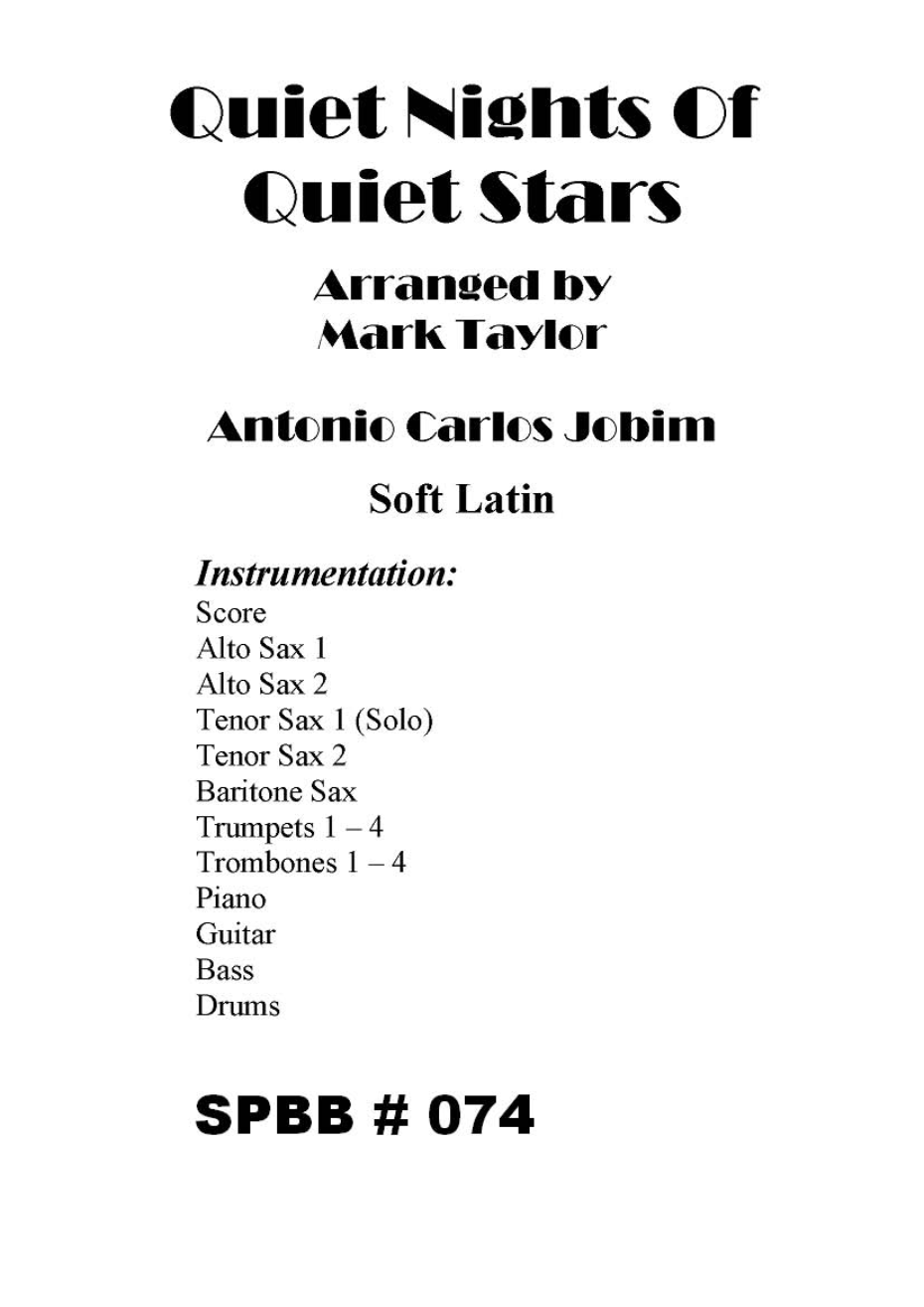
Quiet Nights Of Quiet Stars (M.Taylor) sheet music preview

Quiet Nights Of Quiet Stars (M.Taylor)

Composed by Antonio Carlos Jobim

Arranged by Mark Taylor

  • Ensemble: Big Band
  • Pages: 37
  • Instruments (17): Alto Sax 1, Alto Sax 2, Tenor Sax 1, Tenor Sax 2, Baritone Sax, Trumpet 1, Trumpet 2, Trumpet 3, Trumpet 4, Trombone 1, Trombone 2, Trombone 3, Trombone 4, Piano, Guitar, Bass, Drums
  • Difficulty: medium
  • Content: Individual Parts
  • Format: PDF Download (Instant)
  • Price: $24.99

"Corcovado," known in English as "Quiet Nights of Quiet Stars," stands as one of the crown jewels of the Bossa Nova movement, composed by the legendary Antonio Carlos Jobim in 1960. Immortalized globally by the historic 1963 collaboration between Stan Getz, João Gilberto, and Astrud Gilberto on *Getz/Gilberto*, this timeless masterpiece epitomizes the understated elegance, cool sophistication, and lush harmonic language of Brazilian jazz. Jobim’s evocative melody captures the tranquil beauty of a quiet night overlooking Rio de Janeiro, merging traditional samba rhythms with sophisticated American jazz harmonies that forever altered the landscape of modern popular music and jazz standards alike. Master arranger Mark Taylor brings his signature compositional polish to this definitive big band setting, crafting an arrangement that balances authentic Brazilian groove with rich, contemporary jazz orchestration. Unfolding at a relaxed, swaying Bossa Nova tempo, the chart opens with an atmospheric introduction that immediately establishes the tranquil yet alluring mood. Taylor utilizes warm, lush chord voicings across the saxophones and muted brass to evoke the breezy, coastal atmosphere of Copacabana. The energy remains sophisticated and intimate throughout, relying on subtle dynamic shifts and gorgeous harmonic colorations rather than high-octane bombast to captivate the listener. Taylor’s arrangement brilliantly showcases the texture of the modern 16-piece big band, cleverly dividing thematic material between shimmering woodwind solis and rich brass punctuations. The lead alto saxophone and flugelhorns (or trumpets on flugelhorns) frequently carry the primary melody, draped in sophisticated extended harmonies that highlight Jobim’s original chord substitutions. An expressive improvised solo section allows a featured soloist—ideally on tenor saxophone or guitar—to stretch out over a supportive, authentic rhythm section vamp. The ensemble writing avoids dense, cluttered scoring, instead favoring transparent textures that let the inherent beauty of the melody breathe while offering subtle counterlines that reward careful listening and precise execution. Advanced high school, collegiate, and professional jazz ensembles will find this chart to be an exceptional vehicle for developing stylistic versatility, subtle time-feel, and section cohesion. While the technical demands regarding range and velocity are moderate, the true challenge lies in capturing the elusive, relaxed eighth-note feel inherent to authentic Bossa Nova—avoiding any stiffness in the rhythm section and maintaining a feather-light touch in the brass. It serves as an ideal program contrast to high-energy swing or heavy funk charts, providing a sophisticated, romantic focal point for any concert or festival performance. Achieving an authentic performance of this Mark Taylor arrangement requires meticulous attention to the subtle, laid-back Bossa Nova groove. The rhythm section is the anchor: the drummer should utilize a clean, crisp cross-stick pattern on the snare alongside a steady bossa bass drum pulse, avoiding heavy ride cymbal crashes that can muddy the delicate texture. The bass player must lock in with a hypnotic, undulating two-measure cell rather than a driving walking bass line. For the wind players, the primary technical hurdle is stylistic rather than physical. Avoid over-blowing; brass players should use cup mutes or gentle harmonization to blend smoothly into the ensemble fabric. Articulations must be soft and rounded, treating eighth notes with an even, straight feel rather than a swung triplet interpretation. Rehearsals should focus heavily on section intonation, particularly during the dense chord voicings in the middle register, ensuring that the inner voices bloom without masking the lead melodic line. Q: What instruments and parts are included in this 16-instrument big band arrangement? A: The instrumentation features a standard 16-piece big band lineup comprising 2 alto saxophones, 2 tenor saxophones, baritone saxophone, 4 trumpets, 4 trombones, guitar, piano, bass, and drums, spanning a comprehensive 37-page score and set of parts. Q: What is the designated difficulty level for this chart? A: This arrangement is graded as medium (suitable for advanced high school, collegiate, and community big bands), requiring refined ensemble balance and stylistic awareness rather than extreme technical dexterity or upper-register endurance. Q: What is the musical style and historical background of the composition? A: Composed by Antonio Carlos Jobim in 1960 and popularized during the 1960s Bossa Nova craze, this piece represents the fusion of cool jazz harmony with traditional Brazilian samba rhythms. Q: What makes Mark Taylor’s specific arrangement unique? A: Taylor expertly balances lush, contemporary extended harmonies with transparent scoring, utilizing warm voicings and subtle counterlines that capture the serene, romantic atmosphere of Jobim's original vision without over-arranging the melody. Q: What is the recommended performance duration and tempo feel? A: The arrangement is set at a relaxed, steady Bossa Nova tempo (around 120-126 BPM for quarter notes) and typically runs approximately 3 to 4 minutes depending on the length of the improvised solo section.

Questions and answers

What is included in the Quiet Nights Of Quiet Stars (M.Taylor) PDF?
The verified current file contains individual parts across 37 pages.
How many instruments or parts are listed for Quiet Nights Of Quiet Stars (M.Taylor)?
The verified instrumentation list contains 17 entries for this Big Band arrangement.
Who is credited for Quiet Nights Of Quiet Stars (M.Taylor)?
Composer: Antonio Carlos Jobim. Arranger: Mark Taylor.
What difficulty is listed for Quiet Nights Of Quiet Stars (M.Taylor)?
The verified difficulty level is medium.
Can I preview Quiet Nights Of Quiet Stars (M.Taylor) before buying?
Yes. The product page provides a preview generated from the current PDF file.
How is Quiet Nights Of Quiet Stars (M.Taylor) delivered?
After successful payment, the digital PDF is made available for download. The displayed price is $24.99.

Musicians Also Search For

Quiet Nights Of Quiet Stars Mark Taylor PDFQuiet Nights Of Quiet Stars Mark Taylor sheet musicQuiet Nights Of Quiet Stars arranged by Mark TaylorMark Taylor big band chartsMark Taylor jazz arrangements PDFQuiet Nights Of Quiet Stars Antonio Carlos Jobim sheet musicQuiet Nights Of Quiet Stars Antonio Carlos Jobim big band arrangementsAntonio Carlos Jobim big band chartsQuiet Nights Of Quiet Stars big band arrangementsQuiet Nights Of Quiet Stars big band PDF downloadQuiet Nights Of Quiet Stars jazz sheet musicbig band sheet music downloadQuiet Nights Of Quiet Stars individual parts downloadQuiet Nights Of Quiet Stars sheet music PDFbuy Quiet Nights Of Quiet Stars sheet musicdownload Quiet Nights Of Quiet Stars PDFQuiet Nights Of Quiet Stars jazz chartsbest Mark Taylor big band arrangementsAntonio Carlos Jobim arranged by Mark TaylorQuiet Nights Of Quiet Stars printable sheet musicbig band repertoire PDF

All Antonio Carlos Jobim sheet music