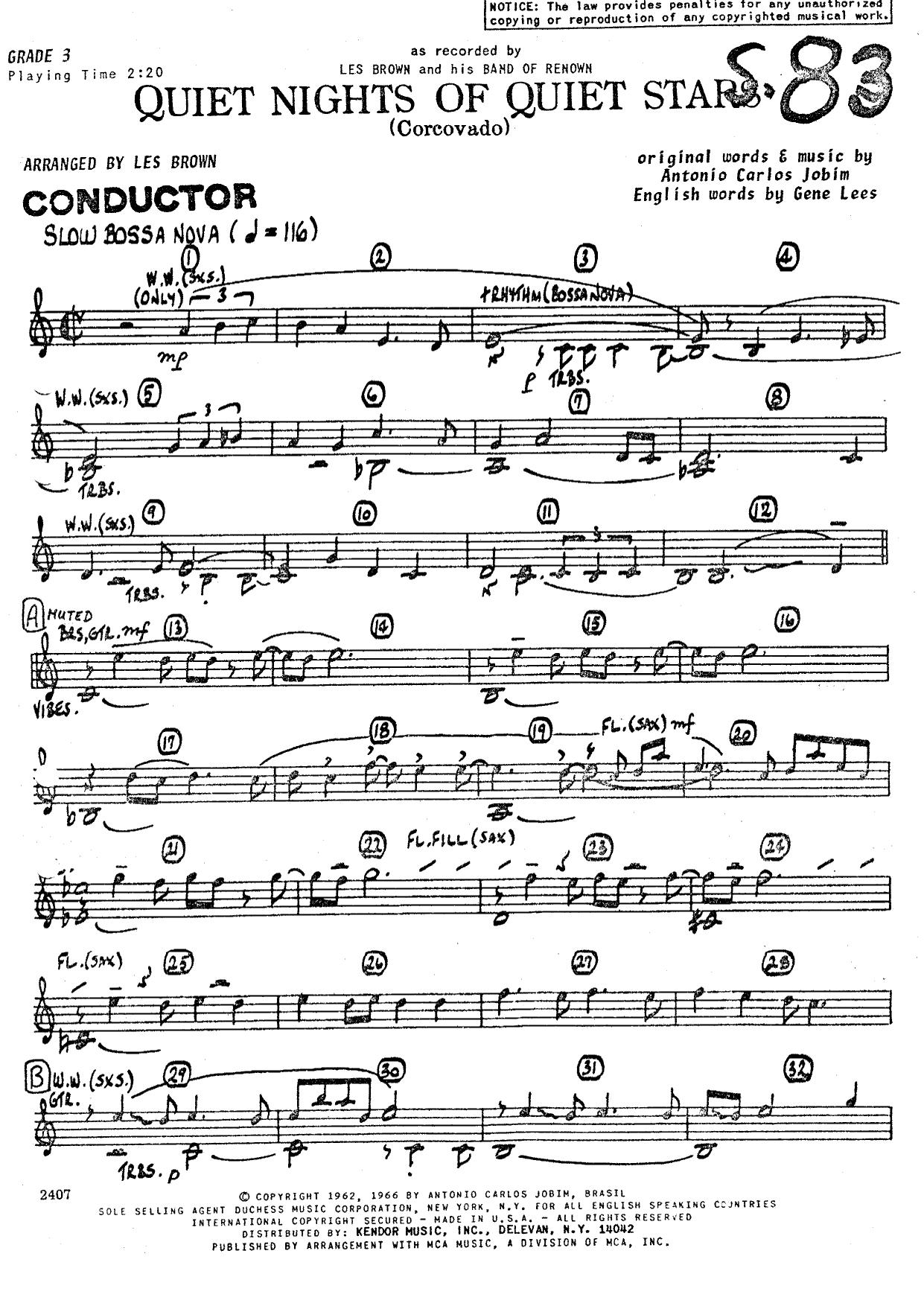
Quiet Nights Of Quiet Stars (L.Brown) sheet music preview

Quiet Nights Of Quiet Stars (L.Brown)

Composed by Antonio Carlos Jobim

Arranged by Les Brown

  • Ensemble: Big Band
  • Pages: 27
  • Instruments (18): Conductor, 1st Sax (Substitute Part - Eb Alto Sax), 2nd Eb Alto Sax, 3rd Sax (Substitute Part - Bb Tenor), 4th Bb Tenor Sax, Baritone (Optional), 1st Bb Trumpet, 2nd Bb Trumpet, Trumpet III, 4th Bb Trumpet, Trombone I, 2nd Trombone, 3rd Trombone, 4th Trombone, Bass, Rhythm Guitar, Drums, Piano
  • Difficulty: medium
  • Content: Individual Parts
  • Format: PDF Download (Instant)
  • Price: $24.99

Antonio Carlos Jobim’s timeless bossa nova masterpiece, "Corcovado" (known in English as "Quiet Nights Of Quiet Stars"), stands as one of the definitive pillars of the 1960s Brazilian jazz crossover movement that captivated North American audiences. Originally composed by Jobim with English lyrics later penned by Gene Lees, the tune gained international immortality through landmark recordings by Stan Getz, Astrud Gilberto, and Frank Sinatra. Within the jazz idiom, it represents a masterclass in harmonic economy and lyrical melancholy, blending traditional samba rhythms with sophisticated, impressionistic jazz harmonies that evoke the warm, tranquil atmosphere of a Rio de Janeiro evening. Crafted by legendary bandleader and master arranger Les Brown, this sophisticated big band adaptation translates the intimate aesthetic of the bossa nova into a lush, ensemble-wide sonic landscape. Maintaining a relaxed, undulating Latin groove at a comfortable medium-slow tempo, the chart opens with an evocative harmonic atmosphere that immediately establishes a mood of serene introspection and romantic warmth. Brown’s scoring relies heavily on transparent textures, allowing the rhythm section to maintain an authentic bossa nova pulse while the horns weave delicate, counter-melodic commentary around the primary thematic material. Les Brown’s signature arranging style shines through the clever use of close-position reed voicings and subtle dynamic shading, which prevent the texture from sounding heavy while still providing a rich, full-ensemble sound. Rather than relying on a bombastic shout chorus, Brown builds emotional intensity through gorgeous chordal expansions, delicate harmonic shifts, and tasteful counterlines in the lower brass. The arrangement features prominent spots for the saxophone section, utilizing a warm soli texture that highlights the inherent lyricism of Jobim's melody, alongside structured space for a featured soloist to improvise within the gentle harmonic framework of the form. Advanced high school, collegiate, and professional big bands will find this arrangement an exceptional vehicle for developing stylistic versatility, breath control, and subtle dynamic control. Because the chart relies entirely on stylistic nuance, ensemble listening, and rhythmic precision rather than sheer technical velocity, it provides an invaluable masterclass in restraint and musicality. Performing this piece challenges horn sections to balance lush, sustained chords against a delicate percussion-driven backdrop, making it a standout, sophisticated ballad-tempo feature for any sophisticated jazz ensemble concert program. Navigating this arrangement successfully requires the ensemble to master the delicate balance between a relaxed feel and absolute rhythmic precision. The rhythm section must anchor the performance with an authentic bossa nova groove—avoiding any tendency to rush or swing the eighth notes. Drummers should utilize a crisp cross-stick pattern on the snare with a steady ride cymbal pulse, while the bass player maintains an even, hypnotic two-bar bossa cell. For the wind players, the primary technical challenge lies in sustaining long, lyrical phrases with consistent intonation and vibrato control at soft dynamics. Horn players must take full advantage of breath marks and avoid forcing the sound; the beauty of Les Brown’s voicings depends on a warm, blended acoustic profile. Conductors should emphasize smooth voice-leading during rehearsals, ensuring that inner-voices in the saxophones and trombones balance cleanly beneath the lead melody. Mutes are generally not required, keeping the acoustic palette warm and natural. Q: What instruments and parts are included in this arrangement? A: This arrangement is scored for an 8-instrument ensemble comprising Alto Saxophone, Tenor Saxophone, Baritone Saxophone, Trumpet, and Trombone parts, supplemented by a full rhythm section across 27 total pages of music. Q: What is the difficulty level of this Les Brown arrangement? A: The arrangement is best suited for advanced high school, collegiate, and professional jazz ensembles due to its heavy reliance on subtle dynamic control, intonation, and stylistic restraint rather than fast technical passages. Q: What musical style and historical context define this chart? A: It is rooted in the 1960s bossa nova movement pioneered by Antonio Carlos Jobim, adapted through the swinging, sophisticated lens of legendary bandleader Les Brown's orchestral tradition. Q: What makes this specific arrangement unique compared to standard vocal charts? A: Instead of focusing on a vocal soloist, Les Brown's instrumental treatment reinterprets Jobim's classic melody through exquisite chordal voicings, lush reed solis, and subtle harmonic counterlines tailored specifically for a jazz horn section. Q: What is the recommended performance tempo and duration? A: The chart is performed at a relaxed, medium-slow bossa nova tempo (approximately 116–124 BPM), resulting in a standard performance duration of roughly 3 to 4 minutes depending on solo extensions.

Questions and answers

What is included in the Quiet Nights Of Quiet Stars (L.Brown) PDF?
The verified current file contains a conductor score and individual parts across 27 pages.
How many instruments or parts are listed for Quiet Nights Of Quiet Stars (L.Brown)?
The verified instrumentation list contains 18 entries for this Big Band arrangement.
Who is credited for Quiet Nights Of Quiet Stars (L.Brown)?
Composer: Antonio Carlos Jobim. Arranger: Les Brown.
What difficulty is listed for Quiet Nights Of Quiet Stars (L.Brown)?
The verified difficulty level is medium.
Can I preview Quiet Nights Of Quiet Stars (L.Brown) before buying?
Yes. The product page provides a preview generated from the current PDF file.
How is Quiet Nights Of Quiet Stars (L.Brown) delivered?
After successful payment, the digital PDF is made available for download. The displayed price is $24.99.

Musicians Also Search For

Quiet Nights Of Quiet Stars Les Brown PDFQuiet Nights Of Quiet Stars Les Brown sheet musicQuiet Nights Of Quiet Stars arranged by Les BrownLes Brown big band chartsLes Brown jazz arrangements PDFQuiet Nights Of Quiet Stars Antonio Carlos Jobim sheet musicQuiet Nights Of Quiet Stars Antonio Carlos Jobim big band arrangementsAntonio Carlos Jobim big band chartsQuiet Nights Of Quiet Stars big band arrangementsQuiet Nights Of Quiet Stars big band PDF downloadQuiet Nights Of Quiet Stars jazz sheet musicbig band sheet music downloadQuiet Nights Of Quiet Stars conductor score PDFQuiet Nights Of Quiet Stars individual parts downloadQuiet Nights Of Quiet Stars sheet music PDFbuy Quiet Nights Of Quiet Stars sheet musicdownload Quiet Nights Of Quiet Stars PDFQuiet Nights Of Quiet Stars jazz chartsbest Les Brown big band arrangementsAntonio Carlos Jobim arranged by Les BrownQuiet Nights Of Quiet Stars printable sheet musicbig band repertoire PDF

All arrangements by Les Brown All Antonio Carlos Jobim sheet music