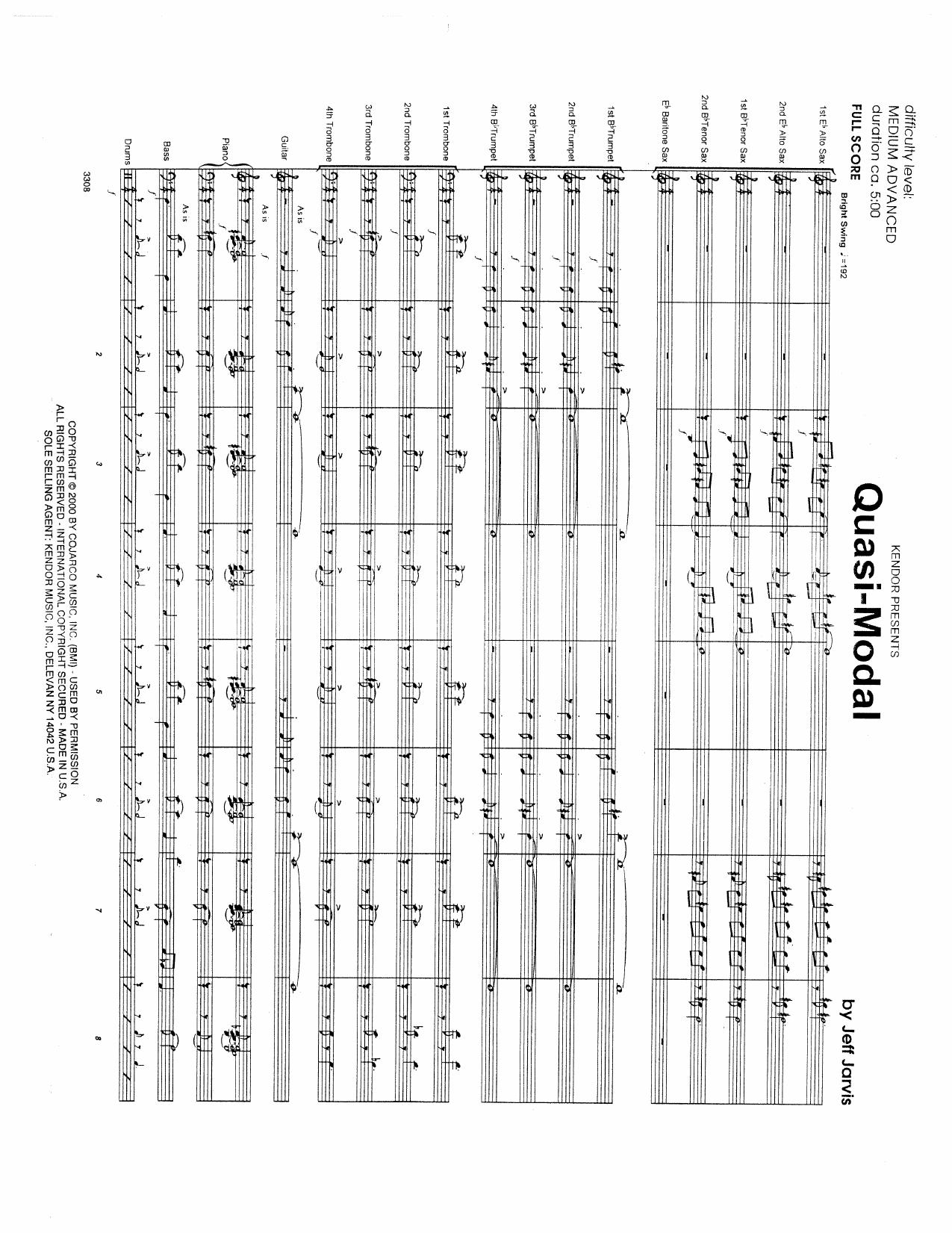
Quasi-Modal (J.Jarvis)
Composed by Jeff Jarvis
Arranged by Jeff Jarvis
- Ensemble: Big Band
- Pages: 99
- Instruments (17): 1st Eb Alto Sax, 2nd Eb Alto Sax, 1st Bb Tenor Sax, 2nd Bb Tenor Sax, Eb Baritone Sax, 1st Bb Trumpet, 2nd Bb Trumpet, 3rd Bb Trumpet, 4th Bb Trumpet, 1st Trombone, 2nd Trombone, 3rd Trombone, 4th Trombone, Guitar, Piano, Bass, Drums
- Difficulty: advanced
- Content: Individual Parts
- Format: PDF Download (Instant)
- Price: $24.99
Jeff Jarvis originally crafted "Quasi-Modal" as a masterclass in modern big band writing, bridging the gap between post-bop modal exploration and contemporary jazz ensemble accessibility. Drawing inspiration from the modal jazz innovations pioneered by Miles Davis and Wayne Shorter, the composition constructs an open harmonic framework that encourages linear freedom while maintaining the tight, punchy discipline characteristic of elite contemporary big band literature. The title itself hints at the dual nature of the work: it flirts with modal stagnation and freedom, yet continually grounds itself through clever structural anchors and driving rhythmic momentum. Driven by an engaging, infectious modern groove rather than a traditional straight-ahead swing feel, "Quasi-Modal" operates at an assertive medium-up tempo that commands continuous ensemble alertness. The harmonic landscape shifts fluidly between suspended modal plateaus and unexpected chromatic passing chords, evoking a mood that is simultaneously intellectual, coolly sophisticated, and high-energy. The arrangement opens with an atmospheric, rhythm-section-driven vamp before the horns enter with interlocking, linear motifs that establish the primary thematic material. Jarvis constructs rich, contemporary block-voicing for the saxophones that gradually opens up into roaring brass counterlines, creating a dynamic texture that continually reinvents the underlying tension. The structural brilliance of this chart lies in its clever distribution of melodic responsibility and space for improvisation. The primary melody is introduced cleanly by the trumpet and alto saxophone sections, working in unison before expanding into lush, fourth-based harmonies. Solo opportunities are thoughtfully integrated into the arrangement, providing designated soloists a generous modal canvas—often anchored by two-chord or cyclical vamps—to stretch out melodically without getting lost in dense chord changes. Technical challenges for the ensemble center primarily on precision articulation, maintaining consistent time feel through shifting metric accents, and blending complex chord extensions across the brass and reed sections. The climax features a towering shout chorus that builds organically out of a cyclical ostinato, showcasing brass pyrotechnics and aggressive ensemble syncopation before winding down to a cool, suspenseful coda. Advanced high school, collegiate, and professional jazz ensembles will find "Quasi-Modal" to be an exceptionally rewarding addition to their repertoire. It provides an ideal vehicle for teaching students how to phrase in a modern modal style, emphasizing horizontal line-reading over vertical chord-crunching. Directors looking to challenge their horn sections with sophisticated contemporary voicings while offering their rhythm section an opportunity to lock into a demanding, infectious groove will discover that Jarvis has engineered a masterclass in modern big band arrangement. Success with "Quasi-Modal" hinges heavily on the rhythm section's ability to establish a deep, unhurried pocket that anchors the modal harmonies. The drummer should avoid heavy, predictable ride-cymbal swing patterns, opting instead for a conversational, interactive approach that complements the shifting accents of the horn lines. Piano and guitar players must voice chords sparsely, utilizing open-voiced fourths and avoiding cluttered rootless voicings that might muddy the modal clarity. For the wind sections, precision in articulation is paramount; short, accented notes must be clipped sharply to contrast against the flowing, legato modal lines. Watch out for dynamic balance during the dense ensemble passages, ensuring that the inner-voice harmony in the trombones and tenor saxophones cuts through without masking the lead trumpet. Directors should rehearse the transitional vamps separately to ensure seamless tempo stability before attempting the full form of the chart. Q: What instrumentation and parts are included in this publication? A: The 99-page package includes a full conductor score and complete parts for a standard 17-instrument big band: 2 altos, 2 tenors, 1 baritone saxophone, 4 trumpets, 4 trombones, guitar, piano, bass, and drums. Q: What is the difficulty level of "Quasi-Modal"? A: This arrangement is graded as advanced (Level 4/5), making it best suited for accomplished high school jazz ensembles, university bands, and professional community big bands. Q: What is the musical style and historical background of the piece? A: Written by renowned composer and arranger Jeff Jarvis, the piece is a contemporary jazz composition heavily influenced by the modal jazz movement of the 1960s, blending open harmonic structures with modern big band energy. Q: What makes this specific arrangement unique? A: It uniquely balances modal freedom with tight, aggressive big band shout choruses, offering spacious solo sections built over cyclical vamps that encourage creative, linear improvisation. Q: What is the performance tempo and expected duration? A: The piece is set at an energetic, driving medium-up tempo with a modern groove feel, and typically runs between 5 to 6 minutes in performance duration depending on solo lengths.
Questions and answers
- What is included in the Quasi-Modal (J.Jarvis) PDF?
- The verified current file contains a conductor score and individual parts across 99 pages.
- How many instruments or parts are listed for Quasi-Modal (J.Jarvis)?
- The verified instrumentation list contains 17 entries for this Big Band arrangement.
- Who is credited for Quasi-Modal (J.Jarvis)?
- Composer: Jeff Jarvis. Arranger: Jeff Jarvis.
- What difficulty is listed for Quasi-Modal (J.Jarvis)?
- The verified difficulty level is advanced.
- Can I preview Quasi-Modal (J.Jarvis) before buying?
- Yes. The product page provides a preview generated from the current PDF file.
- How is Quasi-Modal (J.Jarvis) delivered?
- After successful payment, the digital PDF is made available for download. The displayed price is $24.99.
Musicians Also Search For
Quasi-Modal Jeff Jarvis PDF • Quasi-Modal Jeff Jarvis sheet music • Quasi-Modal arranged by Jeff Jarvis • Jeff Jarvis big band charts • Jeff Jarvis jazz arrangements PDF • Quasi-Modal Jeff Jarvis big band arrangements • Quasi-Modal big band arrangements • Quasi-Modal big band PDF download • Quasi-Modal jazz sheet music • big band sheet music download • Quasi-Modal conductor score PDF • Quasi-Modal individual parts download • Quasi-Modal sheet music PDF • buy Quasi-Modal sheet music • download Quasi-Modal PDF • Quasi-Modal jazz charts • best Jeff Jarvis big band arrangements • Quasi-Modal printable sheet music • big band repertoire PDF