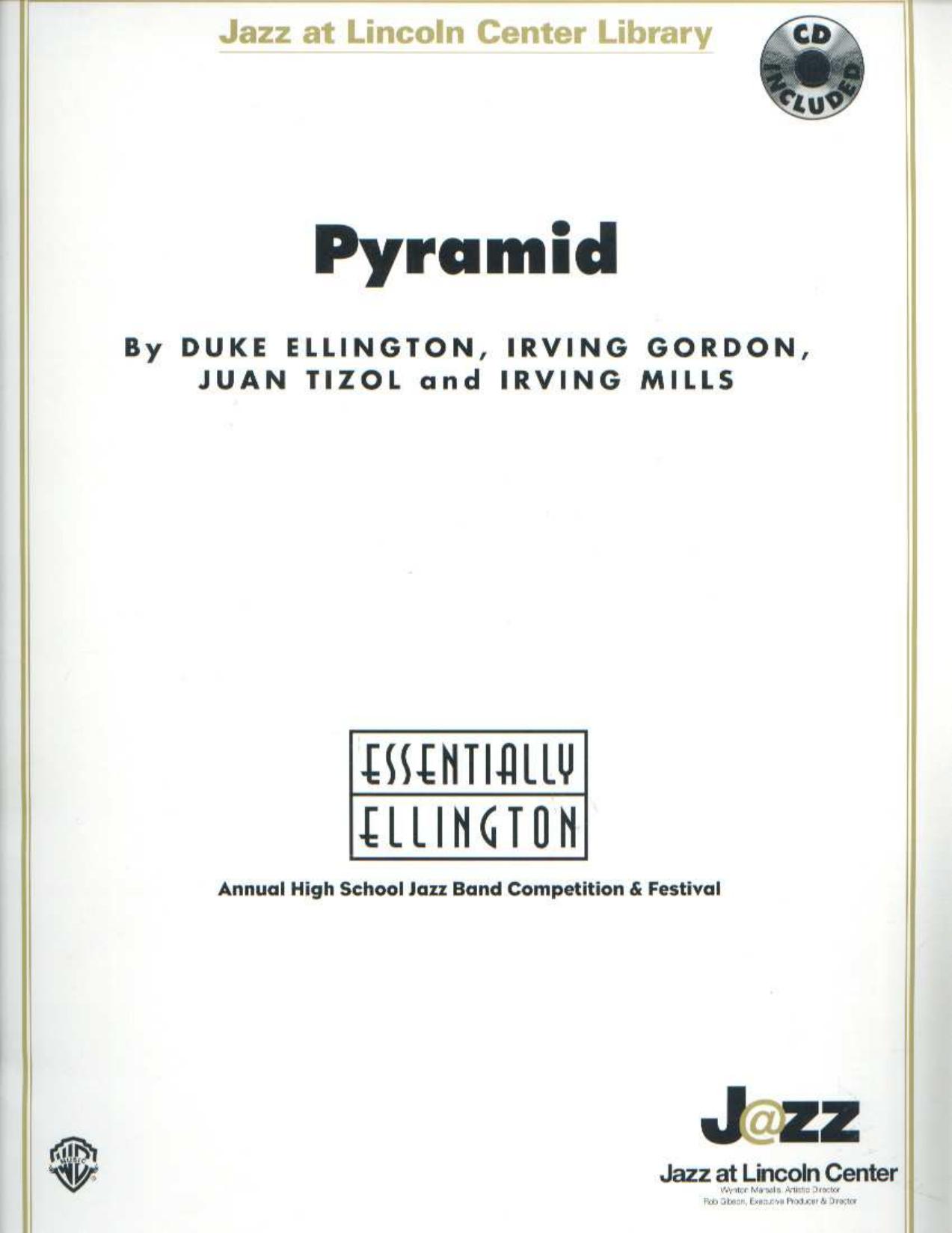
Pyramid (D.Ellington)
Composed by Duke Ellington
Arranged by Duke Ellington & B.Strayhorn.D.Berger
- Ensemble: Big Band
- Pages: 32
- Instruments (15): Reed 1 Alto Sax, Reed 2 Alto Sax, Reed 3 Clarinet, Reed 4 Tenor Sax, Reed 5 Bari Sax, Trumpet 1, Trumpet 2, Trumpet 3, Trumpet 4, Trombone 1, Trombone 2, Trombone 3, Bass, Drums, Maracas
- Difficulty: medium
- Content: Individual Parts
- Format: PDF Download (Instant)
- Price: $24.99
Duke Ellington’s compositional genius reached its zenith during his historic collaborations with co-arranger Billy Strayhorn, producing sophisticated orchestral miniatures that defied simple categorization within the swing era. "Pyramid," originally recorded by the Duke Ellington Orchestra in 1938, stands as a mesmerizing example of Ellington's exotic, mood-painting style—often referred to in his catalog as "impressionistic jazz." Written during a period when the orchestra was expanding its harmonic palette and exploring modal-leaning textures well before the modal jazz movement of the late 1950s, the piece utilizes an enigmatic, ancient-sounding motif that evokes the mystique of the desert. Unlike the high-octane jump tunes of the era, "Pyramid" relies on dense, haunting sonorities, slow-burning tension, and rich instrumental colorations that showcase Ellington's unique philosophy of writing specifically for the individual tonal personalities of his sidemen. This definitive big band publication, edited and transcribed by jazz historian and arranger David Berger in collaboration with the Ellington-Strayhorn legacy, captures the nocturnal atmosphere and sultry medium-tempo swing feel of the original Victor recording. The musical landscape is defined by its dark, brooding key center and unusual chord progressions, creating an air of suspense and timeless elegance. The mood shifts masterfully between hushed, shimmering ensemble voicings and deeply expressive blues-inflected statements. The arrangement exploits the lower registers of the woodwinds—featuring a distinctive clarinet and saxophone voicing—to establish a rich, velvety foundation beneath undulating brass figures that evoke sweeping desert winds. Berger’s meticulous transcription retains the subtle interplay and sophisticated Ellingtonian harmonies that separate this chart from standard stock arrangements. The chart opens with an evocative, atmospheric introduction before settling into a persistent, hypnotic groove anchored by the rhythm section. Reed-heavy textures carry much of the thematic material, utilizing Ellington’s favored voicing techniques where the clarinet doubles the lead alto saxophone an octave higher, creating a piercing yet creamy timbre. Solos are integrated organically into the structural fabric, allowing featured improvisers space to stretch out over exotic modal vamps rather than standard functional changes. The ensemble writing demands precise dynamic control, particularly in maintaining a balanced blend during the subdued transitional passages that lead into the chart's smoldering developmental climaxes. Advanced high school, collegiate, and professional jazz ensembles will find this arrangement an exceptional vehicle for developing sophisticated ensemble listening, intonation, and stylistic nuance. Because the chart relies less on sheer velocity and much more on tone color, dynamic subtlety, and deep rhythmic pocket-playing, it offers a masterclass in Ellingtonian ensemble discipline. Performing "Pyramid" challenges modern big bands to look beyond traditional swing-era bombast and embrace a more textural, cinematic approach to jazz orchestration, making it a show-stopping, highly sophisticated centerpiece for any serious concert or festival program. Conductors approaching "Pyramid" must prioritize balance, timbre, and deep stylistic cohesion over volume. The tempo should remain a steady, unhurried medium swing that lets the heavy, nocturnal groove breathe naturally without dragging. A primary technical challenge lies in the intricate reed voicings; the clarinet and saxophone sections must blend seamlessly, matching vibrato widths and articulation styles to achieve Ellington's signature vocal-like quality. Pay close attention to dynamic markings, as the emotional impact of the chart depends heavily on sudden drops from rich ensemble crescendos down to a mysterious whisper. Brass players should utilize subtle, tasteful plunger or cup mutes where appropriate to enhance the exotic textures, avoiding excessive edge in their tone. Rehearsal time should be dedicated first to locking in the rhythm section's undercurrent, ensuring the bass and ride cymbal establish a relentless, hypnotic pulse before layering the complex horn harmonies on top. Q: What instruments and parts are included in this arrangement? A: The instrumentation features 15 parts total, specifically scored for Alto Saxophone 1, Alto Saxophone 2, Clarinet, Tenor Saxophone, Baritone Saxophone, plus standard brass and rhythm sections, accompanied by a comprehensive 32-page conductor score. Q: What is the difficulty level of this chart? A: This arrangement is graded as advanced, making it best suited for college, advanced high school, and professional big bands that possess strong section-playing capabilities and mature stylistic awareness. Q: What is the historical style and background of "Pyramid"? A: Composed by Duke Ellington and associated with his legendary late-1930s orchestra, "Pyramid" represents Ellington's impressionistic, exotic style, blending elements of early swing with modal-leaning, atmospheric harmonies. Q: What makes this specific David Berger arrangement unique? A: Meticulously transcribed and edited by David Berger from the original Ellington recordings, this version authentically preserves the complex, low-register woodwind voicings and nuanced dynamic contrasts that standard stock charts overlook. Q: What is the performance duration and tempo feel of the piece? A: The piece is structured around a sultry, hypnotic medium-swing feel in 4/4 time, typically lasting between 4 to 5 minutes depending on the length of the integrated improvised solos.
Questions and answers
- What is included in the Pyramid (D.Ellington) PDF?
- The verified current file contains a conductor score and individual parts across 32 pages.
- How many instruments or parts are listed for Pyramid (D.Ellington)?
- The verified instrumentation list contains 15 entries for this Big Band arrangement.
- Who is credited for Pyramid (D.Ellington)?
- Composer: Duke Ellington. Arranger: Duke Ellington & B.Strayhorn.D.Berger.
- What difficulty is listed for Pyramid (D.Ellington)?
- The verified difficulty level is medium.
- Can I preview Pyramid (D.Ellington) before buying?
- Yes. The product page provides a preview generated from the current PDF file.
- How is Pyramid (D.Ellington) delivered?
- After successful payment, the digital PDF is made available for download. The displayed price is $24.99.
Musicians Also Search For
Pyramid Duke Ellington & B.Strayhorn.D.Berger PDF • Pyramid Duke Ellington & B.Strayhorn.D.Berger sheet music • Pyramid arranged by Duke Ellington & B.Strayhorn.D.Berger • Duke Ellington & B.Strayhorn.D.Berger big band charts • Duke Ellington & B.Strayhorn.D.Berger jazz arrangements PDF • Pyramid Duke Ellington sheet music • Pyramid Duke Ellington big band arrangements • Duke Ellington big band charts • Pyramid big band arrangements • Pyramid big band PDF download • Pyramid jazz sheet music • big band sheet music download • Pyramid conductor score PDF • Pyramid individual parts download • Pyramid sheet music PDF • buy Pyramid sheet music • download Pyramid PDF • Pyramid jazz charts • best Duke Ellington & B.Strayhorn.D.Berger big band arrangements • Duke Ellington arranged by Duke Ellington & B.Strayhorn.D.Berger • Pyramid printable sheet music • big band repertoire PDF