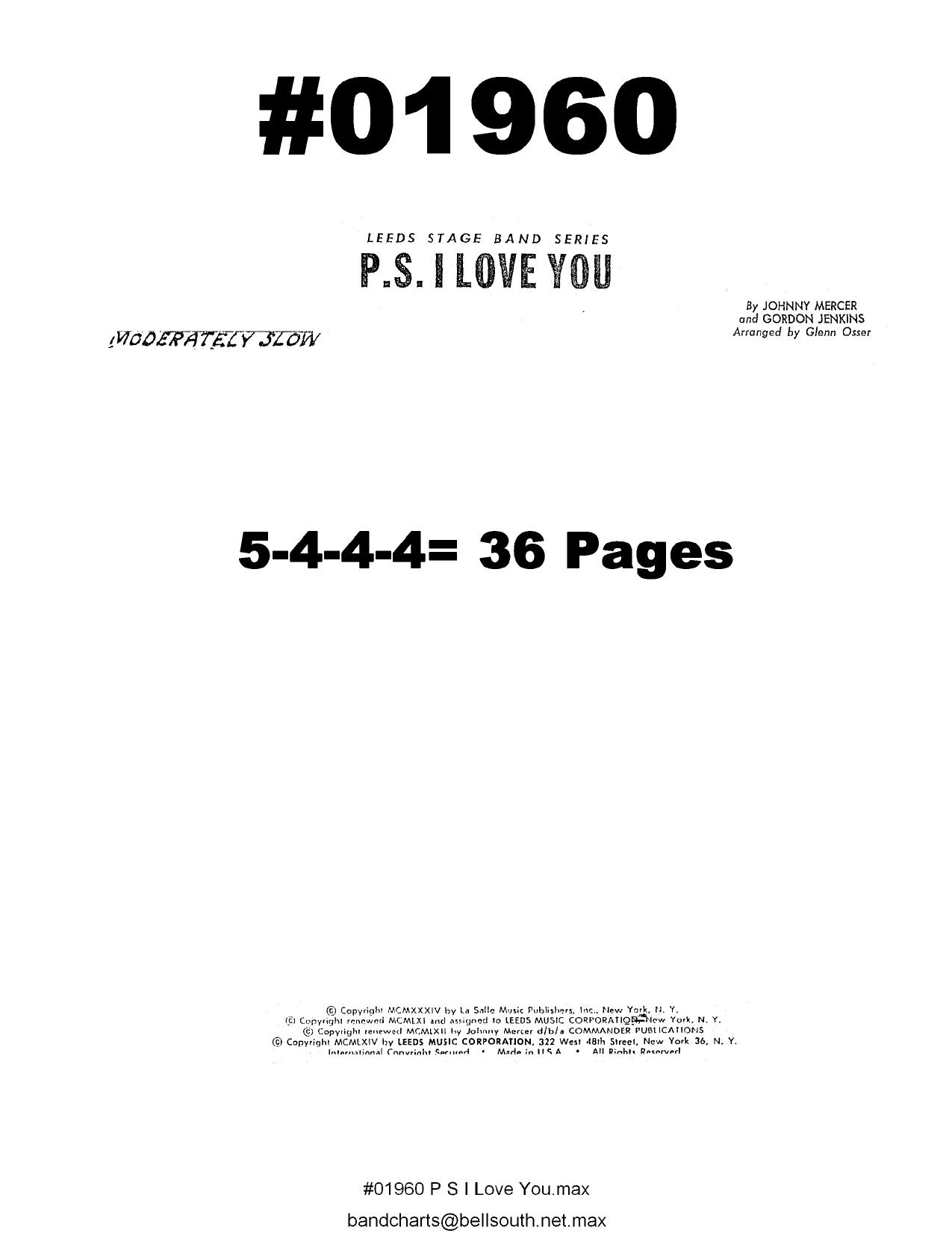
P.S. I Love You (G.Osser) sheet music preview

P.S. I Love You (G.Osser)

Composed by Johnny Mercer

Arranged by Glenn Osser

  • Ensemble: Big Band
  • Pages: 37
  • Instruments (17): 1st Bb Trumpet, 2nd Bb Trumpet, 3rd Bb Trumpet, 4th Bb Trumpet, 1st Trombone, 2nd Trombone, 3rd Trombone, 4th Trombone, 1st Eb Alto Sax, 3rd Eb Alto Sax, 2nd Bb Tenor Sax, 4th Bb Tenor Sax, 5th Eb Baritone Sax, String Bass, Drums, Guitar, Piano (Accordion)
  • Difficulty: medium
  • Content: Individual Parts
  • Format: PDF Download (Instant)
  • Price: $24.99

Johnny Mercer and Gordon Jenkins penned "P.S. I Love You" in 1934, establishing a lush, romantic standard that would eventually cross over from the Great American Songbook into the permanent jazz repertoire. While recorded by numerous vocalists and instrumentalists across the decades, the tune truly found its footing in jazz instrumentation as a vehicle for expressive balladry and sophisticated harmonic exploration. The mid-century big band era embraced its sweeping melody and bittersweet nostalgia, transforming the Tin Pan Alley pop tune into a masterclass in dynamic control and lyricism. Glenn Osser’s masterful big band arrangement captures the essence of classic 1950s arranging, characterized by rich, velvety saxophone solis, warm brass voicings, and an underlying medium-to-slow swing feel that emphasizes emotional resonance over sheer velocity. Set in a comfortable yet harmonically vibrant key, the chart exudes a warm, cinematic mood reminiscent of late-night radio broadcasts and sophisticated supper clubs. Osser avoids dense, dissonant modernisms in favor of lush, extended tertian harmonies, utilizing major 7ths, added 9ths, and smooth chromatic voice-leading to elevate the emotional weight of Mercer's original melody. The texture is transparent, allowing every section to breathe while maintaining a thick, luxurious harmonic cushion. The arrangement opens with an inviting introduction that sets a reflective mood before transitioning into the primary thematic statements. The saxophone section carries much of the melodic weight early on, exhibiting Osser’s signature knack for tight, Glenn Miller-esque block voicings that blend seamlessly. Brass sections enter with gentle, cushioned counter-melodies and warm sustained pads, building subtle dramatic tension without ever overpowering the delicate balance. Featured solo space allows a lead horn—ideally a breathy tenor saxophone or a muted trumpet—to improvise over changes that stay true to the romantic contour of the tune. Technical demands are moderate rather than virtuosic, placing a premium on intonation, blend, vibrato control, and phrasing rather than high-note endurance or breakneck fingerbusters. Advanced high school ensembles, collegiate jazz orchestras, and professional community big bands will find this chart an ideal vehicle for working on ensemble listening and ballad playing. Because the difficulties lie in subtle stylistic execution—such as maintaining a consistent swing eighth-note subdivision at a relaxed tempo and achieving a unified saxophone blend—it serves as an invaluable educational tool. Conductors will appreciate how naturally the arrangement sits under the fingers of the players, freeing up the ensemble to focus entirely on nuance, dynamic contrast, and deep, expressive storytelling. Achieving the proper execution of Glenn Osser’s arrangement requires meticulous attention to balance, intonation, and a relaxed, forward-moving tempo. Set the feel as a laid-back medium swing (approximately quarter note = 96–104 BPM), ensuring that the rhythm section maintains a feather-light ride cymbal pattern and an understated walking bass line that never rushes. The primary technical challenge is maintaining warmth and precise intonation during exposed, soft ensemble passages where minor pitch discrepancies become immediately apparent. Saxophones should focus on a unified, homogeneous tone color, keeping vibrato controlled and matching the lead alto's phrasing precisely. Brass players must prioritize a warm, round attack, avoiding any harsh brassy edges on sustained chords. Mutes are generally not required, keeping the natural acoustic palette rich and organic. Rehearsal should begin with the rhythm section alone to lock in the subtle groove, followed by sectional balance checks before combining the full ensemble. Pay close attention to dynamic markings; the emotional impact of this chart relies entirely on seamless crescendos and decrescendos rather than sudden volume shifts. Q: What instruments and parts are included in this arrangement? A: The arrangement is scored for a 9-instrument big band instrumentation, featuring Alto Saxophone, Tenor Saxophone, Baritone Saxophone, Trumpet, Trombone, and a complete rhythm section framework spanning 37 pages of parts and score. Q: What is the difficulty level of this chart? A: This arrangement is well-suited for intermediate to advanced high school, collegiate, and professional community jazz bands, focusing primarily on blend, intonation, and phrasing rather than extreme technical virtuosity. Q: What is the style and historical context of this piece? A: Written by Johnny Mercer and arranged by Glenn Osser, this chart embodies the sophisticated, lush ballad style of mid-century big bands, transforming a 1934 Tin Pan Alley standard into a classic jazz expression. Q: What makes Glenn Osser's arrangement unique? A: Osser distinguishes his treatment through signature velvety saxophone block voicings, transparent textures, and sophisticated extended harmonies that prioritize emotional depth and cinematic warmth over heavy dissonance. Q: What is the performance duration and recommended tempo? A: The arrangement is designed as a relaxed medium swing ballad, typically clocking in around 3 to 4 minutes with a recommended tempo of approximately quarter note = 96–104 BPM.

Questions and answers

What is included in the P.S. I Love You (G.Osser) PDF?
The verified current file contains individual parts across 37 pages.
How many instruments or parts are listed for P.S. I Love You (G.Osser)?
The verified instrumentation list contains 17 entries for this Big Band arrangement.
Who is credited for P.S. I Love You (G.Osser)?
Composer: Johnny Mercer. Arranger: Glenn Osser.
What difficulty is listed for P.S. I Love You (G.Osser)?
The verified difficulty level is medium.
Can I preview P.S. I Love You (G.Osser) before buying?
Yes. The product page provides a preview generated from the current PDF file.
How is P.S. I Love You (G.Osser) delivered?
After successful payment, the digital PDF is made available for download. The displayed price is $24.99.

Musicians Also Search For

P.S. I Love You Glenn Osser PDFP.S. I Love You Glenn Osser sheet musicP.S. I Love You arranged by Glenn OsserGlenn Osser big band chartsGlenn Osser jazz arrangements PDFP.S. I Love You Johnny Mercer sheet musicP.S. I Love You Johnny Mercer big band arrangementsJohnny Mercer big band chartsP.S. I Love You big band arrangementsP.S. I Love You big band PDF downloadP.S. I Love You jazz sheet musicbig band sheet music downloadP.S. I Love You individual parts downloadP.S. I Love You sheet music PDFbuy P.S. I Love You sheet musicdownload P.S. I Love You PDFP.S. I Love You jazz chartsbest Glenn Osser big band arrangementsJohnny Mercer arranged by Glenn OsserP.S. I Love You printable sheet musicbig band repertoire PDF

All arrangements by Glenn Osser All Johnny Mercer sheet music