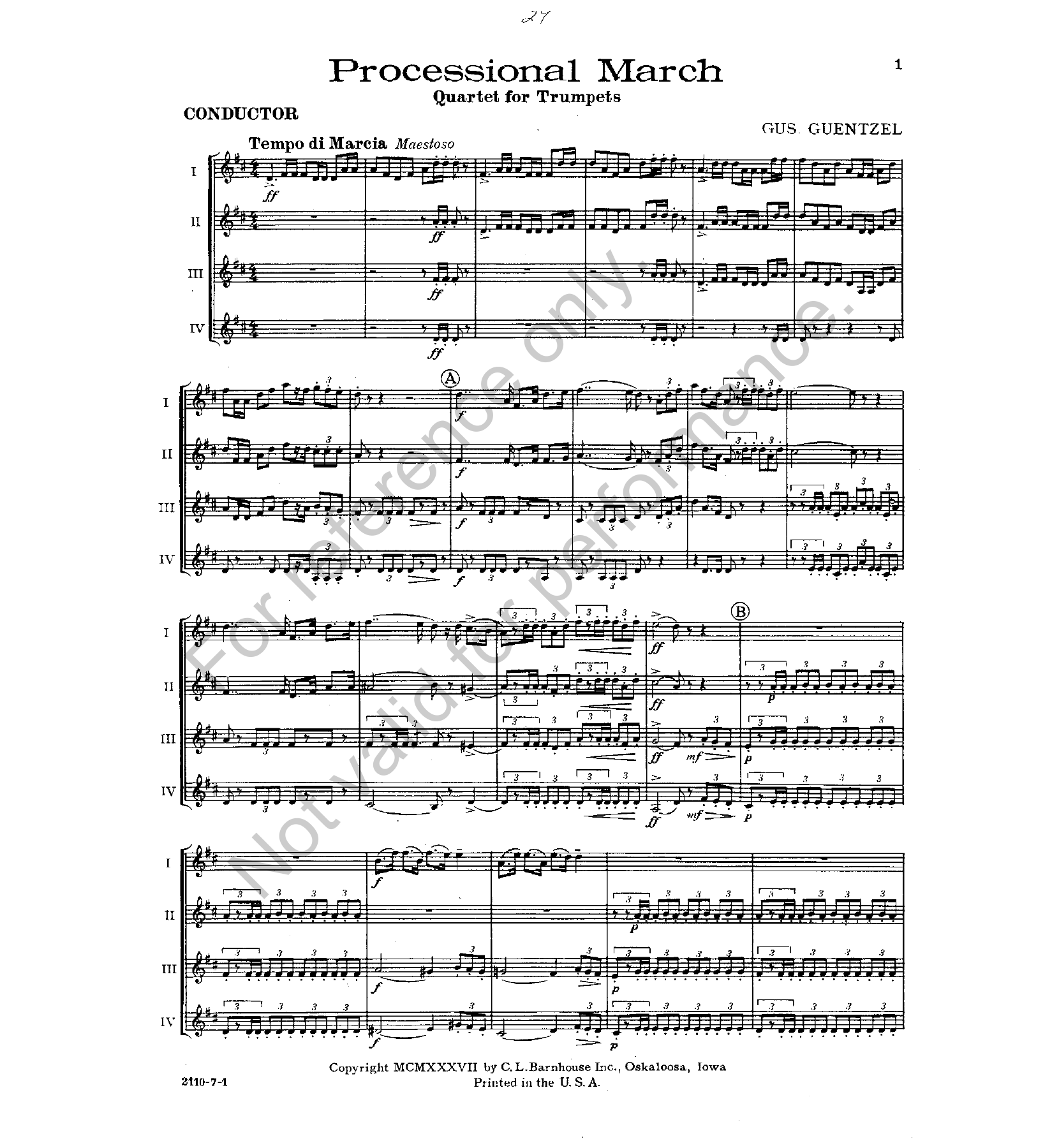
Processional March (G.Guentzel)
Composed by Gus Guentzel
Arranged by Gus. Guentzel
- Ensemble: Small Ensemble
- Style: Jazz Standard
- Pages: 3
- Difficulty: easy
- Content: Sheet Music
- Format: PDF Download (Instant)
- Price: $12.99
"Processional March," composed and arranged by Gus. Guentzel in 1937, emerges from an era rich with diverse musical influences, bridging the late big band swing period and the burgeoning bebop movement. While not a jazz standard in the improvisational sense, this piece reflects the compositional rigor and melodic clarity characteristic of Guentzel's prolific output for various ensembles, often rooted in traditional march and concert band styles. Guentzel himself was a respected composer, arranger, and musician, known for his work with brass and woodwind ensembles, and later for film studios in Hollywood. His compositions, like this "Processional March," are notable for their robust construction and appeal to both performers and audiences, embodying a formal yet engaging musicality. This arrangement of "Processional March" is conceived as a medium swing, offering a stately yet propulsive feel in a bright, accessible key, likely F major or Bb major, typical for brass-centric pieces. The mood is celebratory and grand, evoking a sense of dignified procession while maintaining an underlying rhythmic energy suitable for a small jazz ensemble. Its character is one of controlled exuberance, designed to uplift and inspire. The piece balances melodic strength with harmonic interest, providing a solid foundation for ensemble interplay. The energy is consistently high, driven by a steady, swinging pulse that encourages precise articulation and dynamic contrast from all instrumentalists. Gus. Guentzel's approach to this arrangement emphasizes clarity and melodic integrity. While the original composition is a march, this jazz arrangement reinterprets its thematic material through the lens of swing. Expect well-crafted soli sections that showcase different instrumental groups, potentially featuring intricate counterpoint or harmonized melody lines. Guentzel, known for his detailed scoring, likely employs rich, full voicings, even within a small ensemble context, to give the piece a larger-than-life sound. The arrangement may feature a "shout chorus" where the full ensemble plays with maximum intensity, driving towards a powerful conclusion. Signature techniques might include a blend of traditional march-like fanfares with syncopated jazz rhythms, creating a unique hybrid sound that is both familiar and fresh. The melody is primarily carried by the lead voices, often the trumpet or alto saxophone, with supporting lines woven throughout the ensemble. While the original march format might not traditionally include extended improvisational sections, this jazz arrangement for small ensemble provides ample opportunity for featured solos over its strong harmonic progression, allowing individual musicians to express themselves within the piece's structured framework. Technical challenges include maintaining precise ensemble rhythm in the swing feel, navigating potentially intricate soli passages, and executing dynamic swells and releases with unified intent. The reward lies in performing a piece that is both historically significant in its compositional origin and musically satisfying in its jazz reinterpretation, offering a blend of tradition and swing that is highly engaging. This arrangement is particularly suitable for college and community jazz ensembles, as well as advanced high school groups, providing an excellent vehicle for developing ensemble precision, stylistic understanding, and soloistic confidence within a structured, yet swinging, context. "Processional March" should be approached with a medium swing feel, emphasizing a lifted, buoyant quarter note rather than a heavy, driving one. The tempo should be consistent, allowing the melodic lines to breathe while maintaining forward momentum. Key technical challenges include achieving unified articulation in the brass soli sections, particularly in any fanfare-like passages, and ensuring the rhythm section provides a steady, yet flexible, foundation. Conductors should encourage musicians to phrase across bar lines, particularly in the longer melodic statements, to enhance the piece's processional flow. Dynamics are crucial; dramatic contrasts between forte and piano sections will highlight the piece's inherent grandeur. While specific special techniques like plunger mutes or falls might be cued in the parts, musicians should be prepared to execute standard jazz inflections such as scoops and subtle vibrato where appropriate to enhance the swing feel. Rehearsal tips include isolating soli passages for intonation and rhythmic accuracy, and working on the overall dynamic arc to build effectively towards the climactic moments. Q: What instruments/parts are included in this small ensemble arrangement? A: This small ensemble arrangement typically includes parts for standard jazz instrumentation, such as lead alto saxophone, tenor saxophone, trumpet, trombone, piano, bass, and drums. Specific voicings may vary, but it is designed for a compact yet full sound. Q: What is the difficulty level of "Processional March (G. Guentzel)" for a jazz ensemble? A: This arrangement is rated as a Grade 4, making it suitable for college, community, and advanced high school jazz ensembles. It presents challenges in ensemble precision, dynamic control, and stylistic interpretation, while remaining accessible to dedicated musicians. Q: What is the musical style and historical context of this arrangement? A: Originally composed as a march in 1937, this arrangement reinterprets the piece as a medium swing jazz work. It blends the formal structure and melodic strength of a traditional march with the rhythmic vitality and harmonic language of the swing era. Q: What makes this arrangement unique compared to other jazz ensemble pieces? A: Its uniqueness stems from its origin as a formal march by Gus. Guentzel, reimagined with a medium swing feel. This fusion provides a distinctive character, combining a stately, processional quality with classic jazz voicings and opportunities for improvisation. Q: What is the approximate performance duration and recommended tempo for this piece? A: The performance duration will vary slightly based on tempo and any improvised solos, but a medium swing tempo around 120-140 BPM is recommended. This allows for a stately yet energetic feel, typically resulting in a performance time of approximately 3-4 minutes.
Musicians Also Search For
Processional March Gus. Guentzel PDF • Processional March Gus. Guentzel sheet music • Processional March arranged by Gus. Guentzel • Gus. Guentzel small ensemble charts • Gus. Guentzel jazz arrangements PDF • Processional March Gus Guentzel sheet music • Processional March Gus Guentzel small ensemble arrangement • Gus Guentzel small ensemble charts • Processional March small ensemble arrangement • Processional March small ensemble PDF download • Processional March jazz ensemble sheet music • small ensemble sheet music instant download • Processional March sheet music with parts • Processional March Jazz Standard chart • Jazz Standard small ensemble arrangements • buy Processional March sheet music online • download Processional March PDF • Processional March jazz chart • best Gus. Guentzel small ensemble arrangements • Gus Guentzel songs arranged by Gus. Guentzel • Processional March printable sheet music • small ensemble repertoire PDF