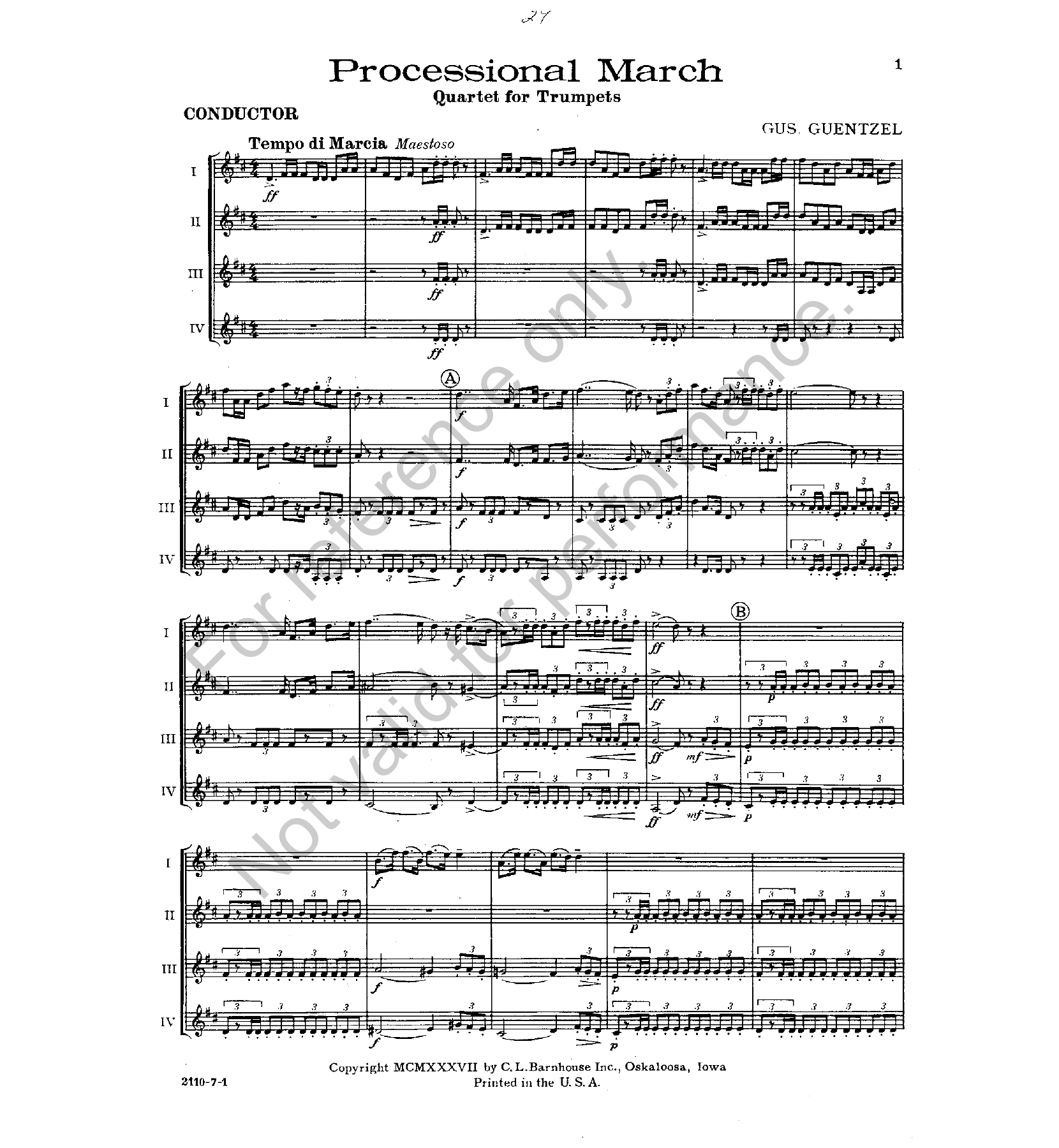
Processional March
Composed by Traditional
Arranged by Unknown Arranger
- Ensemble: Small Ensemble
- Style: March
- Pages: 3
- Difficulty: easy
- Content: Sheet Music
- Format: PDF Download (Instant)
- Price: $12.99
The stately and enduring form of the march has been a cornerstone of musical tradition for centuries, serving purposes from military parades to ceremonial entrances. While the original composer of "Processional March" remains traditional, its roots likely extend back to the 18th or 19th century, a period when marches solidified their structure and became integral to public and private events. This genre is characterized by its strong, regular pulse, typically in 2/4 or 4/4 time, designed to accompany synchronized movement. Its enduring appeal lies in its ability to evoke dignity, purpose, and a sense of occasion. Though not a jazz standard in the conventional sense, the march form provides a robust framework that jazz arrangers have frequently reinterpreted, infusing its inherent propulsion with syncopated rhythms and harmonic sophistication. This particular arrangement bridges the gap, offering a traditional march with subtle jazz inflections that make it suitable for a diverse range of performances, from formal concerts to festive outdoor events. This rendition of "Processional March" maintains a dignified and resolute character, best performed at a moderate, unwavering tempo around quarter note = 120-132 BPM. The key of B-flat major lends a bright, open quality, contributing to its uplifting and celebratory mood. The energy is consistently forward-moving, driven by a strong rhythmic foundation that encourages a confident and unified ensemble sound. The arrangement opens with a powerful, full-ensemble statement of the main theme, establishing its grandeur immediately. Throughout, the texture remains relatively dense, emphasizing the collective power of the small ensemble rather than individual virtuosity. The piece evokes a sense of anticipation and triumph, making it an excellent choice for opening a set or marking a significant moment. The Unknown Arranger's approach to "Processional March" is characterized by a respectful yet imaginative treatment of the traditional form. While preserving the melodic integrity of the original, the arranger introduces subtle harmonic extensions and rhythmic nuances that elevate the piece beyond a simple transcription. The voicings are full and resonant, particularly in the brass, creating a rich tapestry of sound that belies the small ensemble format. There are no extended solo sections; instead, the melody is passed between different sections of the ensemble, ensuring all parts contribute to the melodic development. The brass often carries the primary melodic lines with strong, unified articulation, while the rhythm section provides a steady, supportive bedrock. A particular highlight is a brief, harmonically rich counter-melody introduced in the middle section, offering a moment of lyrical contrast before returning to the full-bodied main theme. The arrangement culminates in a powerful, sustained chord, leaving a lasting impression of majesty and finality. "Processional March" is ideally suited for intermediate-level ensembles, such as advanced high school, community college, or dedicated community bands. The technical demands are moderate, focusing more on precision, blend, and rhythmic accuracy than on extreme ranges or complex improvisational skills. The primary challenge lies in maintaining a consistent tempo and articulation throughout, ensuring a unified and impactful ensemble sound. Rewarding to perform, this piece allows every musician to contribute to a grand, cohesive statement. Its three-page length makes it concise and manageable for programming, yet substantial enough to make a strong musical impression. "Processional March" requires a steadfast and precise approach to tempo and articulation. Aim for a consistent quarter note = 120-132 BPM, emphasizing a strong, grounded pulse rather than a rushed feel. The primary technical challenge lies in achieving unified articulation across the ensemble, particularly in the brass. Encourage players to use a crisp, detached articulation for the quarter and eighth notes, ensuring clarity and rhythmic drive. The dynamic contrasts, though not extreme, should be clearly defined to shape the melodic phrases. Pay close attention to the sustained whole notes and half notes, ensuring they are held for their full value with a rich, consistent tone. Rehearsal should focus on ensemble blend and intonation, especially in the full-ensemble sections where the voicings are dense. Practice the main theme slowly to ensure all parts lock in rhythmically and harmonically before bringing it up to tempo. No special techniques like plungers or falls are required, allowing the focus to remain on fundamental ensemble musicianship. Q: What instruments are included in this arrangement of "Processional March"? A: This arrangement is for a small ensemble, typically including standard jazz big band instrumentation with reduced numbers, such as trumpets, trombones, saxophones (alto, tenor, baritone), and a rhythm section (piano, bass, drums). Specific part details are usually listed on the sheet music itself. Q: What is the difficulty level of "Processional March" for performers? A: This arrangement is considered intermediate difficulty. It requires solid fundamental technique, good ensemble blend, and precise rhythmic execution, making it suitable for advanced high school, college, or community jazz ensembles. Q: What is the musical style and historical context of "Processional March"? A: "Processional March" is based on a traditional march, a musical form with historical roots in ceremonial and military music, often from the 18th or 19th century. This arrangement infuses the traditional march structure with subtle jazz harmonic and rhythmic sensibilities. Q: What makes this particular arrangement of "Processional March" unique? A: The Unknown Arranger's treatment is distinctive for its full, resonant voicings that maximize the small ensemble sound, its respectful yet harmonically enriched approach to the traditional melody, and its focus on cohesive ensemble playing rather than individual solos. Q: What is the approximate performance duration of this piece? A: Given its three-page length and a moderate tempo of around quarter note = 120-132 BPM, "Processional March" typically has a performance duration of approximately 2 to 3 minutes.
Musicians Also Search For
Processional March Unknown Arranger PDF • Processional March Unknown Arranger sheet music • Processional March arranged by Unknown Arranger • Unknown Arranger small ensemble charts • Unknown Arranger jazz arrangements PDF • Processional March Traditional sheet music • Processional March Traditional small ensemble arrangement • Traditional small ensemble charts • Processional March small ensemble arrangement • Processional March small ensemble PDF download • Processional March jazz ensemble sheet music • small ensemble sheet music instant download • Processional March sheet music with parts • Processional March March chart • March small ensemble arrangements • buy Processional March sheet music online • download Processional March PDF • Processional March jazz chart • best Unknown Arranger small ensemble arrangements • Traditional songs arranged by Unknown Arranger • Processional March printable sheet music • small ensemble repertoire PDF