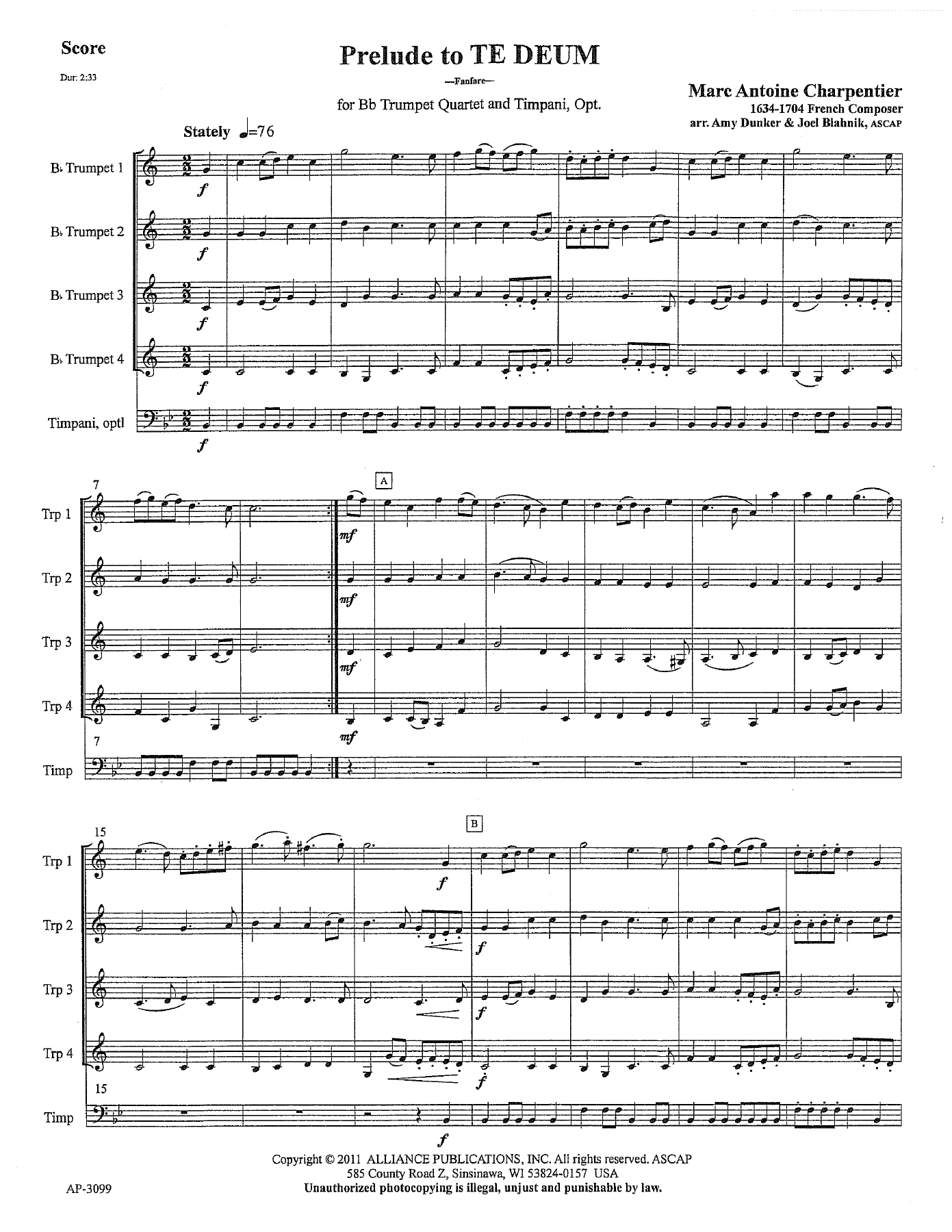
Prelude-to-Te-Deum (Te)
Composed by Marc-Antoine Charpentier
Arranged by Te
- Ensemble: Small Ensemble
- Style: Traditional
- Pages: 7
- Instruments (5): Bb Trumpet 1, Bb Trumpet 2, Bb Trumpet 3, Bb Trumpet 4, Timpani
- Difficulty: easy
- Content: Individual Parts
- Format: PDF Download (Instant)
- Price: $12.99
Marc-Antoine Charpentier's iconic "Te Deum" (H. 146), specifically its majestic Prelude, stands as one of the most recognizable fanfares in classical music history. Composed around 1688-1698 during the French Baroque era, its grand, celebratory character became synonymous with European royalty and triumph, later achieving widespread fame as the signature tune for the European Broadcasting Union. This arrangement, "Prelude-to-Te-Deum (Te)," reimagines Charpentier's stately procession through a small ensemble lens, maintaining its regal essence while infusing it with a 'Traditional' musical style, implying a respectful, perhaps slightly modernized, classical interpretation rather than a jazz reharmonization. The piece is presented in its original bright, fanfare-like tempo, typically a brisk allegro, in a major key, evoking a mood of grandeur, solemnity, and celebration. Arranger Te approaches this classical masterpiece with a focus on clarity and ensemble balance, ensuring that the original harmonic and melodic integrity of Charpentier's work is preserved. While the term 'Traditional' here indicates a faithful adherence to the classical idiom rather than a jazz interpretation, Te's arrangement for small ensemble showcases a masterful understanding of instrumental voicing. Expect a transparent texture where each part contributes meaningfully to the overall tapestry, allowing the original counterpoint and melodic lines to shine. The arrangement likely features the primary melodic statements passed between different voices, ensuring dynamic interest and showcasing the full breadth of the ensemble's capabilities. There are no traditional jazz solos or improvisation sections; the focus remains on the ensemble's unified interpretation of the composed material. Performance of "Prelude-to-Te-Deum (Te)" is rewarding for its ability to transport both performers and audience to a realm of classical elegance. The main melodic lines, instantly recognizable, are often carried by the upper voices, demanding precise articulation and unified phrasing to achieve the desired majestic effect. Technical challenges lie primarily in maintaining a consistent, bright tempo, achieving crisp ensemble attacks and releases, and executing the Baroque-style ornamentation with grace and precision. The arrangement is designed to highlight the ensemble's collective musicianship, requiring careful attention to balance and blend. The iconic opening fanfare and the subsequent flowing melodic sections provide numerous opportunities for the ensemble to demonstrate dynamic control and expressive interpretation. This arrangement is particularly well-suited for college-level small ensembles, community orchestras, or advanced high school groups seeking to explore classical repertoire in a chamber setting. Its 'Traditional' style makes it an excellent choice for concert programs that aim to bridge classical and perhaps more contemporary idioms, or simply to feature a beloved classical work with a fresh, intimate sound. The demands on individual players are moderate to advanced, focusing on ensemble cohesion and stylistic authenticity rather than virtuosic improvisation. Conductors should emphasize a bright, unwavering tempo, typically around quarter note = 120-132, to capture the original fanfare-like energy. Articulation must be precise and unified, particularly in the opening statements, with a clear distinction between detached and legato passages. Encourage musicians to listen across the ensemble to maintain impeccable intonation and balance, ensuring that the primary melodic lines are always prominent without overpowering the accompanying voices. Special attention should be given to any Baroque-style ornamentation, such as trills or mordents, executing them cleanly and stylistically. Rehearsal time should focus on ensemble attacks, releases, and dynamic shaping to build the piece's grand, celebratory character. There are no specific jazz techniques like falls or doits required, as this arrangement adheres to a classical 'Traditional' style. Q: What instruments are included in this arrangement? A: This is a small ensemble arrangement, typically implying a flexible instrumentation often including woodwinds, brass, and/or strings, with specific parts detailed on the score. Q: What is the difficulty level of "Prelude-to-Te-Deum (Te)"? A: This arrangement is considered moderately difficult, suitable for advanced high school, college, or community ensembles. It demands strong ensemble playing, precise articulation, and stylistic awareness. Q: What musical style does this arrangement represent, and what is its historical context? A: This arrangement is in a 'Traditional' classical style, faithful to Marc-Antoine Charpentier's original Baroque composition from the late 17th century, known for its majestic and celebratory character. Q: What makes Te's arrangement of "Prelude-to-Te-Deum" unique? A: Te's arrangement preserves the original classical integrity while skillfully re-voicing it for a small ensemble, highlighting clarity, balance, and the inherent beauty of Charpentier's iconic work without jazz reharmonization. Q: What is the approximate performance duration and recommended tempo for this piece? A: The approximate performance duration is 2-3 minutes. It should be played at a bright, majestic tempo, typically around quarter note = 120-132, to capture its fanfare-like essence.
Questions and answers
- What is included in the Prelude-to-Te-Deum (Te) PDF?
- The verified current file contains a conductor score and individual parts across 7 pages.
- How many instruments or parts are listed for Prelude-to-Te-Deum (Te)?
- The verified instrumentation list contains 5 entries for this Small Ensemble arrangement.
- Who is credited for Prelude-to-Te-Deum (Te)?
- Composer: Marc-Antoine Charpentier. Arranger: Te.
- What difficulty is listed for Prelude-to-Te-Deum (Te)?
- The verified difficulty level is easy.
- What style is listed for Prelude-to-Te-Deum (Te)?
- The catalog lists the style as Traditional.
- Can I preview Prelude-to-Te-Deum (Te) before buying?
- Yes. The product page provides a preview generated from the current PDF file.
- How is Prelude-to-Te-Deum (Te) delivered?
- After successful payment, the digital PDF is made available for download. The displayed price is $12.99.
Musicians Also Search For
Prelude-to-Te-Deum Te PDF • Prelude-to-Te-Deum Te sheet music • Prelude-to-Te-Deum arranged by Te • Te small ensemble charts • Te jazz arrangements PDF • Prelude-to-Te-Deum Marc-Antoine Charpentier sheet music • Prelude-to-Te-Deum Marc-Antoine Charpentier small ensemble arrangements • Marc-Antoine Charpentier small ensemble charts • Prelude-to-Te-Deum small ensemble arrangements • Prelude-to-Te-Deum small ensemble PDF download • Prelude-to-Te-Deum jazz sheet music • small ensemble sheet music download • Prelude-to-Te-Deum conductor score PDF • Prelude-to-Te-Deum individual parts download • Prelude-to-Te-Deum sheet music PDF • Prelude-to-Te-Deum Traditional charts • Traditional small ensemble arrangements • buy Prelude-to-Te-Deum sheet music • download Prelude-to-Te-Deum PDF • Prelude-to-Te-Deum jazz charts • best Te small ensemble arrangements • Marc-Antoine Charpentier arranged by Te • Prelude-to-Te-Deum printable sheet music • small ensemble repertoire PDF