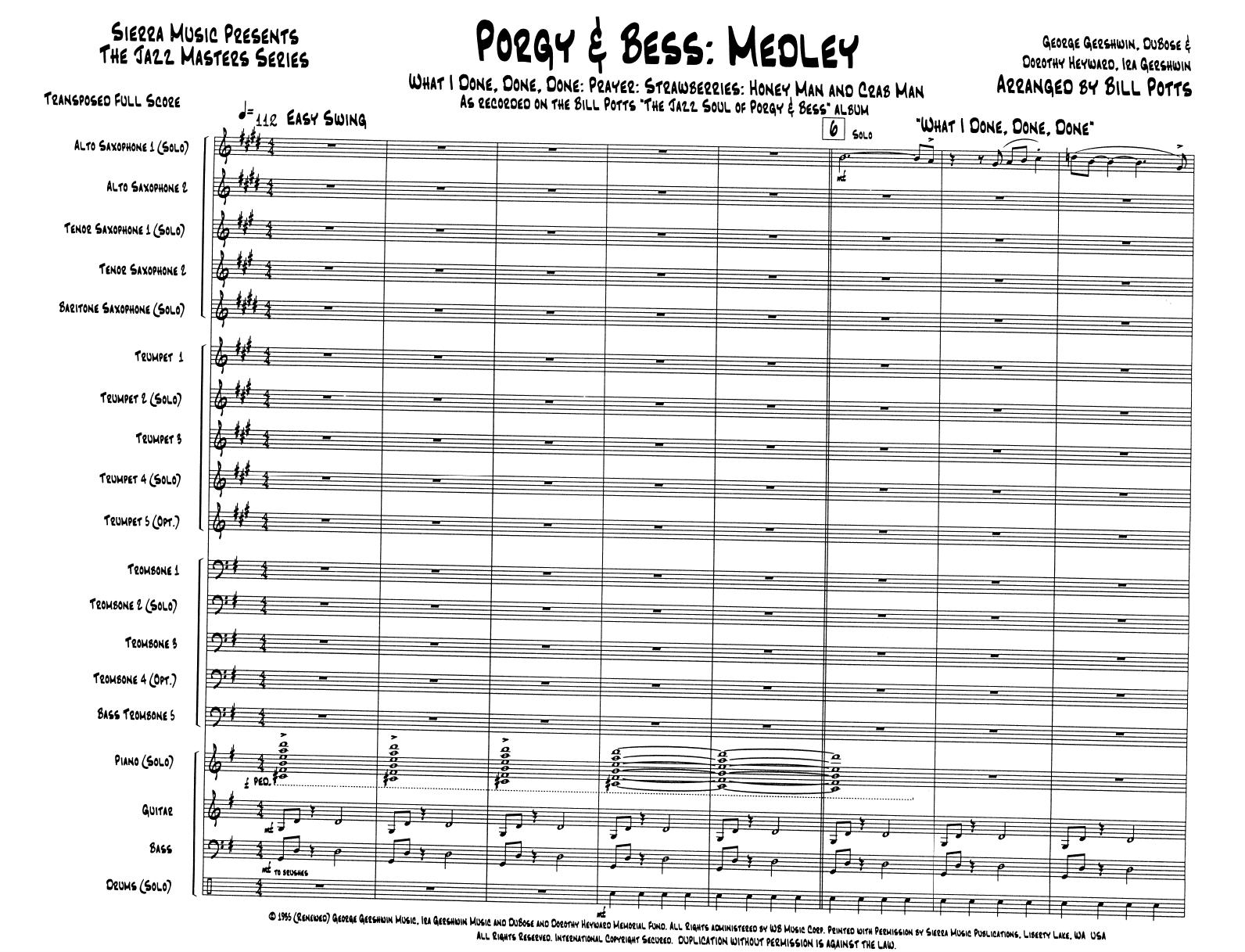
Porgy & Bess Medley (B.Potts)
Composed by George Gershwin
Arranged by Bill Potts
- Ensemble: Big Band
- Pages: 18
- Instruments (19): Alto Saxophone 1 (Solo), Alto Saxophone 2, Tenor Saxophone 1 (Solo), Tenor Saxophone 2, Baritone Saxophone (Solo), Trumpet 1, Trumpet 2 (Solo), Trumpet 3, Trumpet 4 (Solo), Trumpet 5 (Opt.), Trombone 1, Trombone 2 (Solo), Trombone 3, Trombone 4 (Opt.), Bass Trombone 5, Piano (Solo), Guitar, Bass, Drums (Solo)
- Difficulty: easy
- Content: Individual Parts
- Format: PDF Download (Instant)
- Price: $24.99
George Gershwin’s 1935 folk opera *Porgy and Bess* stands as one of the towering pillars of American musical theater, its rich tapestry of blues-inflected melodies and sophisticated harmonies providing an endless wellspring for jazz interpretation. While countless artists have reinterpreted individual themes like "Summertime" or "It Ain't Necessarily So," the project of translating the dramatic scope of the opera into a cohesive orchestral jazz suite reached its zenith with Bill Potts’ monumental 1959 recording, *The Jazz Soul of Porgy & Bess*. Commissioned by United Artists, Potts assembled a veritable "all-star" big band featuring luminaries like Art Farmer, Phil Woods, and Bill Evans to record arrangements that treated Gershwin’s source material not merely as a collection of pop tunes, but as a suite of modern jazz masterpieces. This specific 18-page orchestration captures the sophisticated harmonic palette and driving momentum that defined Potts' acclaimed writing style. Moving fluidly through contrasting moods, the medley balances sultry, blues-drenched slow-swing passages with brisk, harmonically adventurous up-tempo sections. The opening movements evoke the humid, atmospheric tension of Catfish Row through lush, extended brass voicings and smoky woodwind textures, before gradually building in rhythmic intensity. Potts expertly manipulates Gershwin’s original motifs, layering countermelodies in the saxophones against shifting harmonic backdrops that bridge the gap between traditional swing-era big band writing and the modal explorations of the late 1950s. At the heart of the chart lies a masterclass in dynamic contrast and instrumental coloration. The saxophone section functions as a unified choir, delivering intricate soli passages that demand crisp articulation and immaculate intonation, while the brass section alternates between muted, textural backgrounds and soaring, punchy shout choruses. Featured solo spaces allow individual improvisers to stretch out over sophisticated chord changes that retain the dramatic weight of the original theater score. The writing requires a rhythm section capable of maintaining an elastic, driving groove that can shift effortlessly from a relaxed, floating medium swing to aggressive, punchy accents. Advanced college ensembles, professional repertory big bands, and elite community jazz orchestras will find this chart to be a rewarding centerpiece for a serious concert program. Because of its demanding score requirements—spanning 19 distinct instrumental parts across standard big band instrumentation—and its reliance on subtle stylistic shifts, the arrangement demands mature players who are comfortable with advanced chromaticism and nuanced dynamic control. Performing Potts' treatment offers modern bands a direct link to the golden age of jazz orchestration while providing a rigorous, highly engaging showcase for both ensemble cohesion and individual artistry. Success with this Bill Potts arrangement hinges on striking the right balance between the relaxed, vocal phrasing of traditional swing and the harmonic sophistication of modern jazz. The tempo requires a steady, unhurried pulse during the slower thematic statements, ensuring that the rhythm section avoids rushing the underlying subdivision. Conductors should pay close attention to the dynamic shading in the brass; when players are instructed to use cup or harmonic mutes, the intonation must remain centered, particularly during dense, clustered chord voicings. The saxophone soli sections demand meticulous blend and light articulation—avoid heavy accents unless explicitly marked by Potts. In the up-tempo transition segments, the drummer should drive the ensemble with crisp ride cymbal phrasing and controlled, reactive fills that support rather than overpower the horn lines. Rehearsal time is best utilized by sectionals focusing on intonation within the extended chord structures before integrating the full ensemble. Q: What instruments and parts are included in this arrangement? A: The chart is scored for a standard 19-instrument big band lineup, which includes 2 alto saxophones, 2 tenor saxophones, 1 baritone saxophone, 4 trumpets, 4 trombones, guitar, piano, bass, drums, and a comprehensive conductor score spanning 18 pages. Q: What is the difficulty level of this big band chart? A: This arrangement is calibrated for advanced college, professional, and elite community jazz orchestras due to its sophisticated extended harmonies, dense scoring, and technical demands across all sections. Q: What is the style and historical context of this piece? A: Written by master arranger Bill Potts for his acclaimed 1959 project *The Jazz Soul of Porgy & Bess*, this medley translates George Gershwin's 1935 operatic themes into the idiom of modern post-bop and sophisticated swing. Q: What makes this Bill Potts arrangement unique compared to other versions of Gershwin's music? A: Potts treats the source material as a unified, symphonic jazz suite, utilizing advanced harmonic substitutions, rich woodwind voicings, and dramatic dynamic contrasts that elevate the music far beyond a standard chord-melody medley. Q: What is the performance duration and tempo framework of the medley? A: The medley features a multi-movement structure that moves fluidly through varying tempos, typically requiring around 6 to 8 minutes of performance time depending on the length allotted for improvised solo choruses.
Questions and answers
- What is included in the Porgy & Bess Medley (B.Potts) PDF?
- The verified current file contains a conductor score across 18 pages.
- How many instruments or parts are listed for Porgy & Bess Medley (B.Potts)?
- The verified instrumentation list contains 19 entries for this Big Band arrangement.
- Who is credited for Porgy & Bess Medley (B.Potts)?
- Composer: George Gershwin. Arranger: Bill Potts.
- What difficulty is listed for Porgy & Bess Medley (B.Potts)?
- The verified difficulty level is easy.
- Can I preview Porgy & Bess Medley (B.Potts) before buying?
- Yes. The product page provides a preview generated from the current PDF file.
- How is Porgy & Bess Medley (B.Potts) delivered?
- After successful payment, the digital PDF is made available for download. The displayed price is $24.99.
Musicians Also Search For
Porgy & Bess Medley Bill Potts PDF • Porgy & Bess Medley Bill Potts sheet music • Porgy & Bess Medley arranged by Bill Potts • Bill Potts big band charts • Bill Potts jazz arrangements PDF • Porgy & Bess Medley George Gershwin sheet music • Porgy & Bess Medley George Gershwin big band arrangements • George Gershwin big band charts • Porgy & Bess Medley big band arrangements • Porgy & Bess Medley big band PDF download • Porgy & Bess Medley jazz sheet music • big band sheet music download • Porgy & Bess Medley conductor score PDF • Porgy & Bess Medley sheet music PDF • buy Porgy & Bess Medley sheet music • download Porgy & Bess Medley PDF • Porgy & Bess Medley jazz charts • best Bill Potts big band arrangements • George Gershwin arranged by Bill Potts • Porgy & Bess Medley printable sheet music • big band repertoire PDF