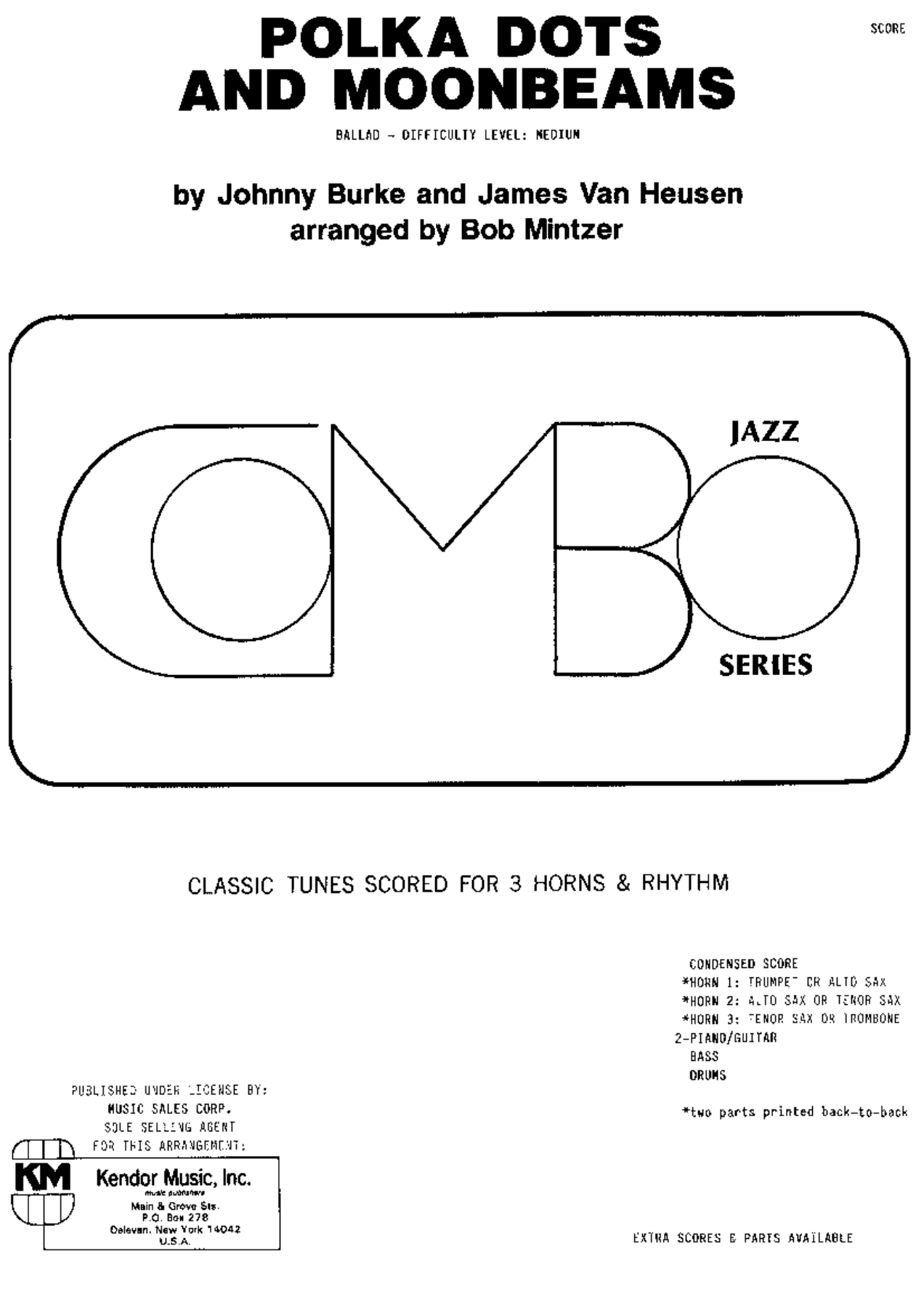
Polka Dots Moonbeams-B.Mintzer - 3 Horns, Rhythm, Score (B.Mintzer)
Composed by Johnny Burke and James Van Heusen
Arranged by Bob Mintzer
- Ensemble: Small Ensemble
- Style: Ballad
- Pages: 12
- Instruments (9): Horn 1 (Bb Trumpet), Horn 1 (Eb Alto Sax), Horn 2 (Eb Alto Sax), Horn 2 (Bb Tenor Sax), Horn 3 (Bb Tenor Sax), Horn 3 (Trombone), Piano/Guitar, Bass, Drums
- Difficulty: easy
- Content: Individual Parts
- Format: PDF Download (Instant)
- Price: $12.99
"Polka Dots and Moonbeams," a timeless ballad from the Great American Songbook, was composed by Johnny Burke and James Van Heusen in 1940. Emerging from the golden age of jazz standards, it quickly became synonymous with the romantic crooning of Frank Sinatra, who recorded it multiple times throughout his career, solidifying its place in the jazz and popular music canon. Its enduring appeal lies in its elegant, flowing melody and sophisticated harmonic progression, making it a favorite vehicle for vocalists and instrumentalists alike to showcase lyrical improvisation and expressive interpretation. The piece embodies the lush, sentimental character of the pre-bop era, offering a poignant reflection on love and longing through its melancholic yet hopeful musical narrative. Bob Mintzer's arrangement of this cherished standard for a small ensemble (3 horns and rhythm section) offers a masterclass in sophisticated ballad writing, tailored for the modern jazz idiom while respecting its classic roots. Mintzer, renowned for his intricate yet accessible voicings and his profound understanding of ensemble dynamics, approaches "Polka Dots and Moonbeams" with a focus on rich harmonic textures and lyrical interplay. The arrangement maintains the original's slow, contemplative ballad tempo, typically in 4/4, allowing ample space for expressive phrasing and nuanced dynamics. Mintzer's signature is evident in the carefully crafted horn voicings, which often feature close-knit harmonies that create a warm, enveloping sound, enhancing the tune's inherent romanticism. The overall mood is one of tender introspection, inviting both performers and listeners into a deeply emotional musical experience. This arrangement masterfully distributes the melody, often featuring the lead horn (typically trumpet or alto saxophone) on the initial statement, allowing for a clear, unadorned presentation of the iconic theme. Subsequent sections might see the melody passed between horns or presented in a harmonized soli, showcasing the ensemble's blend and balance. While specific solo sections are provided, Mintzer's charts often encourage improvisation that is both harmonically inventive and melodically sensitive, urging soloists to explore the emotional depth of the piece rather than just technical prowess. Technical challenges primarily revolve around achieving a unified, expressive sound at a slow tempo, requiring precise intonation, breath control, and dynamic shaping from all musicians. The rhythmic section provides a supportive, flowing foundation, crucial for maintaining the ballad's delicate pulse without rushing or dragging. The rewarding aspect of performing this arrangement lies in its capacity for profound musical expression and the opportunity to contribute to a beautifully orchestrated rendition of a jazz classic. Mintzer's "Polka Dots and Moonbeams" is ideally suited for college-level jazz ensembles, advanced high school groups, and community bands with proficient musicians, as well as professional small jazz combos. The demands on intonation, blend, and musical maturity make it an excellent piece for developing expressive playing and ensemble cohesion. Its concise scoring for three horns makes it particularly versatile for groups that may not have a full big band instrumentation but still desire a rich, professional sound. The arrangement provides an invaluable learning experience in ballad interpretation, harmonic awareness, and the art of ensemble playing within a small, intimate setting. Performers should prioritize a unified, warm tone and precise intonation, especially in the close voicings. The slow ballad tempo (e.g., quarter note = 60-72 bpm) demands exceptional breath control and sustained phrasing. Encourage soloists to focus on melodic development and emotional depth over technical fireworks, drawing inspiration from classic ballad interpretations. The rhythm section should provide a consistent, gentle pulse, emphasizing a flowing feel without being intrusive; drummers should use brushes or light sticks for a soft, shimmering texture. Pay close attention to dynamic contrasts, using them to shape phrases and build emotional intensity. Rehearsal time should be dedicated to balancing the horn voicings, ensuring each voice is heard clearly within the harmonic structure, and practicing seamless transitions between melodic statements and solo sections. Q: What instruments and parts are included in this arrangement? A: This arrangement is scored for a small ensemble, including three horn parts (typically Alto Sax, Tenor Sax, Trumpet, or similar flexible instrumentation), a full rhythm section (Piano, Bass, Drums, Guitar), and a conductor's score. Q: What is the difficulty level of this Bob Mintzer arrangement? A: This arrangement is rated as medium-advanced. It requires proficient instrumentalists with good intonation, strong breath control, and a developed sense of musicality, making it suitable for college, advanced high school, or professional ensembles. Q: What is the musical style and historical context of "Polka Dots and Moonbeams"? A: "Polka Dots and Moonbeams" is a classic jazz ballad from the Great American Songbook, composed in 1940. It embodies the lush, romantic style of the pre-bop era, known for its elegant melody and sophisticated harmonic progression. Q: What makes Bob Mintzer's treatment of this standard unique? A: Mintzer's arrangement is distinguished by its sophisticated three-horn voicings, which create a rich, warm harmonic texture. It balances respect for the original's lyrical beauty with modern jazz sensibilities, offering ample opportunity for expressive playing and tasteful improvisation. Q: What is the typical performance duration and tempo for this arrangement? A: As a slow ballad, the performance duration will typically range from 4 to 6 minutes, depending on the number and length of improvised solos. The tempo is a contemplative ballad feel, usually around quarter note = 60-72 bpm.
Questions and answers
- What is included in the Polka Dots Moonbeams-B.Mintzer - 3 Horns, Rhythm, Score (B.Mintzer) PDF?
- The verified current file contains a conductor score and individual parts across 12 pages.
- How many instruments or parts are listed for Polka Dots Moonbeams-B.Mintzer - 3 Horns, Rhythm, Score (B.Mintzer)?
- The verified instrumentation list contains 9 entries for this Small Ensemble arrangement.
- Who is credited for Polka Dots Moonbeams-B.Mintzer - 3 Horns, Rhythm, Score (B.Mintzer)?
- Composer: Johnny Burke and James Van Heusen. Arranger: Bob Mintzer.
- What difficulty is listed for Polka Dots Moonbeams-B.Mintzer - 3 Horns, Rhythm, Score (B.Mintzer)?
- The verified difficulty level is easy.
- What style is listed for Polka Dots Moonbeams-B.Mintzer - 3 Horns, Rhythm, Score (B.Mintzer)?
- The catalog lists the style as Ballad.
- Can I preview Polka Dots Moonbeams-B.Mintzer - 3 Horns, Rhythm, Score (B.Mintzer) before buying?
- Yes. The product page provides a preview generated from the current PDF file.
- How is Polka Dots Moonbeams-B.Mintzer - 3 Horns, Rhythm, Score (B.Mintzer) delivered?
- After successful payment, the digital PDF is made available for download. The displayed price is $12.99.
Musicians Also Search For
Polka Dots Moonbeams-B.Mintzer - 3 Horns, Rhythm, Score Bob Mintzer PDF • Polka Dots Moonbeams-B.Mintzer - 3 Horns, Rhythm, Score Bob Mintzer sheet music • Polka Dots Moonbeams-B.Mintzer - 3 Horns, Rhythm, Score arranged by Bob Mintzer • Bob Mintzer small ensemble charts • Bob Mintzer jazz arrangements PDF • Polka Dots Moonbeams-B.Mintzer - 3 Horns, Rhythm, Score Johnny Burke and James Van Heusen sheet music • Polka Dots Moonbeams-B.Mintzer - 3 Horns, Rhythm, Score Johnny Burke and James Van Heusen small ensemble arrangements • Johnny Burke and James Van Heusen small ensemble charts • Polka Dots Moonbeams-B.Mintzer - 3 Horns, Rhythm, Score small ensemble arrangements • Polka Dots Moonbeams-B.Mintzer - 3 Horns, Rhythm, Score small ensemble PDF download • Polka Dots Moonbeams-B.Mintzer - 3 Horns, Rhythm, Score jazz sheet music • small ensemble sheet music download • Polka Dots Moonbeams-B.Mintzer - 3 Horns, Rhythm, Score conductor score PDF • Polka Dots Moonbeams-B.Mintzer - 3 Horns, Rhythm, Score individual parts download • Polka Dots Moonbeams-B.Mintzer - 3 Horns, Rhythm, Score sheet music PDF • Polka Dots Moonbeams-B.Mintzer - 3 Horns, Rhythm, Score Ballad charts • Ballad small ensemble arrangements • buy Polka Dots Moonbeams-B.Mintzer - 3 Horns, Rhythm, Score sheet music • download Polka Dots Moonbeams-B.Mintzer - 3 Horns, Rhythm, Score PDF • Polka Dots Moonbeams-B.Mintzer - 3 Horns, Rhythm, Score jazz charts • best Bob Mintzer small ensemble arrangements • Johnny Burke and James Van Heusen arranged by Bob Mintzer • Polka Dots Moonbeams-B.Mintzer - 3 Horns, Rhythm, Score printable sheet music • small ensemble repertoire PDF