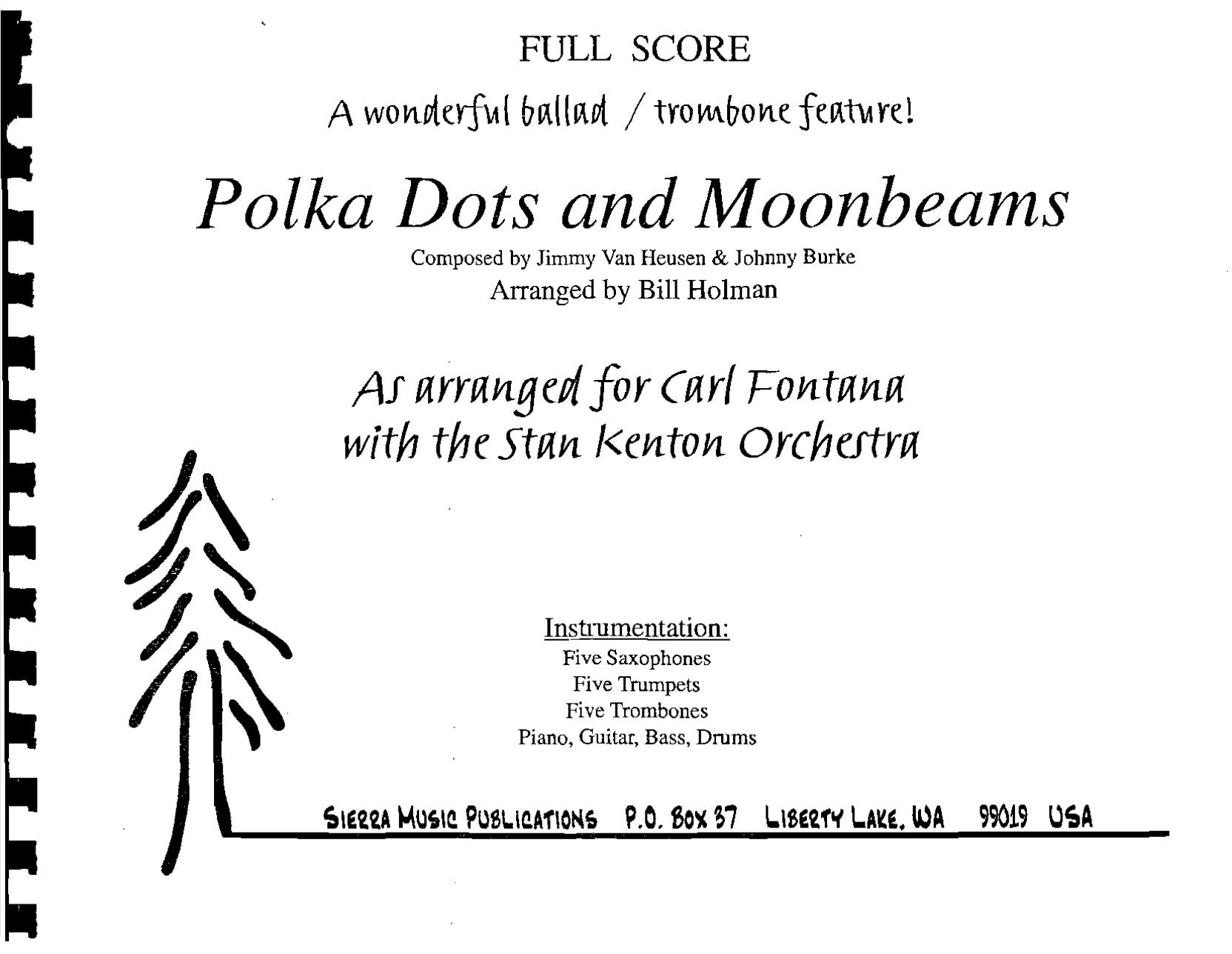
Polka Dots And Moonbeams (B.Holman) sheet music preview

Polka Dots And Moonbeams (B.Holman)

Composed by Jimmy Van Heusen

Arranged by Bill Holman

  • Ensemble: Big Band
  • Pages: 51
  • Instruments (19): Alto Saxophone 1, Alto Saxophone 2, Tenor Saxophone 1, Tenor Saxophone 2, Baritone Saxophone, Trumpet 1, Trumpet 2, Trumpet 3, Trumpet 4, Trumpet 5, Trombone 1 (Solo), Trombone 2, Trombone 3, Bass Trombone 4, Bass Trombone 5, Piano, Guitar, Bass, Drums
  • Difficulty: advanced
  • Content: Individual Parts
  • Format: PDF Download (Instant)
  • Price: $24.99

Composed in 1939 by Jimmy Van Heusen with lyrics by Johnny Burke, "Polka Dots and Moonbeams" quickly ascended the ladder of the Great American Songbook, famously immortalized by Frank Sinatra during his tenure with the Tommy Dorsey Orchestra. This timeless ballad represents the golden era of vocal pop and swing-era balladry, transitioning seamlessly into an essential vehicle for jazz instrumentalists seeking to explore rich harmonic territory. Its enduring appeal lies in its sophisticated, cyclical chord progression and a melody that gracefully bridges romantic nostalgia with melancholy introspection. Bill Holman’s masterwork for big band reframes this classic standard through a lens of modern West Coast cool and ingenious contrapuntal development. Rather than relying on a conventional, straightforward ballad setting, Holman infuses the chart with a sublime, flowing medium-tempo ballad feel (often hovering around a gentle, breathing pulse). The arrangement shimmers with sophisticated, harmonically dense voicings that avoid sentimental clichés, substituting them instead with intricate horn-line interleavings, unexpected chromatic shifts, and signature Holman-esque developmental cross-rhythms. The mood shifts fluidly from tender, exposed intimacy to swelling waves of lush, brass-heavy warmth that evoke a twilight cinematic landscape. Holman masterfully distributes the melodic weight across the ensemble, opening with a fragile, evocative statement carried by the frontline horns before expanding into rich, multi-layered textural solis. The chart features a prominently showcased solo space—typically tailored for a lyrical tenor saxophone or trumpet—framed by exquisitely voiced background figures that react organically to the soloist. Technical challenges in this 51-page manuscript reside primarily in intonation, breath control during extended phrases, and the precision required to execute Holman’s interlocking counterlines without masking the primary melody. The reward for the ensemble lies in navigating its breathtaking harmonic landscape, where every dynamic shift and altered dominant chord serves an expressive purpose. Advanced collegiate, community, and professional big bands will find this arrangement an exceptional centerpiece for concert programming. Because of its reliance on subtle dynamic shading, pristine balance, and mature stylistic execution, it demands an ensemble with strong listening skills and an appreciation for West Coast arrangement aesthetics. It offers a masterclass in modern big band ballad pacing, making it a sophisticated alternative to standard high-energy swing charts on any advanced performance program. Conductors approaching this Bill Holman masterpiece must prioritize balance and linear clarity above sheer volume. The tempo should remain flexible yet anchored, maintaining a relaxed, conversational swing feel even during rubato-adjacent transitional moments. Intonation is the primary technical hurdle; Holman’s dense, extended chord voicings demand meticulous tuning within sections, particularly in the saxophones and muted brass. Rehearsals should begin by isolating the individual contrapuntal lines before assembling the full harmonic verticality, ensuring players understand how their specific voice moves horizontally against the rest of the band. Pay close attention to dynamic markings, as the chart relies heavily on sudden sub-ito drops and gradual crescendos to create its cinematic swells. Mute usage should be handled with care to blend rather than pierce the ensemble texture. Finally, the featured soloist should be encouraged to lean into the lyrical, storytelling aspect of the form, utilizing the subtle harmonic tension provided in the background backgrounds for expressive inspiration. Q: What instruments and parts are included in this arrangement? A: Scored for an 8-instrument core ensemble format featuring Alto Saxophone, Tenor Saxophone, Baritone Saxophone, Trumpet, Trombone, and a complete rhythm section framework spanning 51 comprehensive pages. Q: What is the difficulty level of this chart? A: This arrangement is designated for advanced college, community, and professional big bands due to its intricate contrapuntal lines, sophisticated harmonic vocabulary, and high demands on section blend and intonation. Q: What musical style and historical context does this arrangement represent? A: It is a sophisticated jazz big band treatment of Jimmy Van Heusen’s 1939 standard, filtered through Bill Holman’s signature West Coast modern arranging aesthetic while retaining the romantic essence of the swing ballad era. Q: What makes this particular arrangement by Bill Holman unique? A: Holman replaces conventional, predictable ballad scoring with dense, shifting harmonic textures, ingenious counterpoint, and unexpected developmental cross-rhythms that transform a familiar standard into a modern compositional journey. Q: What is the recommended performance duration and tempo feel? A: The arrangement is paced as a relaxed, flowing medium ballad, typically performing around 4 to 5 minutes depending on the length of the featured improvised solo choruses.

Questions and answers

What is included in the Polka Dots And Moonbeams (B.Holman) PDF?
The verified current file contains a conductor score and individual parts across 51 pages.
How many instruments or parts are listed for Polka Dots And Moonbeams (B.Holman)?
The verified instrumentation list contains 19 entries for this Big Band arrangement.
Who is credited for Polka Dots And Moonbeams (B.Holman)?
Composer: Jimmy Van Heusen. Arranger: Bill Holman.
What difficulty is listed for Polka Dots And Moonbeams (B.Holman)?
The verified difficulty level is advanced.
Can I preview Polka Dots And Moonbeams (B.Holman) before buying?
Yes. The product page provides a preview generated from the current PDF file.
How is Polka Dots And Moonbeams (B.Holman) delivered?
After successful payment, the digital PDF is made available for download. The displayed price is $24.99.

Musicians Also Search For

Polka Dots And Moonbeams Bill Holman PDFPolka Dots And Moonbeams Bill Holman sheet musicPolka Dots And Moonbeams arranged by Bill HolmanBill Holman big band chartsBill Holman jazz arrangements PDFPolka Dots And Moonbeams Jimmy Van Heusen sheet musicPolka Dots And Moonbeams Jimmy Van Heusen big band arrangementsJimmy Van Heusen big band chartsPolka Dots And Moonbeams big band arrangementsPolka Dots And Moonbeams big band PDF downloadPolka Dots And Moonbeams jazz sheet musicbig band sheet music downloadPolka Dots And Moonbeams conductor score PDFPolka Dots And Moonbeams individual parts downloadPolka Dots And Moonbeams sheet music PDFbuy Polka Dots And Moonbeams sheet musicdownload Polka Dots And Moonbeams PDFPolka Dots And Moonbeams jazz chartsbest Bill Holman big band arrangementsJimmy Van Heusen arranged by Bill HolmanPolka Dots And Moonbeams printable sheet musicbig band repertoire PDF

All arrangements by Bill Holman All Jimmy Van Heusen sheet music