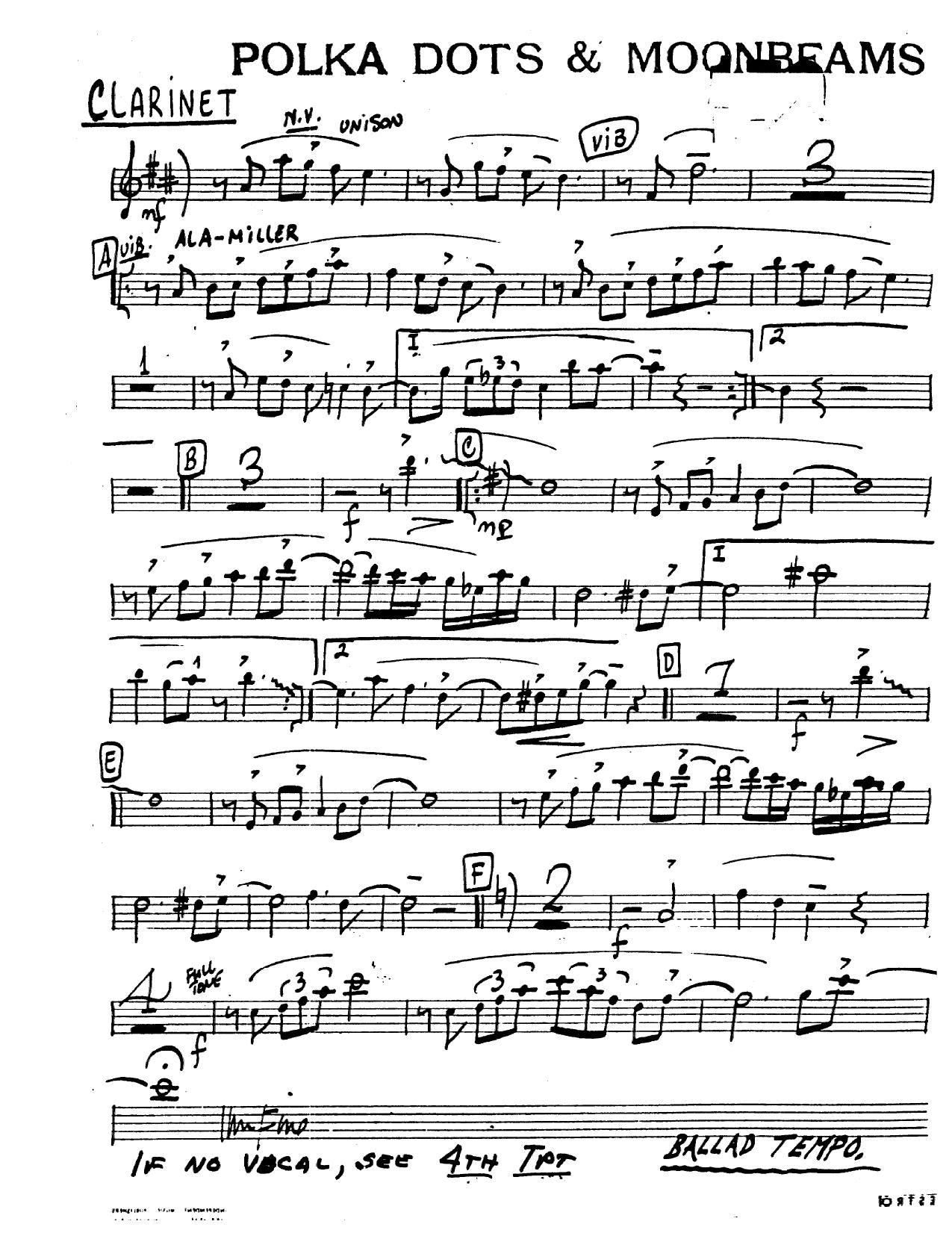
Polka Dots And Moonbeams (B.Eberhard)
Composed by Jimmy Van Heusen
Arranged by Bob Eberhart
- Ensemble: Big Band
- Pages: 19
- Instruments (16): Clarinet, 1st Alto, 2nd Alto, 1st Tenor, 2nd Tenor, 1st Trumpet, 2nd Trumpet, 3rd Trumpet, 4th Trumpet, 1st Bone, 2nd Bone, 3rd Bone, 4th Bone, Bass, Drums, Piano / Guitar
- Difficulty: easy
- Content: Individual Parts
- Format: PDF Download (Instant)
- Price: $24.99
Jimmy Van Heusen and Johnny Burke crafted "Polka Dots and Moonbeams" in 1940, cementing its status as one of the most sublime romantic ballads of the mid-20th-century American Songbook. Immortalized early on by Frank Sinatra with the Tommy Dorsey Orchestra, this quintessential jazz standard has since served as a lyrical touchstone for generations of improvisers, celebrated for its unexpected harmonic turns, lush chromaticism, and evocative, cinematic melody. Bob Eberhart’s masterful big band adaptation reimagines this timeless vehicle as a lush, expressive ballad centered around a warm, sophisticated medium-slow tempo feel. Set in a comfortable concert key that allows the horn sections to project rich, resonant overtones, the arrangement evokes a late-night supper club atmosphere. The mood shifts fluidly between tender, fragile vulnerability and sweeping, cinematic climaxes, driven by rich, extended chord voicings that honor Van Heusen’s original harmonic architecture while introducing modern, sophisticated color tones. Eberhart approaches the 16-instrument ensemble with a deep sensitivity to dynamic contrast and textural variety. Rather than relying on standard, predictable block-chord scoring, the arrangement utilizes rich counterpoint and interwoven woodwind dubbing—leveraging the specified clarinet and dual alto and tenor saxophones—to create a shimmering, multi-layered harmonic backdrop. The melody is initially introduced with utmost intimacy, carried by a featured soloist before expanding into full ensemble soli passages where the saxophones and brass blend seamlessly. The arrangement avoids a heavy-handed shout chorus, opting instead for a glowing, emotive developmental peak that resolves gracefully back into a tranquil, hauntingly quiet coda. Advanced high school, collegiate, and professional community jazz ensembles will find this chart an exceptional vehicle for developing ensemble blend, intonation, and lyrical phrasing. While the technical demands regarding fast fingerwork are minimal, the true challenge—and reward—lies in the sustained breath control, delicate intonation in extreme registers, and mature emotional interpretation required to pull off a successful ballad. It serves as a breathtaking centerpiece for any concert program, offering featured soloists ample room for expressive rubato and melodic extrapolation. Executing this arrangement successfully requires exceptional breath support, precise intonation, and acute listening across the entire 16-piece ensemble, particularly given the exposed nature of a ballad setting. Conductors should establish a relaxed, unhurried tempo feel around 60 to 66 BPM, ensuring that the subdivision remains internalized so that elastic, rubato phrasing by the featured soloist never disrupts the underlying pulse. Rhythm section players must exercise extreme restraint; the piano and guitar should voice chords sparsely with clean, non-pervasive comping that supports the harmonic movement without cluttering the texture. The bass player should employ a warm, half-note or sustained pedal approach rather than a rigid walking pattern during exposed thematic statements. Horn players must pay meticulous attention to balance within the saxophone and brass sections, ensuring that inner-voice harmonies do not obscure the primary melodic line. Subtle use of vibrato is encouraged, but it must be managed collectively to maintain a unified stylistic era. Rehearsals should initially focus on sectional tuning and dynamic shaping, working backward from the dynamic apex to ensure smooth transitions into the quiet, fading final measures. Q: What instruments and parts are included in this 16-instrument big band arrangement? A: The instrumentation features a standard 16-piece big band setup, specifically including parts for Clarinet, Alto Saxophone 1, Alto Saxophone 2, Tenor Saxophone 1, and Tenor Saxophone 2, alongside a full complement of brass and rhythm section parts. Q: What is the overall difficulty level of this arrangement? A: This arrangement is well-suited for advanced high school, collegiate, and professional jazz ensembles, primarily challenging musicians in the areas of intonation, breath support, and lyrical phrasing rather than fast technical execution. Q: What is the historical style and musical context of "Polka Dots and Moonbeams"? A: Composed in 1940 by Jimmy Van Heusen and popularized by Frank Sinatra with Tommy Dorsey, this piece is a cornerstone ballad of the swing era and a foundational jazz standard known for its sophisticated harmony and romantic character. Q: What makes Bob Eberhart’s arrangement unique compared to other versions? A: Eberhart’s treatment stands out through its lush, modern-tinged extended voicings, unique woodwind integration including clarinet and dual alto/tenor saxophones, and a cinematic developmental arc that favors rich textures over a traditional high-volume shout chorus. Q: What is the recommended performance tempo and duration for this piece? A: The arrangement is designed as a medium-slow ballad performed around 60 to 66 BPM, with a typical duration of approximately 4 to 5 minutes depending on the length of improvised solo sections.
Questions and answers
- What is included in the Polka Dots And Moonbeams (B.Eberhard) PDF?
- The verified current file contains individual parts across 19 pages.
- How many instruments or parts are listed for Polka Dots And Moonbeams (B.Eberhard)?
- The verified instrumentation list contains 16 entries for this Big Band arrangement.
- Who is credited for Polka Dots And Moonbeams (B.Eberhard)?
- Composer: Jimmy Van Heusen. Arranger: Bob Eberhart.
- What difficulty is listed for Polka Dots And Moonbeams (B.Eberhard)?
- The verified difficulty level is easy.
- Can I preview Polka Dots And Moonbeams (B.Eberhard) before buying?
- Yes. The product page provides a preview generated from the current PDF file.
- How is Polka Dots And Moonbeams (B.Eberhard) delivered?
- After successful payment, the digital PDF is made available for download. The displayed price is $24.99.
Musicians Also Search For
Polka Dots And Moonbeams Bob Eberhart PDF • Polka Dots And Moonbeams Bob Eberhart sheet music • Polka Dots And Moonbeams arranged by Bob Eberhart • Bob Eberhart big band charts • Bob Eberhart jazz arrangements PDF • Polka Dots And Moonbeams Jimmy Van Heusen sheet music • Polka Dots And Moonbeams Jimmy Van Heusen big band arrangements • Jimmy Van Heusen big band charts • Polka Dots And Moonbeams big band arrangements • Polka Dots And Moonbeams big band PDF download • Polka Dots And Moonbeams jazz sheet music • big band sheet music download • Polka Dots And Moonbeams individual parts download • Polka Dots And Moonbeams sheet music PDF • buy Polka Dots And Moonbeams sheet music • download Polka Dots And Moonbeams PDF • Polka Dots And Moonbeams jazz charts • best Bob Eberhart big band arrangements • Jimmy Van Heusen arranged by Bob Eberhart • Polka Dots And Moonbeams printable sheet music • big band repertoire PDF