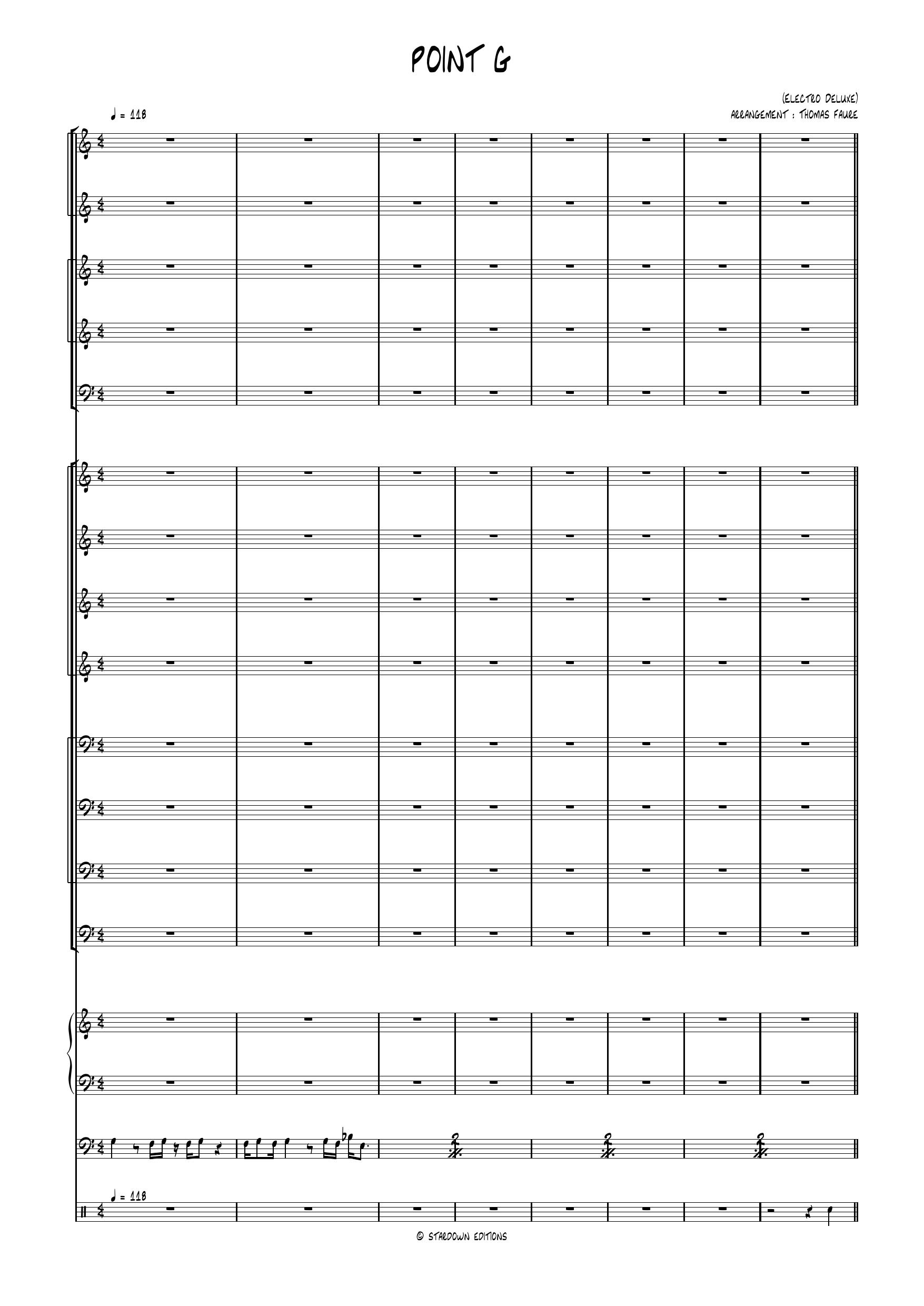
Point G (T.Faure) sheet music preview

Point G (T.Faure)

Composed by T. Faure

Arranged by T.Faure

  • Ensemble: Big Band
  • Style: Jazz Standard
  • Pages: 28
  • Instruments (16): Alto Saxophone 1, Alto Saxophone 2, Tenor Saxophone 1, Tenor Saxophone 2, Baritone Saxophone, Trumpet 1, Trumpet 2, Trumpet 3, Trumpet 4, Trombone 1, Trombone 2, Trombone 3, Trombone 4, Keyboard, Bass Guitar, Drum Set
  • Difficulty: medium
  • Content: Individual Parts
  • Format: PDF Download (Instant)
  • Price: $24.99

Rooted in the sophisticated tradition of the jazz standard, "Point G" by T. Faure stands as a striking contribution to contemporary big band repertoire. Drawing inspiration from the modal explorations of post-bop and the harmonic coloring of the European impressionist school, this composition captures a distinct cross-section of modern jazz evolution. T. Faure crafts a soundworld that bridges the gap between traditional swinging big band idioms and forward-thinking harmonic textures, making the piece a compelling focal point for ensembles looking to stretch their interpretive range beyond standard blues and rhythm changes. Musically, the chart unfolds at a driving, medium-up tempo feel in 4/4, anchored by an infectious rhythmic pulse and modal framework. The mood shifts dynamically between tense, driving anticipation and expansive, lyrical release, evoking a cinematic atmosphere charged with urban sophistication. Faure’s compositional thumbprint is clearly visible in the intricate chord voicings and the clever integration of counterpoint within the brass and reed sections. Rather than relying on predictable block-chord writing, the arrangement utilizes staggered entrances and overlapping motivic cells that give the ensemble a remarkably transparent, floating texture before building into dense, high-energy climaxes. Throughout the 28-page conductor score and accompanying set of parts, melodic responsibilities are shared fluidly across the entire ensemble. The saxophones introduce key thematic fragments with fleet, linear grace, while the brass section interjects with punchy, harmonically rich interventions. Featured solo space allows improvisers to stretch out over sophisticated changes, supported by a rhythm section part that demands subtle interplay rather than static time-keeping. Technical challenges lie primarily in maintaining pristine intonation through extended tertian and quartal harmonies, executing tight rhythmic unisons at brisk tempos, and balancing the inner voices during exposed soli sections. Advanced high school, collegiate, and professional big bands will find "Point G" an exceptionally rewarding challenge. It offers conductors a superb vehicle for teaching modern ensemble blend, dynamic control, and stylistic versatility. The interplay between written precision and open-ended improvisational sections ensures that audiences and performers alike remain completely engaged from the initial downbeat to the final sustained chord. Conductors should establish a crisp, driving medium-up tempo, ensuring the rhythm section maintains an even, buoyant swing feel without dragging or rushing. The primary technical hurdle involves the chromatic voice-leading within the brass and saxophone solis; prioritize slow-tempo sectional rehearsals to lock in intonation on extended and altered chords (such as 9#11 and 13sus voicings) before bringing the chart up to performance speed. Rhythm section players must treat their parts with a high degree of interactive sensitivity. The piano and guitar should comp sparsely, utilizing modern rootless voicings that leave space for the horns, while the bass player anchors the modal shifts with a strong, linear pulse. Horn players should utilize clean articulation—incorporating controlled falls and articulate tongue-slurs where indicated—to preserve the buoyant, modern aesthetic of Faure's writing without over-blowing the ensemble balance. Q: What instruments and parts are included in this arrangement? A: This big band arrangement includes a comprehensive 28-page conductor score alongside complete individual parts for standard instrumentation: 5 saxophones (alto 1-2, tenor 1-2, baritone), 4 trumpets, 4 trombones, guitar, piano, bass, and drum set. Q: What is the difficulty level of this arrangement? A: This piece is graded as advanced (appropriate for top-tier high school, collegiate, and professional jazz ensembles) due to its sophisticated harmonic language, intricate rhythmic unisons, and demands on improvisational soloists. Q: What is the musical style and historical context of "Point G"? A: Composed in the style of a modern jazz standard by T. Faure, the piece fuses post-bop big band sensibilities with contemporary modal jazz textures, reflecting a sophisticated European-American jazz synthesis. Q: What makes T. Faure's arrangement of "Point G" unique? A: The arrangement stands out for its avoidance of predictable block voicings, opting instead for overlapping motivic counterpoint, transparent textures, and shifting harmonic colors that give the big band a remarkably fresh and dynamic voice. Q: What is the performance duration and recommended tempo feel? A: While performance time can vary based on the length of improvised solos, the chart is designed as a substantial medium-up tempo feature operating in a driving 4/4 swing feel.

Questions and answers

What is included in the Point G (T.Faure) PDF?
The verified current file contains a conductor score across 28 pages.
How many instruments or parts are listed for Point G (T.Faure)?
The verified instrumentation list contains 16 entries for this Big Band arrangement.
Who is credited for Point G (T.Faure)?
Composer: T. Faure. Arranger: T.Faure.
What difficulty is listed for Point G (T.Faure)?
The verified difficulty level is medium.
What style is listed for Point G (T.Faure)?
The catalog lists the style as Jazz Standard.
Can I preview Point G (T.Faure) before buying?
Yes. The product page provides a preview generated from the current PDF file.
How is Point G (T.Faure) delivered?
After successful payment, the digital PDF is made available for download. The displayed price is $24.99.

Musicians Also Search For

Point G T.Faure PDFPoint G T.Faure sheet musicPoint G arranged by T.FaureT.Faure big band chartsT.Faure jazz arrangements PDFPoint G T. Faure sheet musicPoint G T. Faure big band arrangementsT. Faure big band chartsPoint G big band arrangementsPoint G big band PDF downloadPoint G jazz sheet musicbig band sheet music downloadPoint G conductor score PDFPoint G sheet music PDFPoint G Jazz Standard chartsJazz Standard big band arrangementsbuy Point G sheet musicdownload Point G PDFPoint G jazz chartsbest T.Faure big band arrangementsT. Faure arranged by T.FaurePoint G printable sheet musicbig band repertoire PDF

All arrangements by T.Faure All T. Faure sheet music