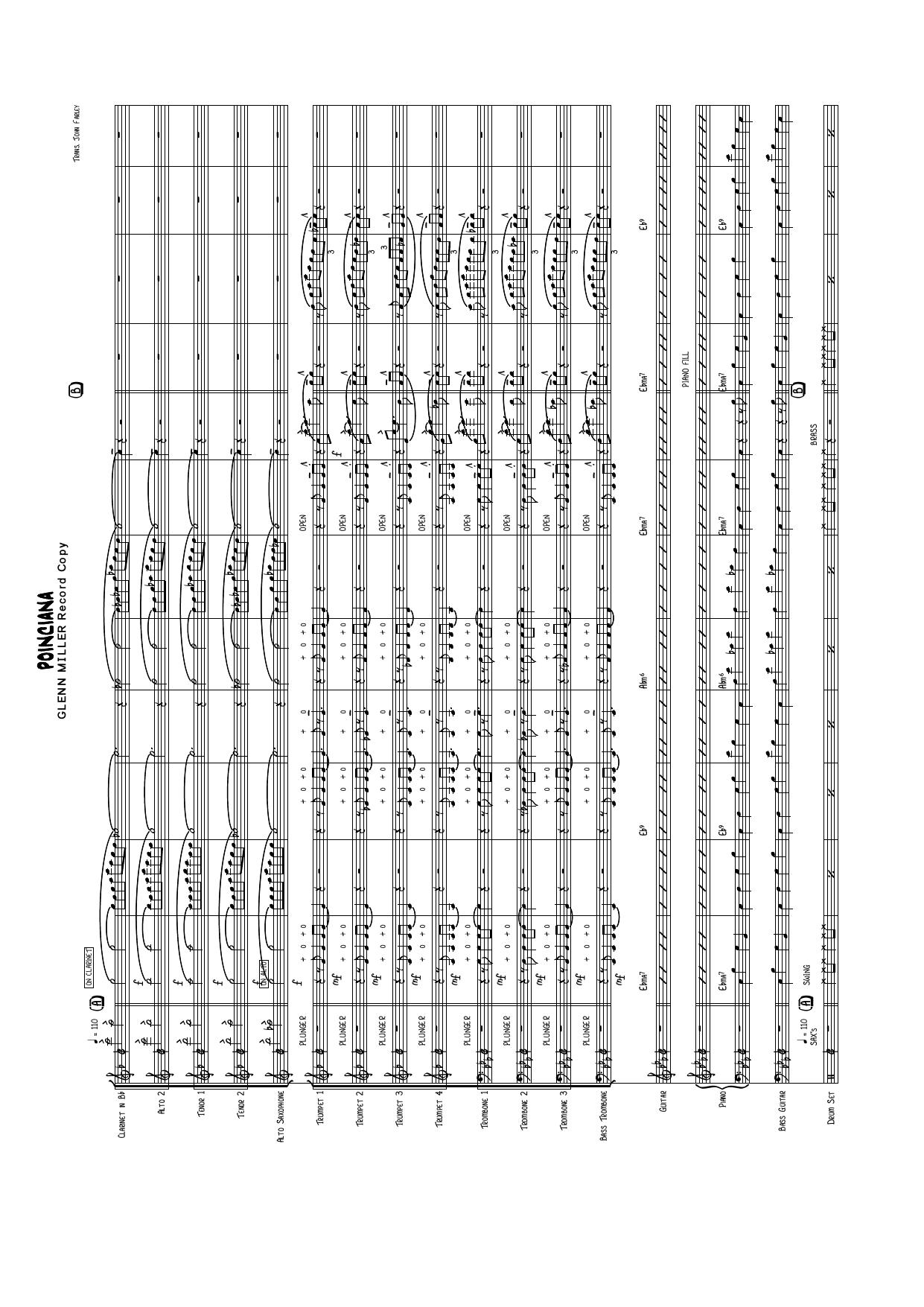
Poinciana (J.Farley) sheet music preview

Poinciana (J.Farley)

Composed by Nat Simon

Arranged by John Farley

  • Ensemble: Big Band
  • Pages: 42
  • Instruments (17): Clarinet in Bb / Alto Saxophone, Alto Saxophone 2, Tenor Saxophone 1, Tenor Saxophone 2, Alto Saxophone / Baritone Saxophone, Trumpet 1, Trumpet 2, Trumpet 3, Trumpet 4, Trombone 1, Trombone 2, Trombone 3, Bass Trombone, Guitar, Piano, Bass Guitar, Drum Set
  • Difficulty: medium
  • Content: Individual Parts
  • Format: PDF Download (Instant)
  • Price: $24.99

Nat Simon and Buddy Bernier’s haunting classic "Poinciana" holds a legendary status in the jazz canon, largely immortalized by pianist Ahmad Jamal’s iconic 1958 live recording at the Pershing Lounge in Chicago. Driven by Vernell Fournier’s hypnotic, syncopated drum groove and Jamal’s cascading, modal-tinged piano voicings, the composition became a masterclass in tension, space, and tropical atmosphere. Rooted in traditional American popular song structure yet possessing an exotic, swaying rhythm, "Poinciana" bridges the gap between mid-century cocktail jazz and modern modal exploration, evoking the sun-drenched warmth and breezy mystery of the Cuban resort town for which it is named. John Farley’s sophisticated big band interpretation transforms this historically piano-driven trio masterpiece into a lush, dynamic orchestral canvas. Opening with a signature rhythmic ostinato that pays homage to Fournier’s iconic drum pattern, the arrangement establishes a languid, undulating medium-Latin groove in a concert key optimized for maximum brass resonance. Farley utilizes rich, extended chord voicings across the five-saxophone, four-trumpet, four-trombone, and four-rhythm section lineup, creating a dense, shimmering texture. The arrangement builds organically from whispered, impressionistic woodwind and muted brass colors into a soaring, harmonically adventurous shout chorus that expands the harmonic vocabulary without losing the hypnotic pull of the underlying groove. Throughout the chart, melody duties are shared fluidly between the saxophone section—anchored by expressive lines for lead alto and tenor—and subtle, harmonized trumpet statements. Featured solo space allows a featured improviser to stretch out over modal vamps, supported by crisp background figures from the ensemble that reference classic West Coast counterpoint. Technical challenges lie primarily in maintaining rhythmic precision during the subtle tempo fluctuations and executing the delicate dynamic shifts required to balance the thick, impressionistic horn chords against the percussion. The rhythm section carries a heavy responsibility; the drummer and bassist must lock into an unyielding, conversational groove that sustains the forward momentum through the rubato and semi-improvised transitions. Advanced high school, collegiate, and professional jazz orchestras will find this 42-page arrangement to be an exceptional programming choice that offers a refreshing departure from standard up-tempo swing charts. It provides an ideal vehicle for showcasing a band's maturity, sectional blend, and control over mood and dynamics. Audiences familiar with the Ahmad Jamal iteration will appreciate the clever big band adaptations, while performers will relish the intricate counterpoint and sophisticated harmonic palette that elevate this timeless standard into a modern concert centerpiece. Success with this arrangement hinges on the rhythm section’s ability to establish and maintain an authentic, unhurried Latin-swing hybrid groove. The drummer should avoid a heavy backbeat, leaning instead toward a nuanced, layered rhythmic ostinato reminiscent of Vernell Fournier’s famous approach, using rimshots and light cymbal work to create forward motion. Brass players must exercise extreme dynamic control; the opening sections require a hushed, breathy tone quality, especially when utilizing cup or basket mutes. Pay close attention to the exposed soli passages in the saxophones, ensuring that intonation on altered dominants remains centered and warm. Conductors should emphasize horizontal phrasing over vertical staccato attacks to preserve the lush, tropical atmosphere characteristic of the style. Balance is crucial during the developmental mid-section, where inner-voice harmonies in the trombones can easily obscure the primary melodic line if players do not dynamically back away from the lead parts. Q: What instruments and parts are included in this 18-instrument big band arrangement? A: The instrumentation features a standard contemporary big band setup spanning 42 pages of score and parts, including a Bb Clarinet doubler, two alto saxophones, two tenor saxophones, a baritone saxophone, four trumpets, four trombones, and a full four-piece rhythm section with dedicated piano, guitar, bass, and drum parts. Q: What is the official difficulty level of John Farley's "Poinciana" big band chart? A: This arrangement is graded as advanced, making it ideal for collegiate ensembles, advanced high school jazz bands, and professional community orchestras equipped with strong section players and a proficient rhythm section. Q: How does this arrangement relate to the historical jazz standard tradition? A: While originally written by Nat Simon as a popular song in 1943, this chart heavily draws inspiration from the hypnotic, modal-inflected rhythmic feel popularized by the Ahmad Jamal Trio in the late 1950s, translating that intimate trio concept into a grand orchestral setting. Q: What makes John Farley's arrangement unique compared to other big band versions of this tune? A: Farley’s chart is distinct for its impressionistic use of extended chord voicings, integrated woodwind doubles featuring Bb clarinet, and a meticulously crafted structural arc that evolves from an intimate, rhythmically taut vamp into a sweeping, harmonically rich shout chorus. Q: What is the performance duration and recommended tempo for this piece? A: The piece is structured for a performance duration of approximately 5 to 6 minutes, performed at a relaxed, swaying medium-Latin tempo of around 116 to 124 beats per minute.

Questions and answers

What is included in the Poinciana (J.Farley) PDF?
The verified current file contains a conductor score and individual parts across 42 pages.
How many instruments or parts are listed for Poinciana (J.Farley)?
The verified instrumentation list contains 17 entries for this Big Band arrangement.
Who is credited for Poinciana (J.Farley)?
Composer: Nat Simon. Arranger: John Farley.
What difficulty is listed for Poinciana (J.Farley)?
The verified difficulty level is medium.
Can I preview Poinciana (J.Farley) before buying?
Yes. The product page provides a preview generated from the current PDF file.
How is Poinciana (J.Farley) delivered?
After successful payment, the digital PDF is made available for download. The displayed price is $24.99.

Musicians Also Search For

Poinciana John Farley PDFPoinciana John Farley sheet musicPoinciana arranged by John FarleyJohn Farley big band chartsJohn Farley jazz arrangements PDFPoinciana Nat Simon sheet musicPoinciana Nat Simon big band arrangementsNat Simon big band chartsPoinciana big band arrangementsPoinciana big band PDF downloadPoinciana jazz sheet musicbig band sheet music downloadPoinciana conductor score PDFPoinciana individual parts downloadPoinciana sheet music PDFbuy Poinciana sheet musicdownload Poinciana PDFPoinciana jazz chartsbest John Farley big band arrangementsNat Simon arranged by John FarleyPoinciana printable sheet musicbig band repertoire PDF

All arrangements by John Farley All Nat Simon sheet music