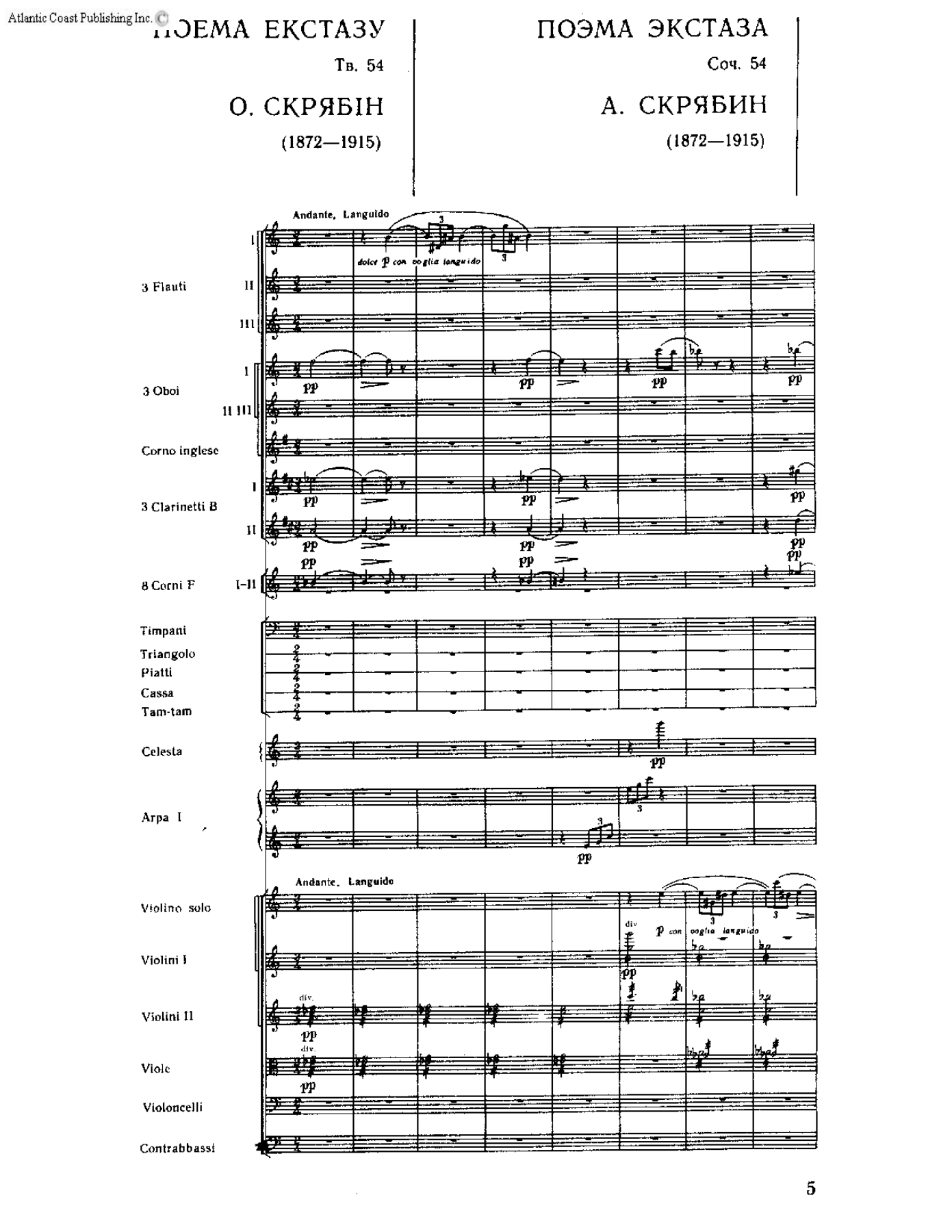
Poem Of Ecstasy, opus (A.Scriabin)
Composed by Alexander Scriabin
Arranged by A. Scriabin
- Ensemble: Concert Band
- Style: Traditional
- Pages: 148
- Instruments (28): Piccolo, Flauti, Oboi, Corno inglese, Clarinetti, Clarinetto basso, Fagotti, Contrafagotto, Corni, Trombe, Tromboni, Tuba, Timpani, Triangolo, Piatti, Cassa, Tam-tam, Campanelli, Celesta, Arpa I, Arpa II, Organo, Violino solo, Violini I, Violini II, Viole, Violoncelli, Contrabbassi
- Difficulty: advanced
- Content: Individual Parts
- Format: PDF Download (Instant)
- Price: $22.99
Alexander Scriabin’s monumental "Poem Of Ecstasy, opus" (also known as Symphony No. 4) is a cornerstone of early 20th-century orchestral literature, first performed in 1908. This original composition, a sprawling tone poem, embodies the late Romantic and early Modernist eras, famous for its mystical, philosophical underpinnings and its exploration of extreme emotional states, from languid introspection to ecstatic triumph. While not a jazz standard in its original form, its rich harmonic language, dramatic dynamic shifts, and soaring melodic lines offer fertile ground for reinterpretation. This particular arrangement by A. Scriabin (the original composer, implying a self-arrangement or a re-imagining by the composer himself, or a contemporary arranger sharing the name) recontextualizes this orchestral masterpiece for the concert band medium, maintaining the essence of the original while adapting it to the wind ensemble's unique timbral palette. The musical character of this arrangement retains the original's epic scope and emotional arc. It traverses a broad dynamic range, from hushed, ethereal passages marked *pianissimo* to overwhelming, full-ensemble climaxes reaching *fortissimo*. While the original is a free-flowing, often rubato work, this concert band transcription maintains a traditional, classical approach to tempo and rhythm, emphasizing precision and blend over a jazz-specific groove. The primary key centers shift frequently, reflecting Scriabin’s innovative harmonic language, which often pushes the boundaries of tonality with its use of mystic chord voicings and non-functional progressions. The mood is overwhelmingly grand and evocative, moving through periods of tension and release, contemplation and explosive joy, culminating in a powerful, transcendent finish. A. Scriabin's approach to this transcription is characterized by a meticulous commitment to the original score's integrity. Rather than imposing jazz idioms, the arranger focuses on translating the orchestral textures and instrumental colors directly to the concert band. This involves sophisticated scoring that distributes the original string and woodwind lines across the various sections of the band, utilizing the full spectrum of clarinets, saxophones, flutes, oboes, bassoons, and brass. Expect intricate counterpoint, demanding unison passages, and carefully balanced voicings that aim to replicate Scriabin's dense harmonic structures. There are no traditional jazz soli sections or shout choruses; instead, the emphasis is on the collective ensemble's ability to articulate complex musical phrases and dynamic contrasts. The arrangement features extended harmonies inherent to Scriabin's style, requiring precise intonation and blend from all sections. Performance details reveal that the melodic material is frequently shared and interwoven among various sections, requiring acute listening and balance. Prominent melodic statements often emerge from the woodwind choir, with brass providing powerful support and dramatic punctuation. While there are no improvised solos, individual principal players will have demanding, exposed lines that require advanced technical proficiency and musical sensitivity. Technical challenges include rapid scale and arpeggio passages, extreme dynamic control, intricate rhythmic figures, and the ability to sustain long, expressive phrases. The sheer length and emotional intensity of the piece demand significant stamina and focus from all performers. It is a profoundly rewarding experience for bands capable of tackling its intellectual and technical demands, offering an opportunity to explore a seminal work of classical modernism through the concert band lens. This arrangement is ideally suited for advanced high school, collegiate, community, and professional concert bands seeking a challenging and artistically fulfilling centerpiece for their repertoire. Approaching "Poem Of Ecstasy" requires meticulous attention to dynamic nuance and harmonic clarity. Key technical challenges include navigating Scriabin’s complex, often dissonant harmonies, demanding precise intonation, especially in dense woodwind and brass voicings. Conductors should emphasize slow, sectional rehearsals to ensure each voice contributes to the overall harmonic fabric. The tempo marking, while fluid in the original, should be interpreted with a traditional, classical feel, prioritizing rhythmic accuracy and ensemble cohesion over rubato, except where explicitly marked. There are no special jazz techniques like plungers or falls required; the focus is on traditional concert band articulation and phrasing. Rehearsal tips include isolating challenging contrapuntal passages, using chorale-style exercises for blend and balance, and dedicating significant time to shaping the dramatic arc of the piece, ensuring the powerful climaxes are earned through careful build-up from the quieter, more introspective moments. Q: What instruments and parts are included in this arrangement? A: This concert band arrangement includes a full complement of standard wind ensemble instrumentation, typically encompassing flutes, oboes, bassoons, clarinets (Bb, bass), saxophones (alto, tenor, bari), trumpets, horns, trombones, euphonium, tuba, and a comprehensive percussion section. Q: What is the difficulty level of this arrangement? A: This arrangement is considered advanced, suitable for collegiate, professional, or highly skilled high school and community concert bands. It demands excellent technical proficiency, advanced musicianship, and significant ensemble experience to perform effectively. Q: What is the musical style and historical context of this piece? A: The original "Poem Of Ecstasy" is a seminal work of early 20th-century orchestral literature, embodying late Romanticism and early Modernism. This concert band arrangement maintains the original's grand, mystical, and emotionally charged classical style, not a jazz idiom. Q: What makes this arrangement unique compared to other concert band pieces? A: Its uniqueness lies in its faithful transcription of a complex, philosophical orchestral tone poem by Alexander Scriabin for the concert band medium, offering a rare opportunity to perform a major classical work not originally conceived for winds, without imposing jazz stylistic elements. Q: What is the approximate performance duration of this arrangement? A: The performance duration for this arrangement is approximately 20-22 minutes, reflecting the substantial length and epic scope of Scriabin's original "Poem Of Ecstasy."
Questions and answers
- What is included in the Poem Of Ecstasy, opus (A.Scriabin) PDF?
- The verified current file contains a conductor score across 148 pages.
- How many instruments or parts are listed for Poem Of Ecstasy, opus (A.Scriabin)?
- The verified instrumentation list contains 28 entries for this Concert Band arrangement.
- Who is credited for Poem Of Ecstasy, opus (A.Scriabin)?
- Composer: Alexander Scriabin. Arranger: A. Scriabin.
- What difficulty is listed for Poem Of Ecstasy, opus (A.Scriabin)?
- The verified difficulty level is advanced.
- What style is listed for Poem Of Ecstasy, opus (A.Scriabin)?
- The catalog lists the style as Traditional.
- Can I preview Poem Of Ecstasy, opus (A.Scriabin) before buying?
- Yes. The product page provides a preview generated from the current PDF file.
- How is Poem Of Ecstasy, opus (A.Scriabin) delivered?
- After successful payment, the digital PDF is made available for download. The displayed price is $22.99.
Musicians Also Search For
Poem Of Ecstasy, opus A. Scriabin PDF • Poem Of Ecstasy, opus A. Scriabin sheet music • Poem Of Ecstasy, opus arranged by A. Scriabin • A. Scriabin concert band charts • A. Scriabin jazz arrangements PDF • Poem Of Ecstasy, opus Alexander Scriabin sheet music • Poem Of Ecstasy, opus Alexander Scriabin concert band arrangements • Alexander Scriabin concert band charts • Poem Of Ecstasy, opus concert band arrangements • Poem Of Ecstasy, opus concert band PDF download • Poem Of Ecstasy, opus jazz sheet music • concert band sheet music download • Poem Of Ecstasy, opus conductor score PDF • Poem Of Ecstasy, opus sheet music PDF • Poem Of Ecstasy, opus Traditional charts • Traditional concert band arrangements • buy Poem Of Ecstasy, opus sheet music • download Poem Of Ecstasy, opus PDF • Poem Of Ecstasy, opus jazz charts • best A. Scriabin concert band arrangements • Alexander Scriabin arranged by A. Scriabin • Poem Of Ecstasy, opus printable sheet music • concert band repertoire PDF