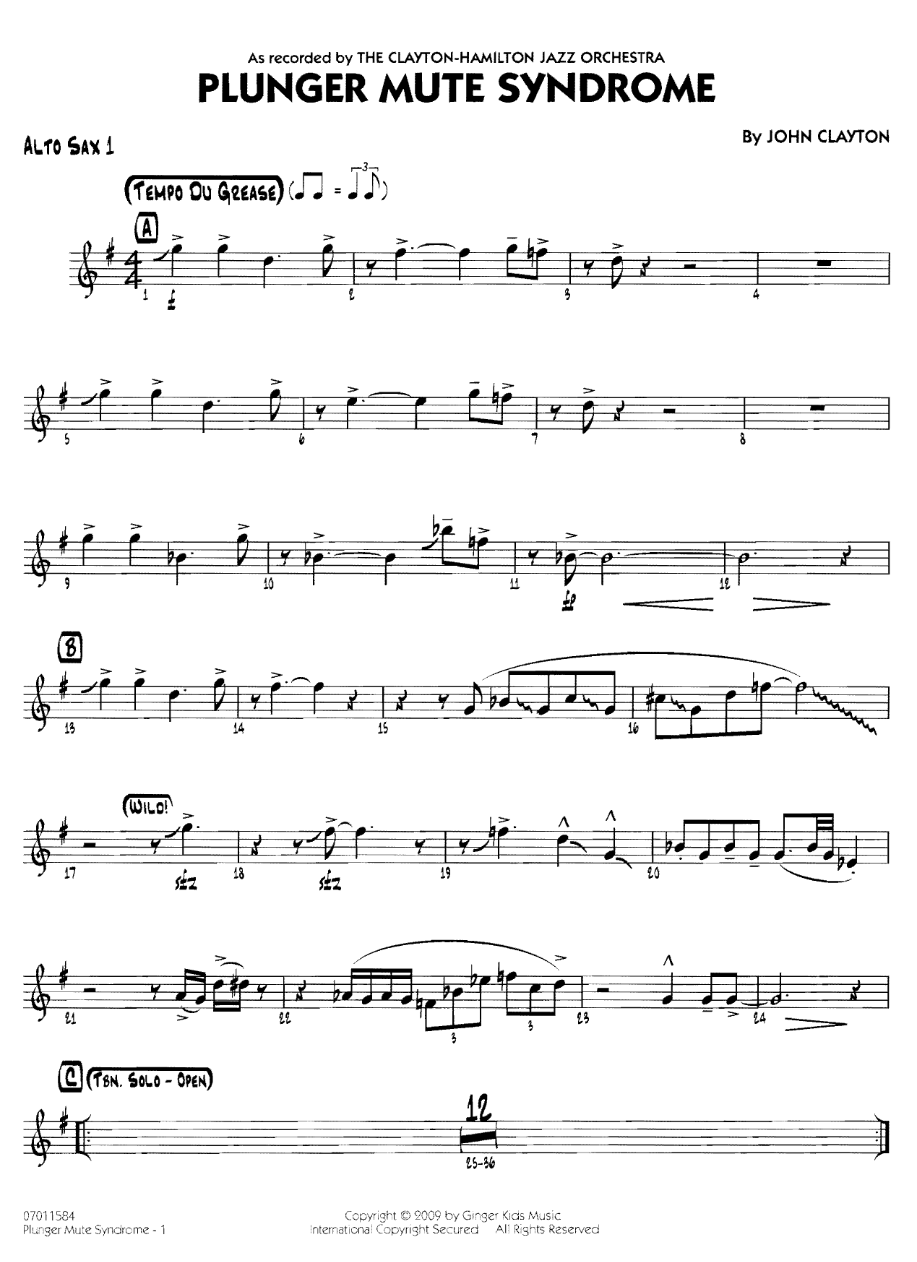
Plunger Mute Syndrome (J.Clayton) sheet music preview

Plunger Mute Syndrome (J.Clayton)

Composed by John Clayton

Arranged by John Clayton

  • Ensemble: Big Band
  • Pages: 36
  • Instruments (18): Alto Sax 1, Alto Sax 2, Tenor Sax 1, Tenor Sax 2, Baritone Sax, Trumpet 1, Trumpet 2, Trumpet 3, Trumpet 4, Trumpet 5, Trombone 1, Trombone 2, Trombone 3, Trombone 4, Guitar, Piano, Bass, Drums
  • Difficulty: medium
  • Content: Individual Parts
  • Format: PDF Download (Instant)
  • Price: $24.99

Brimming with wit, swagger, and sophisticated harmonic motion, "Plunger Mute Syndrome" stands as a masterclass in modern big band writing from the pen of renowned bassist, composer, and arranger John Clayton. Conceived within the rich tradition of contemporary mainstream jazz and heavily informed by the classic Ellingtonian tradition of textural contrast and timbral exploration, this composition showcases Clayton’s uncanny ability to blend traditional swing sensibilities with advanced, contemporary harmonic voicings. Known for his work with the Count Basie Orchestra and the Clayton-Hamilton Jazz Orchestra, Clayton infuses this chart with the driving momentum and effortless groove that define the absolute pinnacle of modern large ensemble jazz. Driven by an infectious, medium-up swing groove, the piece immediately establishes a playful yet demanding musical landscape. The harmonic language balances blues-infused rootality with lush, extended chord structures that shift seamlessly between modal vamps and sophisticated bebop changes. True to its title, the arrangement serves as a dedicated showcase for expressive brass manipulation, demanding absolute mastery of plunger mutes, half-valves, and various dynamic colorations from the trumpet and trombone sections. The emotional arc moves effortlessly from sly, conspiratorial tension to explosive, roof-raising joy, evoking the theatricality of a late-night club set combined with the precision of a world-class concert hall performance. Clayton’s compositional architecture treats the 18-piece big band not merely as a monolith, but as a collection of interlocking conversational units. The woodwind section navigates intricate, harmonically dense solis that require absolute rhythmic unison, while the brass provide punchy, effective counter-melodies punctuated by signature plunger effects. Clayton avoids predictable scoring by continuously shifting textures—pairing muted brass with sparse rhythm section accompaniment before opening up into roaring, highly sophisticated shout choruses. The arrangement features open solo space designed to highlight a strong trumpet or trombone improviser capable of navigating blues changes with theatrical flair and rhythmic authority, supported by a rhythm section chart that demands a locked-in, conversational swing feel from the piano and bass. Advanced collegiate, professional, and elite community big bands will find "Plunger Mute Syndrome" an exceptionally rewarding addition to their repertoire. The chart requires seasoned section players who possess polished intonation, agile reading skills, and the stylistic flexibility to transition smoothly between straight-ahead swing and specialized muted effects. While rhythmically accessible to bands comfortable with modern medium-tempo swing, the subtleties of Clayton’s articulation demands, dynamic shading, and stylistic nuance make it a premier choice for festival performance, juried recitals, or advanced concert settings where ensemble cohesion and individual artistry can truly shine. Navigating "Plunger Mute Syndrome" successfully requires meticulous attention to articulation, stylistic unity, and dynamic contrast across all sections. The tempo should be locked into a comfortable, driving medium-swing feel (around quarter note = 168 BPM) that prioritizes forward momentum over sheer speed; avoid rushing the triplet feel in the ride cymbal and bass lines. Brass players must invest considerable rehearsal time into coordinating plunger techniques (open, closed, half-closed, and wah-wah effects) to ensure the textural colors blend cohesively rather than sounding gimmicky. Conductors should focus heavily on the rhythm section first: the piano and bass must establish an unyielding, conversational groove that anchors the ensemble's dynamic shifts. Ensure the saxophones maintain a dry, articulate tone during fast bebop lines, keeping eighth notes even and light. During the shout choruses, demand absolute balance so the lead trumpet cuts through the thick, extended upper-structure voicings without forcing the tone. Rehearsals should isolate the dynamic swells and sudden drop-offs, as Clayton’s dramatic pauses and whisper-quiet ensemble moments are just as vital to the chart's impact as its roaring climaxes. Q: What instruments and parts are included in this arrangement? A: The chart is scored for a standard 18-piece big band instrumentation: 5 saxophones (2 altos, 2 tenors, 1 baritone), 4 trumpets, 4 trombones, piano, guitar, bass, and drums, spanning a total of 36 comprehensive pages of score and parts. Q: What is the difficulty level of "Plunger Mute Syndrome"? A: This arrangement is graded as advanced (Level 5), making it best suited for collegiate ensembles, professional big bands, and elite high school jazz orchestras with strong section players and capable improvisers. Q: What is the style and historical context of this piece? A: Written in a contemporary mainstream jazz style by master arranger John Clayton, the piece pays homage to the classic Ellingtonian tradition of plunger mute wizardry while incorporating modern harmonic sophistication and driving big band swing. Q: What makes this arrangement unique in a big band library? A: Its primary distinction lies in its deep integration of expressive brass plunger techniques paired with Clayton's signature lush voicings, clever dynamic shifts, and witty, conversational writing between the sections. Q: What is the performance duration and recommended tempo? A: While performance time varies slightly based on open solo sections, the piece is designed as a medium-up swing chart intended to be performed at approximately quarter note = 168 BPM, typically running around 4 to 5 minutes.

Questions and answers

What is included in the Plunger Mute Syndrome (J.Clayton) PDF?
The verified current file contains individual parts across 36 pages.
How many instruments or parts are listed for Plunger Mute Syndrome (J.Clayton)?
The verified instrumentation list contains 18 entries for this Big Band arrangement.
Who is credited for Plunger Mute Syndrome (J.Clayton)?
Composer: John Clayton. Arranger: John Clayton.
What difficulty is listed for Plunger Mute Syndrome (J.Clayton)?
The verified difficulty level is medium.
Can I preview Plunger Mute Syndrome (J.Clayton) before buying?
Yes. The product page provides a preview generated from the current PDF file.
How is Plunger Mute Syndrome (J.Clayton) delivered?
After successful payment, the digital PDF is made available for download. The displayed price is $24.99.

Musicians Also Search For

Plunger Mute Syndrome John Clayton PDFPlunger Mute Syndrome John Clayton sheet musicPlunger Mute Syndrome arranged by John ClaytonJohn Clayton big band chartsJohn Clayton jazz arrangements PDFPlunger Mute Syndrome John Clayton big band arrangementsPlunger Mute Syndrome big band arrangementsPlunger Mute Syndrome big band PDF downloadPlunger Mute Syndrome jazz sheet musicbig band sheet music downloadPlunger Mute Syndrome individual parts downloadPlunger Mute Syndrome sheet music PDFbuy Plunger Mute Syndrome sheet musicdownload Plunger Mute Syndrome PDFPlunger Mute Syndrome jazz chartsbest John Clayton big band arrangementsPlunger Mute Syndrome printable sheet musicbig band repertoire PDF

All arrangements by John Clayton All John Clayton sheet music