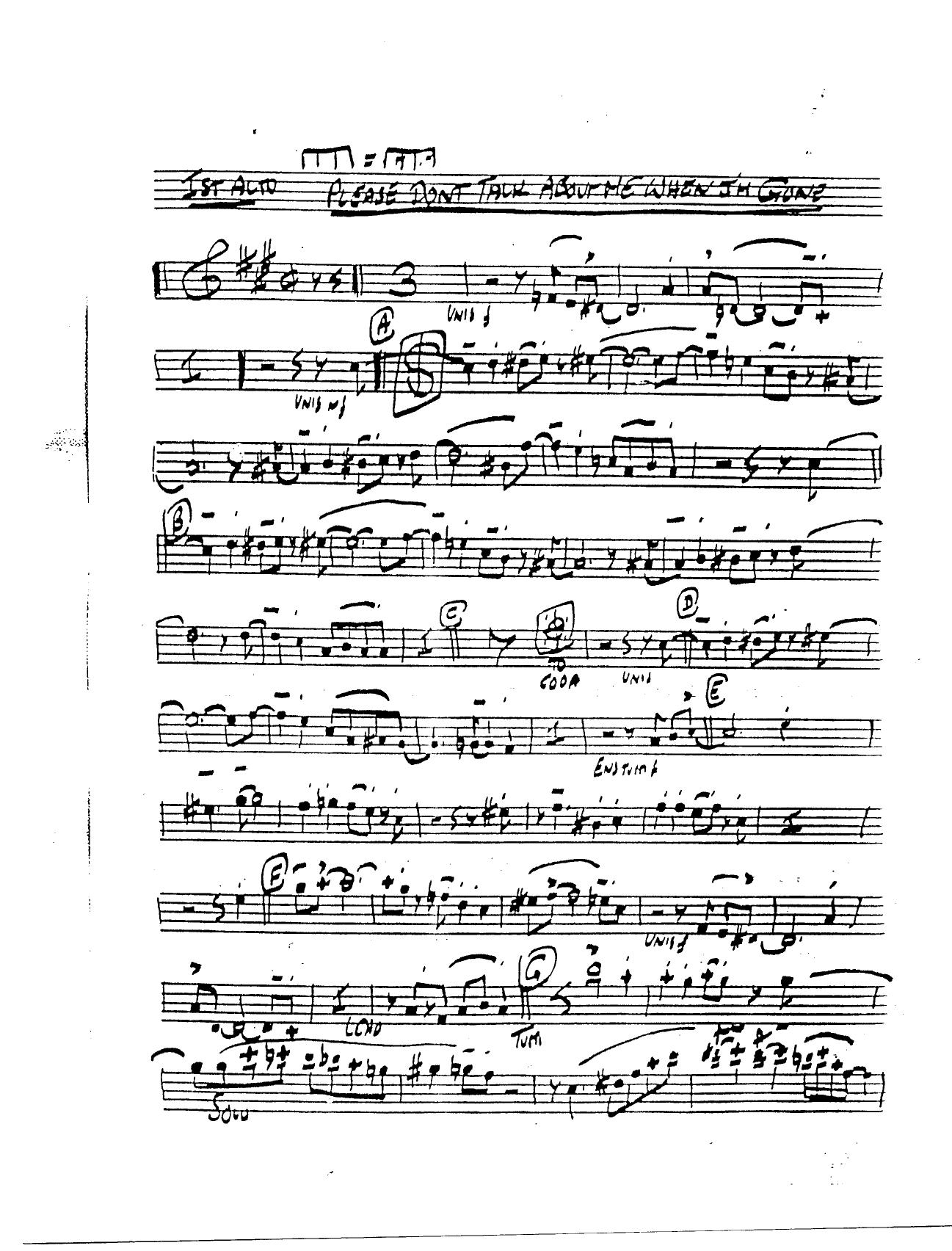
Please Don't Talk About Me When I'n Gone (J.Farley) sheet music preview

Please Don't Talk About Me When I'n Gone (J.Farley)

Composed by Sam H. Stept

Arranged by John Farley

  • Ensemble: Big Band
  • Pages: 28
  • Instruments (18): 1st Alto Saxophone, 2nd Alto Saxophone, 1st Tenor Saxophone, 2nd Tenor Saxophone, Baritone Saxophone, 1st Trumpet, 2nd Trumpet, 3rd Trumpet, 4th Trumpet, 1st Trombone, 2nd Trombone, 3rd Trombone, 4th Trombone, Piano, Guitar, Bass, Drums, Vocal
  • Difficulty: medium
  • Content: Individual Parts
  • Format: PDF Download (Instant)
  • Price: $24.99

Written by Sam H. Stept with lyrics by Sidney Clare, "Please Don't Talk About Me When I'S Gone" stands as one of the quintessential Tin Pan Alley contributions to the early jazz canon. Introduced in 1930, the tune quickly transitioned from a popular vocal vehicle into an enduring instrumental jazz standard, famously embraced by giants like Louis Armstrong, Django Reinhardt, and Coleman Hawkins. It represents the bridge between late-1920s novelty pop and the sophisticated swing era, characterized by an infectious, deceptively jaunty melody hiding a bittersweet, tongue-in-cheek lyric. This historical dual personality makes it an ideal canvas for big band adaptation, offering a rich melodic framework that invites both lighthearted swing and driving, hard-edged improvisation. John Farley’s masterful 18-instrument big band arrangement breathes fresh life into the standard through a vibrant, medium-up swing groove set in a bright, finger-snapping tempo. Farley frames the composition with an effervescent energy, balancing classic Kansas City-style riffing with clever, modern harmonic extensions that gently nudge the 1930s classic into the post-swing idiom. The mood is high-spirited and relentlessly optimistic, evoking the smoky warmth and urbane sophistication of a 1940s metropolitan ballroom while retaining the buoyant, singable charm of its original composition date. Farley’s structural approach relies heavily on dynamic contrast and sectional interplay. The arrangement opens with a crisp, rhythm-section-driven intro before handing the primary melody to a tight, unison sax soli that highlights the agility of the two alto and two tenor voices, anchored by the baritone sax. Rather than keeping the texture uniform, Farley introduces clever counter-melodies in the brass, building relentless momentum toward a textbook, high-octane shout chorus. This climactic section deploys classic brass-versus-reed call-and-response figures, punctuated by smart dynamic shifts that prevent the arrangement from ever feeling static. Solos are strategically opened up over standard changes, giving featured players ample room to stretch out. Advanced high school ensembles, collegiate jazz orchestras, and professional community big bands will find this 28-page chart exceptionally rewarding. While the rhythm section must maintain a relentless, feather-light swing pulse, the horn sections are required to execute crisp articulation, precise dynamic control, and clean blend work during the intricate soli passages. Technical demands are moderate-to-advanced, primarily concerning stylistic uniformity rather than extreme range, making it a stellar showcase piece for festival adjudication or a sophisticated anchor for a standard concert program. Success with this arrangement hinges on achieving an authentic, buoyant medium-up swing feel without rushing the tempo. The conductor should ensure that the rhythm section—particularly the ride cymbal and walking bass—locks into a driving, behind-the-beat pulse that gives the horns room to breathe. Key technical challenges lie in the precision of the sectional solis. The saxophones must pay close attention to uniform articulation, ensuring that short notes are properly clipped and accented notes carry appropriate weight without distorting the intonation. Brass players should utilize subtle fall-offs and doits only where indicated, keeping stylistic choices tasteful and appropriate to the late-swing aesthetic. During rehearsal, isolate the shout chorus to balance the brass volume against the moving reed counter-lines. Ensure that the dynamic drop immediately preceding the final chorus is exaggerated; the sudden shift from forte to piano creates the necessary tension that makes the ultimate payoff explosive and satisfying for both the band and the audience. Q: What specific instruments and parts are included in this arrangement? A: The 28-page publication includes a complete 18-instrument big band instrumentation, featuring standard parts for two alto saxophones, two tenor saxophones, baritone saxophone, four trumpets, four trombones, and a full rhythm section of piano, bass, drums, and guitar. Q: What is the overall difficulty level of this chart? A: This arrangement is graded as medium-advanced, making it ideally suited for capable high school varsity jazz bands, collegiate ensembles, and professional community big bands looking for a polished festival or concert piece. Q: What is the historical style and background of the music? A: The piece is based on Sam H. Stept’s 1930 Tin Pan Alley standard, arranged here in a classic, vibrant medium-up swing style that pays homage to the golden age of big band jazz while incorporating fresh, sophisticated counter-lines. Q: What makes John Farley’s arrangement unique compared to other versions? A: Farley’s treatment stands out through its clever integration of modern harmonic colorations, a tightly crafted saxophone soli, and a dynamic, high-energy shout chorus that builds exceptional momentum through brass and reed call-and-response. Q: What is the recommended performance duration and tempo for this arrangement? A: While performance time can vary slightly depending on the length of improvised solos, the chart is designed to run approximately 3.5 to 4 minutes at a brisk, energetic medium swing tempo.

Questions and answers

What is included in the Please Don't Talk About Me When I'n Gone (J.Farley) PDF?
The verified current file contains individual parts across 28 pages.
How many instruments or parts are listed for Please Don't Talk About Me When I'n Gone (J.Farley)?
The verified instrumentation list contains 18 entries for this Big Band arrangement.
Who is credited for Please Don't Talk About Me When I'n Gone (J.Farley)?
Composer: Sam H. Stept. Arranger: John Farley.
What difficulty is listed for Please Don't Talk About Me When I'n Gone (J.Farley)?
The verified difficulty level is medium.
Can I preview Please Don't Talk About Me When I'n Gone (J.Farley) before buying?
Yes. The product page provides a preview generated from the current PDF file.
How is Please Don't Talk About Me When I'n Gone (J.Farley) delivered?
After successful payment, the digital PDF is made available for download. The displayed price is $24.99.

Musicians Also Search For

Please Don't Talk About Me When I'n Gone John Farley PDFPlease Don't Talk About Me When I'n Gone John Farley sheet musicPlease Don't Talk About Me When I'n Gone arranged by John FarleyJohn Farley big band chartsJohn Farley jazz arrangements PDFPlease Don't Talk About Me When I'n Gone Sam H. Stept sheet musicPlease Don't Talk About Me When I'n Gone Sam H. Stept big band arrangementsSam H. Stept big band chartsPlease Don't Talk About Me When I'n Gone big band arrangementsPlease Don't Talk About Me When I'n Gone big band PDF downloadPlease Don't Talk About Me When I'n Gone jazz sheet musicbig band sheet music downloadPlease Don't Talk About Me When I'n Gone individual parts downloadPlease Don't Talk About Me When I'n Gone sheet music PDFbuy Please Don't Talk About Me When I'n Gone sheet musicdownload Please Don't Talk About Me When I'n Gone PDFPlease Don't Talk About Me When I'n Gone jazz chartsbest John Farley big band arrangementsSam H. Stept arranged by John FarleyPlease Don't Talk About Me When I'n Gone printable sheet musicbig band repertoire PDF

All arrangements by John Farley All Sam H. Stept sheet music