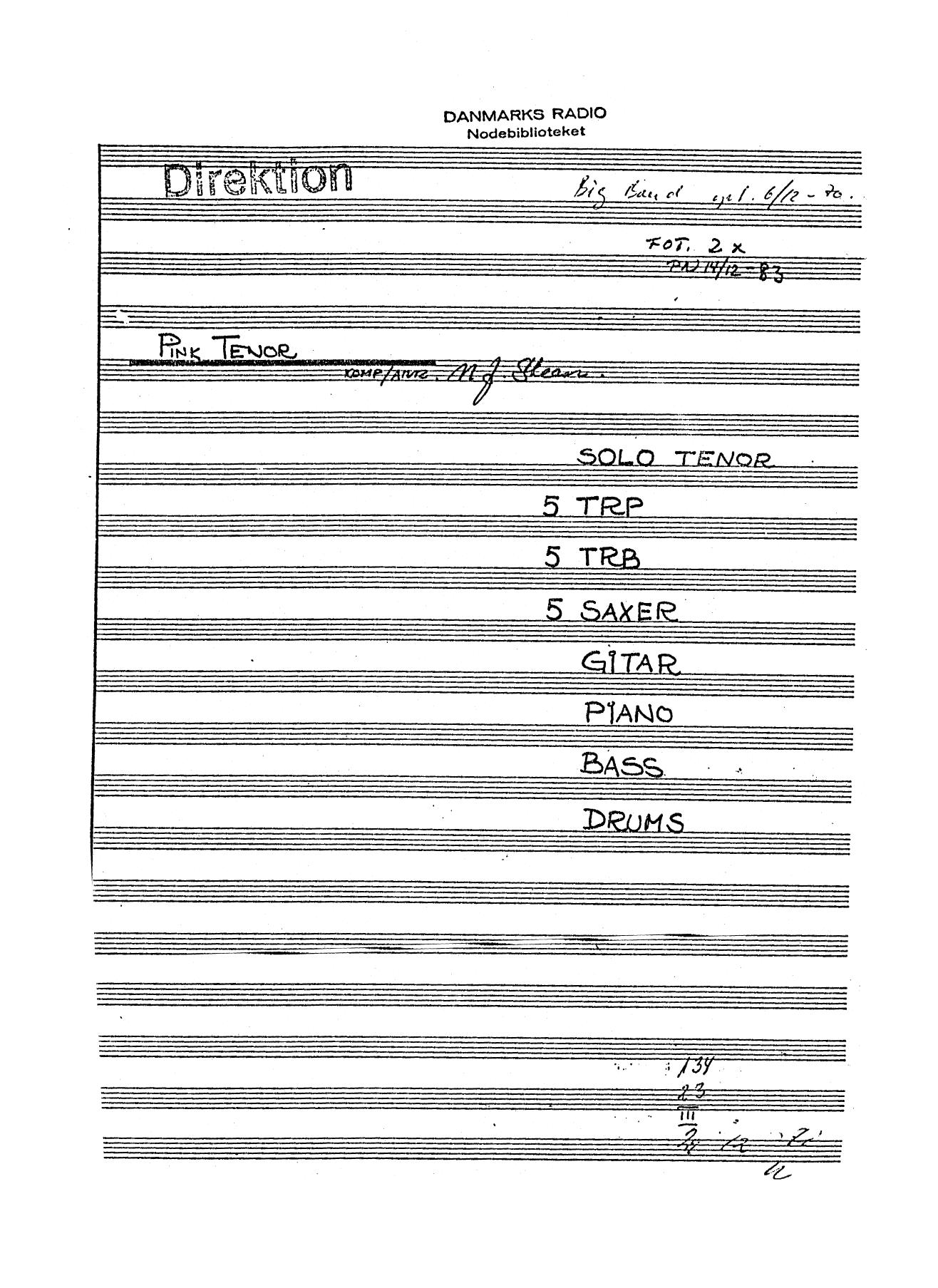
Pink Tenor (N.J.Steen)
Composed by N. J. Steen
Arranged by N.J.Steen
- Ensemble: Big Band
- Style: Jazz Standard
- Pages: 62
- Instruments (20): Conductor Score, Alto Saxophone 1, Alto Saxophone 2, Solo Tenor Saxophone, Tenor Saxophone 2, Baritone Saxophone, Trumpet 1, Trumpet 2, Trumpet 3, Trumpet 4, Trumpet 5, Trombone 1, Trombone 2, Trombone 3, Trombone 4, Trombone 5, Piano, Guitar, Bass, Drums
- Difficulty: advanced
- Content: Individual Parts
- Format: PDF Download (Instant)
- Price: $24.99
"Pink Tenor," composed and arranged by the esteemed jazz artist N.J. Steen, stands as a vibrant contribution to modern big band repertoire, capturing the sophisticated harmonic language and driving rhythmic intensity of contemporary mainstream jazz. Emerging from a tradition that bridges classic swinging idioms with modern compositional complexity, the work reflects Steen’s deep immersion in the big band tradition, showcasing an acute ear for dynamic contrast, rich brass texturing, and linear momentum. It channels the spirit of mid-century modal and hard-bop writing while incorporating fresh, contemporary voicings that challenge and reward modern ensembles. Musically, the composition is anchored in a sophisticated medium-up swing groove that demands immaculate internal time and rhythmic precision from the rhythm section. Opening with an inviting, sultry vamp, the piece quickly establishes a sleek, urbane mood characterized by shimmering saxophone counterlines and crisp, punctuation-driven brass stabs. The harmonic landscape moves fluidly between traditional blues-infused extensions and unexpected modal shifts, creating an underlying tension that continually propels the listener forward. The mood alternates effortlessly between cool, understated sophistication and high-octane, swinging exuberance, evoking the late-night ambiance of a premier metropolitan jazz club. Steen’s arrangement is meticulously crafted to highlight the distinct tonal colors of the 20-piece jazz orchestra. The melody is introduced by the saxophone section—led by the featured tenor saxophone—before opening up into lush, harmonically dense ensemble solis that demand absolute blend and intonation control. The arrangement builds organically toward a powerhouse shout chorus, utilizing dynamic terraced instrumentation and soaring trumpet lines that stretch the upper registers before resolving into a triumphant restatement of the primary theme. Featured solo changes provide ample space for a standout tenor saxophonist to stretch out over changes that favor both linear bebop phrasing and blues-drenched expression. Advanced high school, collegiate, and professional big bands will find this chart an exceptional vehicle for showcasing technical proficiency and stylistic versatility. While the rhythm section requires a mature drummer capable of driving a relentless swing feel alongside a locked-in bassist, the horn sections will benefit immensely from working on articulation, dynamic shading, and balance. "Pink Tenor" offers a deeply rewarding rehearsal process that translates directly into an unforgettable concert experience, making it a stellar centerpiece for any serious jazz ensemble's performance program. Executing "Pink Tenor" successfully requires rigorous attention to articulation style and stylistic uniformity across all sections. The tempo should remain steady and forward-moving, anchored by a light, conversational ride cymbal pattern that avoids heavy-handed quarter-note stomping. Conductors should emphasize the distinction between short, accented, staccato notes and longer, connected lines, particularly during the dense brass-and-reed interlocks. The saxophones must prioritize a warm, unified acoustic blend during the opening melody, ensuring that the lead tenor floats effortlessly above the accompaniment without forcing their tone. In the brass section, trumpet players should approach high-register passages with controlled brilliance rather than brute volume, utilizing natural drops and doits judiciously to enhance—rather than obscure—the underlying harmony. Rehearsal time should initially be divided into sectional work, focusing on the intricate inner-voice movements within the trombone choir and the rhythmic synchronization of the syncopated ensemble shout choruses. Pay close attention to dynamic markings; dropping immediately to a delicate piano behind the featured soloist will maximize the dramatic impact of the subsequent ensemble crescendos. Q: What specific instruments and parts are included in this publication? A: This 62-page publication includes a full conductor score and individual parts for a standard 20-instrument big band lineup, featuring Alto Saxophone 1, Alto Saxophone 2, Tenor Saxophone 1, Tenor Saxophone 2, Baritone Saxophone, 4 Trumpets, 4 Trombones, Guitar, Piano, Bass, Drums, and auxiliary instrumentation. Q: What is the overall difficulty level of this arrangement? A: This arrangement is rated at an advanced level, making it best suited for collegiate, advanced high school, community, and professional big bands that possess strong reading skills and solid rhythmic precision. Q: What is the musical style and historical background of the piece? A: Written by N.J. Steen, "Pink Tenor" is a contemporary jazz standard-style composition rooted in the hard-bop and modern mainstream big band traditions, emphasizing sophisticated harmonies and a driving medium-up swing feel. Q: What makes this specific arrangement unique compared to standard charts? A: Its uniqueness lies in N.J. Steen’s signature writing style, which seamlessly integrates lush, modern harmonic extensions with classic sectional counterpoint, highlighted by a prominent feature for tenor saxophone and a dynamic, high-impact shout chorus. Q: What is the suggested performance duration and tempo for the piece? A: The piece is designed as a medium-up swing chart with a performance duration of approximately 5 to 6 minutes, depending on the length of the open solo sections chosen by the conductor.
Questions and answers
- What is included in the Pink Tenor (N.J.Steen) PDF?
- The verified current file contains a conductor score and individual parts across 62 pages.
- How many instruments or parts are listed for Pink Tenor (N.J.Steen)?
- The verified instrumentation list contains 20 entries for this Big Band arrangement.
- Who is credited for Pink Tenor (N.J.Steen)?
- Composer: N. J. Steen. Arranger: N.J.Steen.
- What difficulty is listed for Pink Tenor (N.J.Steen)?
- The verified difficulty level is advanced.
- What style is listed for Pink Tenor (N.J.Steen)?
- The catalog lists the style as Jazz Standard.
- Can I preview Pink Tenor (N.J.Steen) before buying?
- Yes. The product page provides a preview generated from the current PDF file.
- How is Pink Tenor (N.J.Steen) delivered?
- After successful payment, the digital PDF is made available for download. The displayed price is $24.99.
Musicians Also Search For
Pink Tenor N.J.Steen PDF • Pink Tenor N.J.Steen sheet music • Pink Tenor arranged by N.J.Steen • N.J.Steen big band charts • N.J.Steen jazz arrangements PDF • Pink Tenor N. J. Steen sheet music • Pink Tenor N. J. Steen big band arrangements • N. J. Steen big band charts • Pink Tenor big band arrangements • Pink Tenor big band PDF download • Pink Tenor jazz sheet music • big band sheet music download • Pink Tenor conductor score PDF • Pink Tenor individual parts download • Pink Tenor sheet music PDF • Pink Tenor Jazz Standard charts • Jazz Standard big band arrangements • buy Pink Tenor sheet music • download Pink Tenor PDF • Pink Tenor jazz charts • best N.J.Steen big band arrangements • N. J. Steen arranged by N.J.Steen • Pink Tenor printable sheet music • big band repertoire PDF