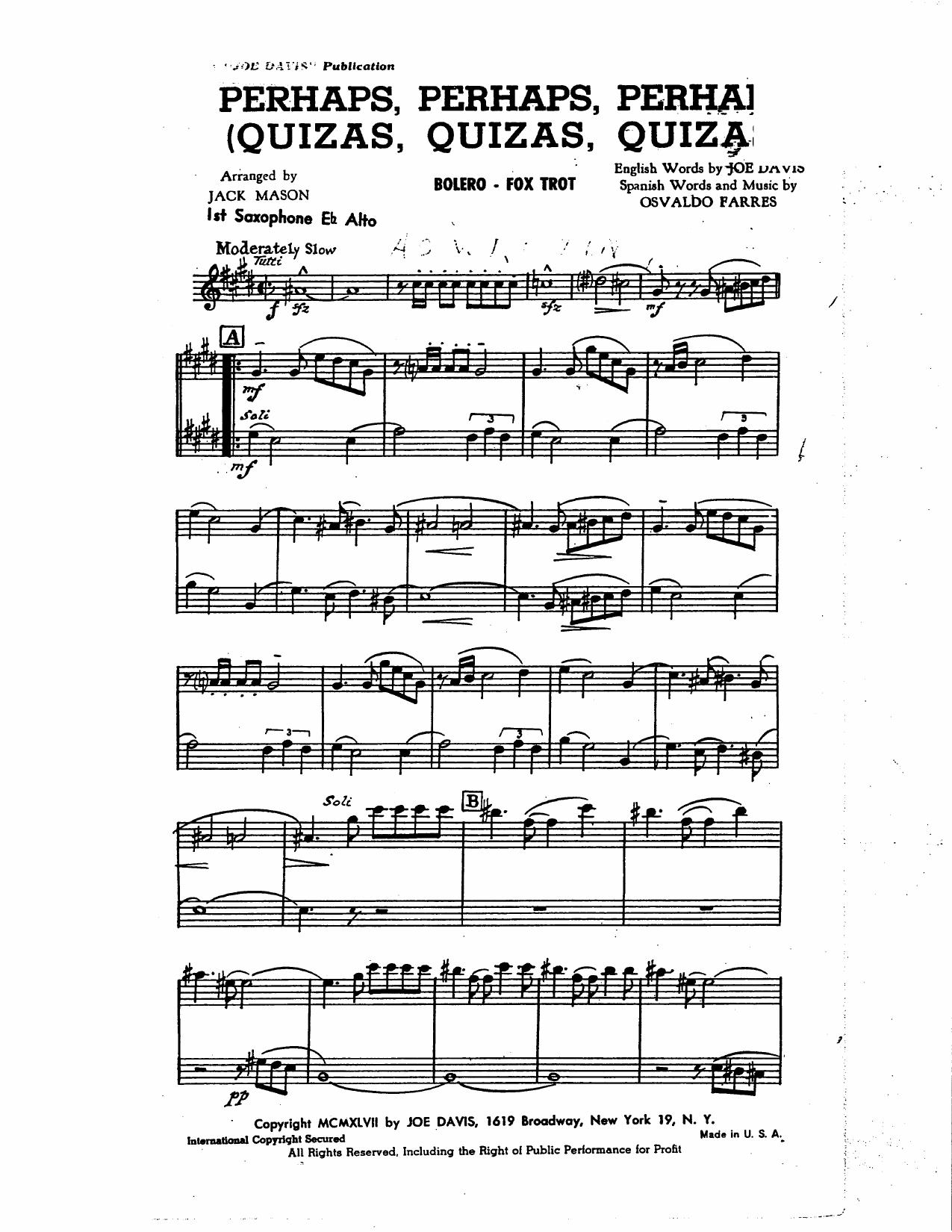
Perhaps, Perhaps, Perhaps (J.Mason)
Composed by Osvaldo Farrés
Arranged by Jack Mason
- Ensemble: Big Band
- Pages: 24
- Instruments (14): 1st Saxophone Eb Alto, 3rd Saxophone Eb Alto, 2nd Saxophone Bb Tenor, 4th Saxophone Bb Tenor, 5th Saxophone Eb Baritone, 1st Trumpet in Bb, 2nd Trumpet in Bb, 3rd Trumpet in Bb, 1st Trombone, 2nd Trombone, Bass, Guitar, Drum Guide, Piano
- Difficulty: medium
- Content: Individual Parts
- Format: PDF Download (Instant)
- Price: $24.99
Originally penned in 1947 by the brilliant Cuban songwriter Osvaldo Farrés as "Quizás, Quizás, Quizás," this timeless melody transcended Latin music borders to become an international pop and jazz staple, famously popularized in the English-speaking world by Doris Day in 1958. The composition represents a brilliant intersection of Afro-Cuban rhythmic insistence and sophisticated American song-form sensibilities. Its enduring appeal lies in the tension between its driving, danceable habanera-inflected pulse and its melancholy, unresolved lyrical theme, making it a natural canvas for jazz interpretation where sultry moods and rhythmic interplay can take center stage. Jack Mason’s masterful big band adaptation reimagines Farrés's classic through a sleek, dynamic Latin-jazz lens, balancing infectious groove with lush, sophisticated harmonic voicings. Operating at a sultry, measured medium-tempo Latin groove, the chart evokes the smoky ambiance of a mid-century Havana supper club while maintaining the punchy brass stabs and crisp articulation expected of contemporary big band writing. The arrangement establishes an immediate sense of intrigue through a rhythmic vamp in the rhythm section, quickly answered by rich, interlocking saxophone harmonies that lay down a velvet carpet of sound before the full ensemble enters. Throughout the chart, Mason showcases his trademark knack for textural variety, alternating between transparent, rhythm-section-driven interludes and roaring, full-ensemble climaxes. The melody is introduced by the alto and tenor saxophones in tight, breathy unison before being handed off to the full brass section, creating a rich sonic dialogue across the ensemble. A standout feature of the arrangement is a well-crafted shout chorus that builds organically, utilizing extended jazz harmonies and syncopated counterlines to drive the energy skyward without ever sacrificing the underlying dance groove. Solo space is thoughtfully provided, allowing a featured horn player to stretch out over accessible, modally tinged changes that fit comfortably under the fingers while offering plenty of room for expressive phrasing. Advanced high school, collegiate, and community jazz ensembles will find this 14-instrument configuration exceptionally rewarding to prepare and perform. While the technical demands—such as crisp articulation in the brass and stylistic authenticity in the rhythm section—require disciplined ensemble listening, the chart does not rely on blistering tempos or extreme altissimo ranges. Instead, it places a premium on stylistic cohesion, dynamic control, and groove, making it an outstanding choice for festival repertoire, spring concerts, or sophisticated dance sets that demand both musical depth and immediate audience engagement. Success with this arrangement hinges entirely on establishing an authentic, unhurried Latin groove that locks tightly between the percussion, bass, and piano. The conductor should ensure the rhythm section avoids a stiff, straight-eighth feel; the underlying subdivisions must breathe with a natural, swaying pulse. Brass players should approach accented figures with a punchy, non-forced attack, utilizing warm, rounded tones rather than aggressive, biting edges that can cloud the lush chordal voicings. Pay close attention to the dynamic contrast between the subdued saxophone soli sections and the full-ensemble hits; precision in short, clipped notes during the transitional vamps will create the necessary dramatic tension. Rehearsal time is best spent isolating the rhythm section to cement the percussion patterns before layering in the horn sections, ensuring that the dynamic peaks in the shout chorus are achieved through collective balance rather than individual overblowing. Q: What instruments and parts are included in this big band arrangement? A: This 14-instrument chart includes standard big band instrumentation featuring Alto Saxophone 1, Alto Saxophone 3, Tenor Saxophone 2, Tenor Saxophone 4, Baritone Saxophone 5, alongside corresponding trumpet, trombone, and rhythm section parts spanning a 24-page conductor and instrumental score set. Q: What is the difficulty level of this Jack Mason arrangement? A: This chart is calibrated for intermediate-to-advanced ensembles, making it ideal for proficient high school bands, college groups, and community big bands looking to showcase stylistic versatility and section blend. Q: What is the musical style and historical context of the piece? A: Based on Osvaldo Farrés's 1947 Latin standard "Quizás, Quizás, Quizás" and popularized by artists like Doris Day, this arrangement frames the tune in a sophisticated mid-tempo Latin-jazz style that bridges traditional Afro-Cuban rhythms with modern big band harmonies. Q: What makes this specific arrangement unique? A: Jack Mason’s treatment stands out through its clever interplay between transparent, rhythm-section-driven textures, lush saxophone solis, and a dynamically escalating shout chorus that avoids blistering technical demands in favor of deep groove and mood. Q: What is the performance duration and recommended tempo feel? A: The arrangement is designed for a performance duration of approximately 3 to 4 minutes, anchored by a relaxed, sultry medium-tempo Latin groove that prioritizes pocket playing and expressive phrasing over speed.
Questions and answers
- What is included in the Perhaps, Perhaps, Perhaps (J.Mason) PDF?
- The verified current file contains individual parts across 24 pages.
- How many instruments or parts are listed for Perhaps, Perhaps, Perhaps (J.Mason)?
- The verified instrumentation list contains 14 entries for this Big Band arrangement.
- Who is credited for Perhaps, Perhaps, Perhaps (J.Mason)?
- Composer: Osvaldo Farrés. Arranger: Jack Mason.
- What difficulty is listed for Perhaps, Perhaps, Perhaps (J.Mason)?
- The verified difficulty level is medium.
- Can I preview Perhaps, Perhaps, Perhaps (J.Mason) before buying?
- Yes. The product page provides a preview generated from the current PDF file.
- How is Perhaps, Perhaps, Perhaps (J.Mason) delivered?
- After successful payment, the digital PDF is made available for download. The displayed price is $24.99.
Musicians Also Search For
Perhaps, Perhaps, Perhaps Jack Mason PDF • Perhaps, Perhaps, Perhaps Jack Mason sheet music • Perhaps, Perhaps, Perhaps arranged by Jack Mason • Jack Mason big band charts • Jack Mason jazz arrangements PDF • Perhaps, Perhaps, Perhaps Osvaldo Farrés sheet music • Perhaps, Perhaps, Perhaps Osvaldo Farrés big band arrangements • Osvaldo Farrés big band charts • Perhaps, Perhaps, Perhaps big band arrangements • Perhaps, Perhaps, Perhaps big band PDF download • Perhaps, Perhaps, Perhaps jazz sheet music • big band sheet music download • Perhaps, Perhaps, Perhaps individual parts download • Perhaps, Perhaps, Perhaps sheet music PDF • buy Perhaps, Perhaps, Perhaps sheet music • download Perhaps, Perhaps, Perhaps PDF • Perhaps, Perhaps, Perhaps jazz charts • best Jack Mason big band arrangements • Osvaldo Farrés arranged by Jack Mason • Perhaps, Perhaps, Perhaps printable sheet music • big band repertoire PDF