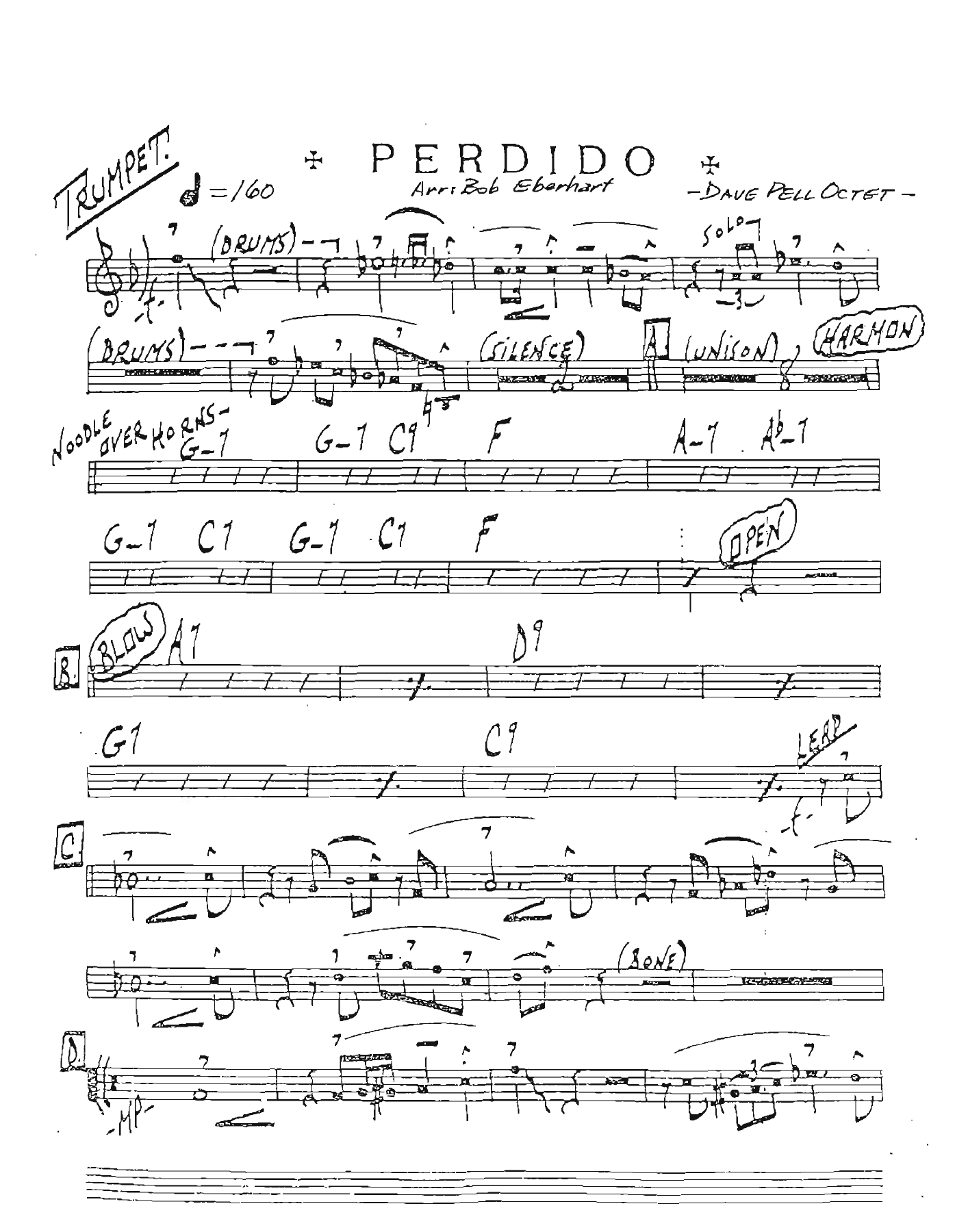
Perdido (4.Octet)
Composed by Juan Tizol
Arranged by 4 horns + Rhythm - Eberhart - Dave Pell Octet
- Ensemble: Small Ensemble
- Style: Jazz Standard
- Pages: 21
- Instruments (8): Trumpet, Trombone, Baritone Saxophone, Tenor Saxophone, Piano, Guitar, Bass, Drums
- Difficulty: easy
- Content: Individual Parts
- Format: PDF Download (Instant)
- Price: $12.99
"Perdido," meaning "lost" in Spanish, is a timeless jazz standard that originated from the fertile creative period of the early 1940s. Composed by trombonist Juan Tizol, a pivotal member of Duke Ellington's orchestra, the tune was first recorded by Ellington's band in 1942, quickly establishing itself as a staple in the big band repertoire. Its initial success was amplified by subsequent recordings from jazz luminaries like Erroll Garner, Dinah Washington, and Charlie Parker, solidifying its status as a cornerstone of the swing and bebop eras. The piece is celebrated for its distinctive AABA form, a memorable 32-bar structure, and its infectious, driving rhythm, which has made it a favorite for both dancers and improvisers. "Perdido" embodies the vibrant energy and sophisticated harmonic language characteristic of the swing era, while its adaptability has allowed it to transcend stylistic boundaries and remain relevant across generations of jazz musicians. This particular arrangement, crafted by Eberhart for the Dave Pell Octet, presents "Perdido" as a medium-up swing with an undeniable classic West Coast jazz aesthetic. The arrangement is set in the original key of Bb major, maintaining the bright and accessible feel of the standard. The mood is one of sophisticated exuberance, capturing the essence of a lively, yet polished, club performance. Eberhart's approach emphasizes clarity, precision, and a buoyant swing feel, typical of the Dave Pell Octet's signature sound. The energy is consistently engaging, driven by a walking bass line and a crisp drum feel, providing a solid foundation for the horn lines. The arrangement evokes a sense of cool confidence and playful interaction, making it an ideal vehicle for showcasing a tight-knit small ensemble. Eberhart’s distinctive treatment for this 4-horn plus rhythm section arrangement is immediately apparent in the meticulous voicings and the interplay between the instrumental voices. The scoring for two trumpets, tenor saxophone, and trombone creates a rich, full sound that belies the ensemble's size, often employing close voicings and carefully crafted counter-melodies. The melody is initially presented by the full horn section in a unison or harmonized soli, giving it a strong, cohesive statement. Subsequent sections feature call-and-response figures and intricate ensemble passages that highlight the octet's precision. Solos are typically open for improvisation over the established chord changes, providing ample opportunity for individual expression. A standout feature is the well-constructed shout chorus, which builds excitement and brings the arrangement to a powerful, yet controlled, climax. The technical challenges lie in achieving a unified ensemble sound, executing precise articulations, and maintaining the relentless, yet relaxed, swing feel throughout. This arrangement is ideally suited for college-level jazz ensembles, advanced community bands, or professional small groups seeking a polished and authentic rendition of a jazz standard. The detailed voicings and ensemble passages offer excellent opportunities for developing blend, balance, and rhythmic precision. While the individual parts are not overly technically demanding, the collective execution requires strong musicianship and a keen sense of ensemble playing. Performing this arrangement is highly rewarding, as it allows musicians to delve into the nuances of West Coast jazz styling and experience the joy of bringing a classic standard to life with sophisticated flair. Conductors should emphasize a consistent, medium-up swing feel from the outset, ensuring the rhythm section establishes a solid, driving pulse without rushing. The key technical challenges include achieving precise articulation and unified phrasing across the horn section, particularly in the soli passages. Encourage musicians to listen across the ensemble to blend their sounds effectively, focusing on intonation within the close voicings. There are no special techniques like plunger mutes or falls explicitly notated, allowing for stylistic interpretation within the West Coast jazz idiom. Rehearsal time should be dedicated to locking in the rhythmic groove, refining ensemble attacks and releases, and ensuring the improvised solos maintain the arrangement's overall character and energy. Pay close attention to dynamics to create shape and build excitement, especially leading into and out of the shout chorus. Q: What instruments/parts are included in this "Perdido" arrangement? A: This arrangement is scored for a 4-horn octet plus rhythm section, specifically including Trumpet 1, Trumpet 2, Tenor Saxophone, Trombone, Piano, Bass, and Drums. Q: What is the difficulty level of this arrangement? A: This arrangement is considered to be of a medium-advanced difficulty, suitable for college-level jazz ensembles, advanced community groups, or professional small ensembles. It requires strong ensemble playing and improvisational skills. Q: What is the musical style and historical context of "Perdido"? A: "Perdido" is a classic jazz standard composed by Juan Tizol in 1942, representing the swing and early bebop eras. This specific arrangement by Eberhart for the Dave Pell Octet captures a sophisticated West Coast jazz style. Q: What makes this "Perdido" arrangement unique compared to others? A: This arrangement is distinctive for its meticulous 4-horn voicings, capturing the signature clean and precise sound of the Dave Pell Octet. It features intricate ensemble interplay, a well-crafted shout chorus, and a medium-up swing feel that is both authentic and engaging. Q: What is the typical performance duration or tempo for this arrangement? A: While performance duration can vary with improvised solos, this arrangement is designed for a medium-up swing tempo, typically resulting in a performance time of approximately 4-6 minutes, depending on the number and length of solos.
Questions and answers
- What is included in the Perdido (4.Octet) PDF?
- The verified current file contains individual parts across 21 pages.
- How many instruments or parts are listed for Perdido (4.Octet)?
- The verified instrumentation list contains 8 entries for this Small Ensemble arrangement.
- Who is credited for Perdido (4.Octet)?
- Composer: Juan Tizol. Arranger: 4 horns + Rhythm - Eberhart - Dave Pell Octet.
- What difficulty is listed for Perdido (4.Octet)?
- The verified difficulty level is easy.
- What style is listed for Perdido (4.Octet)?
- The catalog lists the style as Jazz Standard.
- Can I preview Perdido (4.Octet) before buying?
- Yes. The product page provides a preview generated from the current PDF file.
- How is Perdido (4.Octet) delivered?
- After successful payment, the digital PDF is made available for download. The displayed price is $12.99.
Musicians Also Search For
Perdido 4 horns + Rhythm - Eberhart - Dave Pell Octet PDF • Perdido 4 horns + Rhythm - Eberhart - Dave Pell Octet sheet music • Perdido arranged by 4 horns + Rhythm - Eberhart - Dave Pell Octet • 4 horns + Rhythm - Eberhart - Dave Pell Octet small ensemble charts • 4 horns + Rhythm - Eberhart - Dave Pell Octet jazz arrangements PDF • Perdido Juan Tizol sheet music • Perdido Juan Tizol small ensemble arrangements • Juan Tizol small ensemble charts • Perdido small ensemble arrangements • Perdido small ensemble PDF download • Perdido jazz sheet music • small ensemble sheet music download • Perdido individual parts download • Perdido sheet music PDF • Perdido Jazz Standard charts • Jazz Standard small ensemble arrangements • buy Perdido sheet music • download Perdido PDF • Perdido jazz charts • best 4 horns + Rhythm - Eberhart - Dave Pell Octet small ensemble arrangements • Juan Tizol arranged by 4 horns + Rhythm - Eberhart - Dave Pell Octet • Perdido printable sheet music • small ensemble repertoire PDF