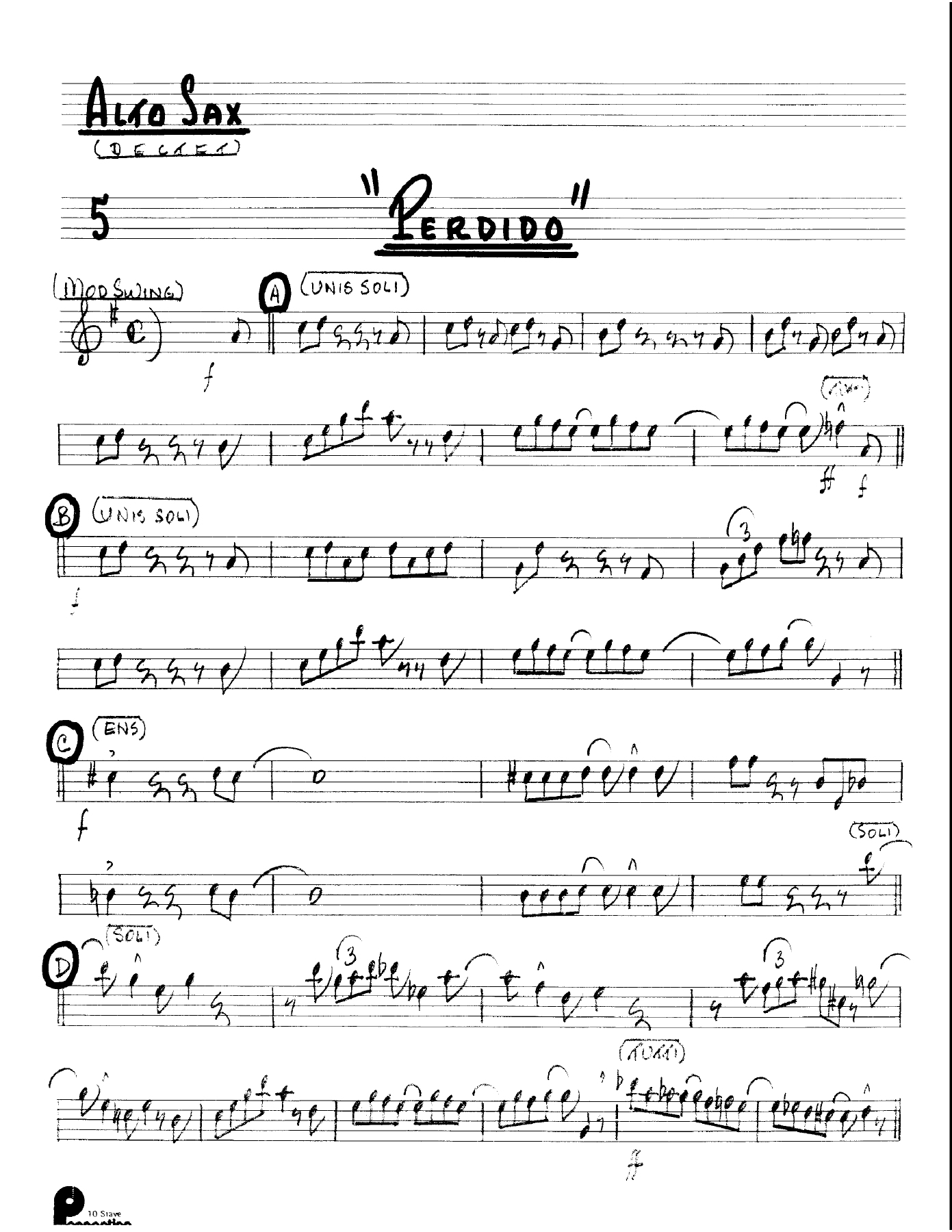
Perdido (Kenton Dectet #005) sheet music preview

Perdido (Kenton Dectet #005)

Composed by Juan Tizol

Arranged by Stan Kenton Dected 176

  • Ensemble: Small Ensemble
  • Style: Jazz Standard
  • Pages: 21
  • Difficulty: easy
  • Content: Sheet Music
  • Format: PDF Download (Instant)
  • Price: $12.99

"Perdido," a quintessential jazz standard, was penned by trombonist Juan Tizol, a long-standing member of Duke Ellington's orchestra. The piece first saw light with a radio transcription recording by Duke Ellington on December 3, 1941, followed by what is widely considered its original Victor label recording on January 21, 1942. This AABA form composition quickly became a cornerstone of the jazz repertoire, renowned for its driving swing feel, short melodic phrases, and harmonic simplicity, making it a favorite for jam sessions and a vehicle for improvisation. The title, Spanish for "lost," also carries connotations of "sloppy" or "indecent," and while lyrics were added in 1944 by Ervin Drake and Hans Lengsfelder, the tune is primarily celebrated for its instrumental prowess. Its enduring popularity is evidenced by countless recordings from jazz luminaries such as Ella Fitzgerald, Charlie Parker, Dave Brubeck, and Oscar Peterson, solidifying its place as the 58th all-time jazz standard on JazzStandards.com. This particular arrangement, "Perdido (Kenton Dectet #005)," showcases the distinctive sound of Stan Kenton's small ensemble work. While Kenton is often associated with his "progressive jazz" big band sound—characterized by bold, experimental arrangements, complex harmonies, and a powerful brass presence—his Dectet arrangements offered a more intimate yet equally sophisticated approach. Kenton's signature style, even in smaller settings, often featured intricate voicings, a strong emphasis on brass, and a departure from purely dance-oriented rhythms, leaning instead towards a more concert-like jazz aesthetic. This arrangement is likely to reflect Kenton's innovative harmonic sensibilities and his ability to craft compelling musical narratives within a smaller instrumental framework. Musically, "Perdido" is typically performed in a medium-bright swing tempo, often in the key of B-flat major, though C# major and F major versions exist in famous recordings. The original's irresistible swing feeling and straightforward harmonic progression (often simplified to ii-V7-I patterns in the 'A' sections and a circle of fifths in the 'B' section) provide a robust foundation for exploration. The Kenton Dectet's treatment would likely infuse this standard with sophisticated reharmonizations, perhaps unexpected melodic counterlines, and dynamic contrasts that build to powerful ensemble sections. Expect the melody to be shared amongst the horns, with ample opportunity for featured solos that highlight individual virtuosity within the ensemble's tight-knit framework. The technical challenges will lie in precision ensemble playing, navigating Kenton's characteristic voicings, and maintaining the energetic swing feel throughout. Performing this arrangement offers immense rewards, allowing musicians to engage with a classic standard through the unique lens of a legendary arranger. It is particularly suitable for college and community jazz ensembles, as well as semi-professional groups seeking to delve into a more nuanced and challenging small ensemble repertoire. The demands on individual players for blend, intonation, and rhythmic accuracy will foster significant musical growth, culminating in a performance that is both historically informed and uniquely Kentonian. The 21 pages of score and parts suggest a substantial and thoroughly developed arrangement, providing a rich performance experience. Approaching "Perdido (Kenton Dectet #005)" requires meticulous attention to articulation and dynamics to capture the Kenton sound. Conductors should emphasize a precise, driving medium swing feel, ensuring the rhythm section lays down a solid, propulsive foundation without rushing. Key technical challenges include navigating Kenton's often dense and angular voicings, particularly in the brass, where balance and intonation are paramount. Rehearsal should focus on isolating these ensemble passages, perhaps by singing lines or playing them slowly to ensure clarity. While specific special techniques are not explicitly noted for this arrangement, musicians should be prepared for potential brass plunger mute work, falls, or doits, which were common in the era and Kenton's broader style. Encourage individual players to imbue their parts with a blues inflection and appropriate vibrato, especially in the saxophone section, to add warmth and character to the sound. **Q: What instruments/parts are included in "Perdido (Kenton Dectet #005)"?** A: This arrangement is for a small ensemble, specifically a Dectet, which typically implies a combination of horns (such as trumpets, trombones, and saxophones) plus a rhythm section (piano, bass, drums, and potentially guitar). The 21 pages indicate a comprehensive set of parts for this configuration. **Q: What is the difficulty level of this arrangement?** A: Given it's a Stan Kenton Dectet arrangement, it is likely to be of an intermediate to advanced difficulty. Musicians should possess strong technical proficiency and a solid understanding of jazz harmony and articulation. **Q: What is the musical style and historical context of "Perdido"?** A: "Perdido" is a classic jazz standard composed by Juan Tizol in 1941, representing the Swing era. It's known for its medium swing feel and AABA form, widely popularized by Duke Ellington's orchestra. **Q: What makes this specific arrangement by Stan Kenton Dectet 176 unique?** A: This arrangement offers a distinctive small ensemble interpretation of the standard, infused with Stan Kenton's characteristic harmonic sophistication, intricate voicings, and a focus on precise, powerful ensemble playing, distinguishing it from traditional big band or combo versions. **Q: What is the typical performance duration or tempo for this piece?** A: "Perdido" is generally performed at a medium-bright swing tempo. While specific duration depends on solos, recordings often range from three to over ten minutes, allowing for extensive improvisation within the arrangement's framework.

Musicians Also Search For

Perdido Stan Kenton Dected 176 PDFPerdido Stan Kenton Dected 176 sheet musicPerdido arranged by Stan Kenton Dected 176Stan Kenton Dected 176 small ensemble chartsStan Kenton Dected 176 jazz arrangements PDFPerdido Juan Tizol sheet musicPerdido Juan Tizol small ensemble arrangementJuan Tizol small ensemble chartsPerdido small ensemble arrangementPerdido small ensemble PDF downloadPerdido jazz ensemble sheet musicsmall ensemble sheet music instant downloadPerdido sheet music with partsPerdido Jazz Standard chartJazz Standard small ensemble arrangementsbuy Perdido sheet music onlinedownload Perdido PDFPerdido jazz chartbest Stan Kenton Dected 176 small ensemble arrangementsJuan Tizol songs arranged by Stan Kenton Dected 176Perdido printable sheet musicsmall ensemble repertoire PDF

All arrangements by Stan Kenton Dected 176 All Juan Tizol sheet music