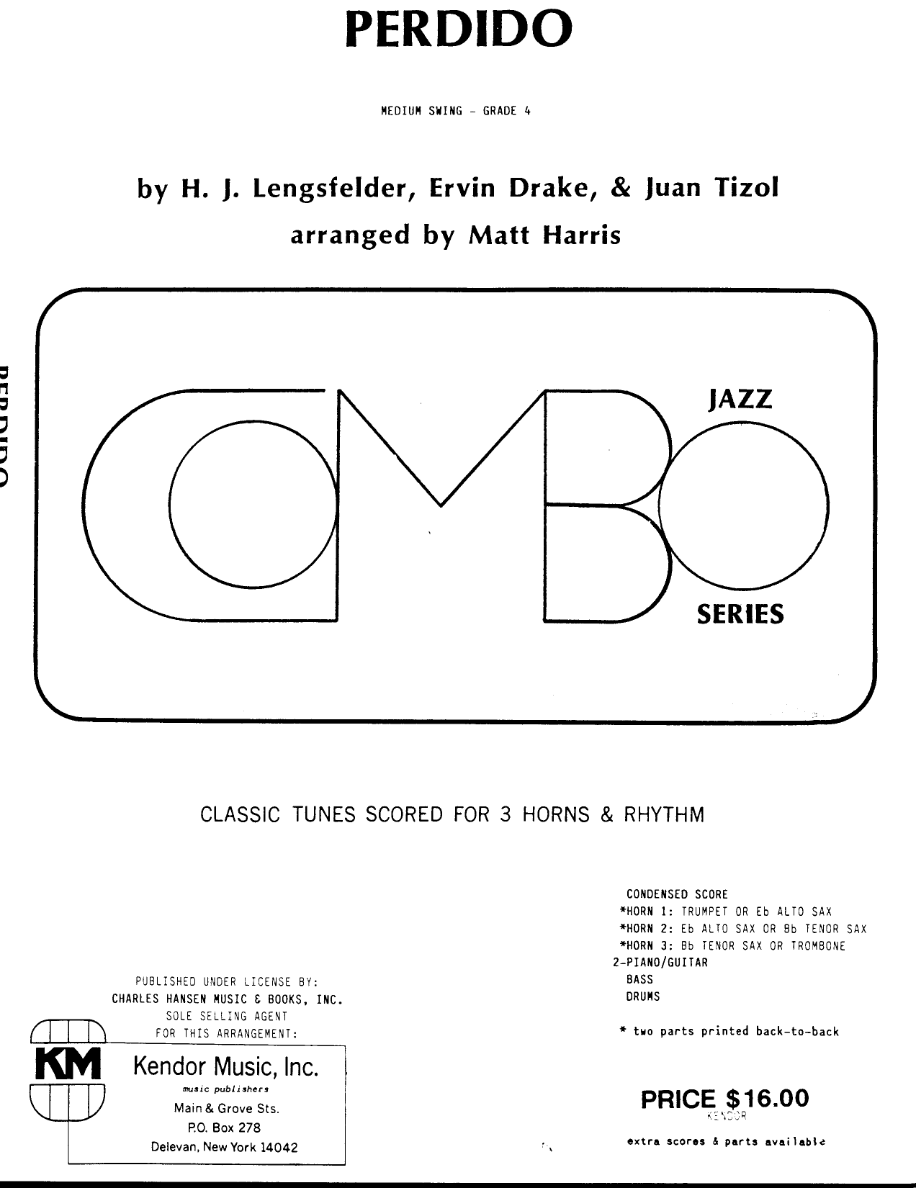
Perdido (M.Harris)
Composed by Juan Tizol
Arranged by M.Harris
- Ensemble: Small Ensemble
- Style: Jazz Standard
- Pages: 25
- Instruments (9): Horn 1 (Bb Trumpet), Horn 1 (Eb Alto Sax), Horn 2 (Eb Alto Sax), Horn 2 (Bb Tenor Sax), Horn 3 (Bb Tenor Sax), Horn 3 (Trombone), Piano/Guitar, Bass, Drums
- Difficulty: easy
- Content: Individual Parts
- Format: PDF Download (Instant)
- Price: $12.99
Juan Tizol's "Perdido," meaning "lost" in Spanish, emerged from the vibrant big band era of the early 1940s, first recorded by Duke Ellington's Orchestra in 1942. This enduring jazz standard quickly became synonymous with the sophisticated, yet accessible, sound that defined the swing and early bebop transition periods. Its memorable, syncopated melody and distinctive harmonic progression have captivated audiences and musicians for decades, solidifying its place in the jazz canon alongside other Ellingtonia. The piece is celebrated for its blend of Latin-tinged rhythms, reflecting Tizol's Puerto Rican heritage, with the quintessential swing feel that characterized the era, making it a perennial favorite for improvisation and ensemble performance. M.Harris’s arrangement of "Perdido" for small ensemble masterfully captures the ebullient spirit of the original while infusing it with a fresh, contemporary sensibility. This rendition establishes a medium-up swing tempo, maintaining the original's infectious energy but allowing for greater rhythmic precision and nuanced articulation. The arrangement is primarily set in the key of E-flat major, providing a bright, resonant harmonic landscape that complements the piece's inherently optimistic mood. M.Harris's signature approach often involves intricate counterpoint and sophisticated harmonic extensions, evident here in the reharmonization of classic melodic lines and the introduction of rich, layered voicings that add depth and color without obscuring the original's melodic integrity. The overall sound evokes a feeling of joyful exuberance, perfect for setting an engaging and uplifting atmosphere. The arrangement thoughtfully distributes the melodic duties, ensuring all voices contribute to the narrative. The iconic "Perdido" theme is initially presented by the lead voice, often a trumpet or alto saxophone, before being passed through various sections, including a cleverly orchestrated soli section that showcases the ensemble's tight interplay. Following the head, ample space is provided for featured improvisations over the standard chord changes, allowing soloists to stretch out and express their individual voices. M.Harris then builds tension and excitement with a dynamic shout chorus, characterized by powerful ensemble figures and driving rhythmic accents, culminating in a return to the main theme. Technically, the arrangement demands strong rhythmic independence and precise articulation from all players, particularly during the soli passages and the energetic shout chorus. The reward lies in the collective experience of performing a timeless classic with a fresh, intelligent treatment that highlights both individual musicianship and cohesive ensemble sound. This arrangement is ideally suited for college-level jazz ensembles, advanced high school groups, and community bands with a solid foundation in jazz performance. The complexity of the voicings and the demands of rhythmic accuracy make it an excellent vehicle for developing sophisticated ensemble playing and understanding advanced harmonic concepts. While challenging, the clear articulation of M.Harris's musical ideas and the inherent familiarity of "Perdido" make it highly approachable and deeply rewarding for dedicated musicians. Its 39 pages suggest a comprehensive and well-developed score and parts, offering a substantial and engaging piece for any small jazz ensemble looking to add a vibrant standard to their repertoire. Approaching M.Harris's "Perdido" requires meticulous attention to rhythmic precision and dynamic contrast. The medium-up swing tempo should be maintained consistently, with a strong emphasis on a relaxed, yet driving, quarter-note pulse. Conductors should encourage a light, buoyant swing eighth-note feel throughout, avoiding a heavy or rushed execution. Technical challenges include the intricate voicings in the soli sections, which demand careful balance and blend, and the precise articulation required for the shout chorus. Rehearsal should focus on isolating these passages, ensuring each voice is heard clearly within the harmonic structure. Special attention should be paid to dynamic shaping, particularly the crescendos and decrescendos that build and release tension. Encourage soloists to engage with the harmonic extensions provided by the arrangement, fostering creative improvisation within the established framework. Q: What instruments and parts are included in this arrangement of "Perdido (M.Harris)"? A: This arrangement is for a small jazz ensemble and typically includes parts for lead trumpet, alto saxophone, tenor saxophone, trombone, piano, bass, and drums, providing a full and balanced sound for a traditional small group. Q: What is the difficulty level of this "Perdido (M.Harris)" arrangement? A: This arrangement is considered advanced intermediate to advanced, suitable for college-level jazz ensembles, advanced high school groups, and community bands with strong fundamental skills, due to its intricate voicings and rhythmic demands. Q: What is the musical style and historical context of "Perdido"? A: "Perdido" is a classic jazz standard composed by Juan Tizol, originally popularized by Duke Ellington's Orchestra in the early 1940s. It embodies the swing era with a Latin-tinged melodic and rhythmic flavor. Q: What makes M.Harris's arrangement of "Perdido" unique? A: M.Harris's arrangement stands out through its sophisticated reharmonizations, intricate counterpoint, and dynamic soli sections, which breathe new life into this classic standard while maintaining its original energetic spirit. Q: What is the typical performance duration and tempo for this arrangement? A: The typical performance duration for this arrangement is approximately 4-6 minutes, depending on the length of improvised solos. It is designed to be played at a medium-up swing tempo, around 180-200 beats per minute.
Questions and answers
- What is included in the Perdido (M.Harris) PDF?
- The verified current file contains a conductor score and individual parts across 25 pages.
- How many instruments or parts are listed for Perdido (M.Harris)?
- The verified instrumentation list contains 9 entries for this Small Ensemble arrangement.
- Who is credited for Perdido (M.Harris)?
- Composer: Juan Tizol. Arranger: M.Harris.
- What difficulty is listed for Perdido (M.Harris)?
- The verified difficulty level is easy.
- What style is listed for Perdido (M.Harris)?
- The catalog lists the style as Jazz Standard.
- Can I preview Perdido (M.Harris) before buying?
- Yes. The product page provides a preview generated from the current PDF file.
- How is Perdido (M.Harris) delivered?
- After successful payment, the digital PDF is made available for download. The displayed price is $12.99.
Musicians Also Search For
Perdido M.Harris PDF • Perdido M.Harris sheet music • Perdido arranged by M.Harris • M.Harris small ensemble charts • M.Harris jazz arrangements PDF • Perdido Juan Tizol sheet music • Perdido Juan Tizol small ensemble arrangements • Juan Tizol small ensemble charts • Perdido small ensemble arrangements • Perdido small ensemble PDF download • Perdido jazz sheet music • small ensemble sheet music download • Perdido conductor score PDF • Perdido individual parts download • Perdido sheet music PDF • Perdido Jazz Standard charts • Jazz Standard small ensemble arrangements • buy Perdido sheet music • download Perdido PDF • Perdido jazz charts • best M.Harris small ensemble arrangements • Juan Tizol arranged by M.Harris • Perdido printable sheet music • small ensemble repertoire PDF